

Reusing Built Heritage. Design for the Sharing Economy
319
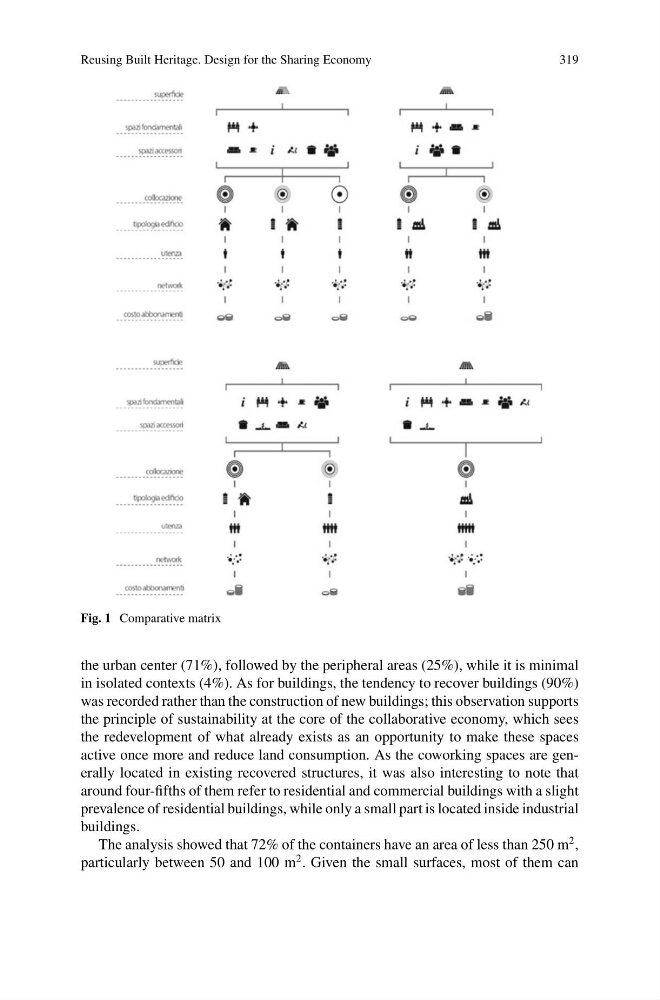
Fig. 1 Comparative matrix
the urban center (71%), followed by the peripheral areas (25%), while it is minimal
in isolated contexts (4%). As for buildings, the tendency to recover buildings (90%)
was recorded rather than the construction of new buildings; this observation supports
the principle of sustainability at the core of the collaborative economy, which sees
the redevelopment of what already exists as an opportunity to make these spaces
active once more and reduce land consumption. As the coworking spaces are generally located in existing recovered structures, it was also interesting to note that
around four-fifths of them refer to residential and commercial buildings with a slight
prevalence of residential buildings, while only a small part is located inside industrial
buildings.
The analysis showed that 72% of the containers have an area of less than 250 m
2 ,
particularly between 50 and 100 m
2 . Given the small surfaces, most of them can
319
Fig. 1 Comparative matrix
the urban center (71%), followed by the peripheral areas (25%), while it is minimal
in isolated contexts (4%). As for buildings, the tendency to recover buildings (90%)
was recorded rather than the construction of new buildings; this observation supports
the principle of sustainability at the core of the collaborative economy, which sees
the redevelopment of what already exists as an opportunity to make these spaces
active once more and reduce land consumption. As the coworking spaces are generally located in existing recovered structures, it was also interesting to note that
around four-fifths of them refer to residential and commercial buildings with a slight
prevalence of residential buildings, while only a small part is located inside industrial
buildings.
The analysis showed that 72% of the containers have an area of less than 250 m
2 ,
particularly between 50 and 100 m
2 . Given the small surfaces, most of them can