

Re-NetTA. Re-Manufacturing Networks for Tertiary Architectures
311
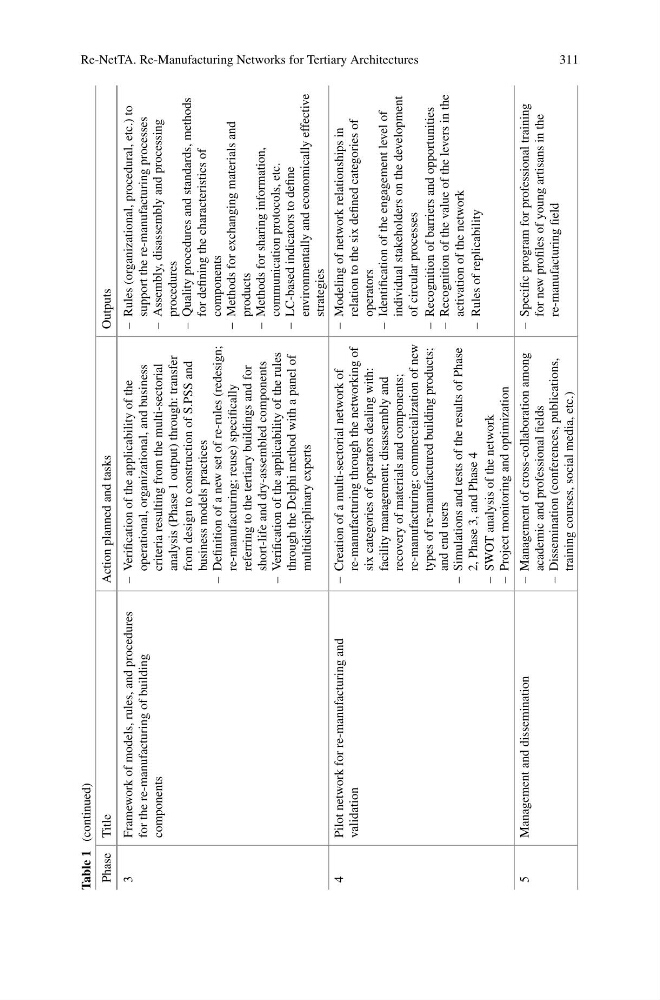
Table 1
(continued)
Phase Title
Action planned and tasks
Outputs
3
Framework of models, rules, and procedures
for the re-manufacturing of building
components
– Verification of the applicability of the
operational, organizational, and business
criteria resulting from the multi-sectorial
analysis (Phase 1 output) through: transfer
from design to construction of S.PSS and
business models practices
– Definition of a new set of re-rules (redesign;
re-manufacturing; reuse) specifically
referring to the tertiary buildings and for
short-life and dry-assembled components
– Verification of the applicability of the rules
through the Delphi method with a panel of
multidisciplinary experts
– Rules (organizational, procedural, etc.) to
support the re-manufacturing processes
– Assembly, disassembly and processing
procedures
– Quality procedures and standards, methods
for defining the characteristics of
components
– Methods for exchanging materials and
products
– Methods for sharing information,
communication protocols, etc.
– LC-based indicators to define
environmentally and economically effective
strategies
4
Pilot network for re-manufacturing and
validation
– Creation of a multi-sectorial network of
re-manufacturing through the networking of
six categories of operators dealing with:
facility management; disassembly and
recovery of materials and components;
re-manufacturing; commercialization of new
types of re-manufactured building products;
and end users
– Simulations and tests of the results of Phase
2, Phase 3, and Phase 4
– SWOT analysis of the network
– Project monitoring and optimization
– Modeling of network relationships in
relation to the six defined categories of
operators
– Identification of the engagement level of
individual stakeholders on the development
of circular processes
– Recognition of barriers and opportunities
– Recognition of the value of the levers in the
activation of the network
– Rules of replicability
5
Management and dissemination
– Management of cross-collaboration among
academic and professional fields
– Dissemination (conferences, publications,
training courses, social media, etc.)
– Specific program for professional training
for new profiles of young artisans in the
re-manufacturing field
311
Table 1
(continued)
Phase Title
Action planned and tasks
Outputs
3
Framework of models, rules, and procedures
for the re-manufacturing of building
components
– Verification of the applicability of the
operational, organizational, and business
criteria resulting from the multi-sectorial
analysis (Phase 1 output) through: transfer
from design to construction of S.PSS and
business models practices
– Definition of a new set of re-rules (redesign;
re-manufacturing; reuse) specifically
referring to the tertiary buildings and for
short-life and dry-assembled components
– Verification of the applicability of the rules
through the Delphi method with a panel of
multidisciplinary experts
– Rules (organizational, procedural, etc.) to
support the re-manufacturing processes
– Assembly, disassembly and processing
procedures
– Quality procedures and standards, methods
for defining the characteristics of
components
– Methods for exchanging materials and
products
– Methods for sharing information,
communication protocols, etc.
– LC-based indicators to define
environmentally and economically effective
strategies
4
Pilot network for re-manufacturing and
validation
– Creation of a multi-sectorial network of
re-manufacturing through the networking of
six categories of operators dealing with:
facility management; disassembly and
recovery of materials and components;
re-manufacturing; commercialization of new
types of re-manufactured building products;
and end users
– Simulations and tests of the results of Phase
2, Phase 3, and Phase 4
– SWOT analysis of the network
– Project monitoring and optimization
– Modeling of network relationships in
relation to the six defined categories of
operators
– Identification of the engagement level of
individual stakeholders on the development
of circular processes
– Recognition of barriers and opportunities
– Recognition of the value of the levers in the
activation of the network
– Rules of replicability
5
Management and dissemination
– Management of cross-collaboration among
academic and professional fields
– Dissemination (conferences, publications,
training courses, social media, etc.)
– Specific program for professional training
for new profiles of young artisans in the
re-manufacturing field