

14
R. Capello et al.
Rivalry
(Low)
(High)
Private goods
c
i
f
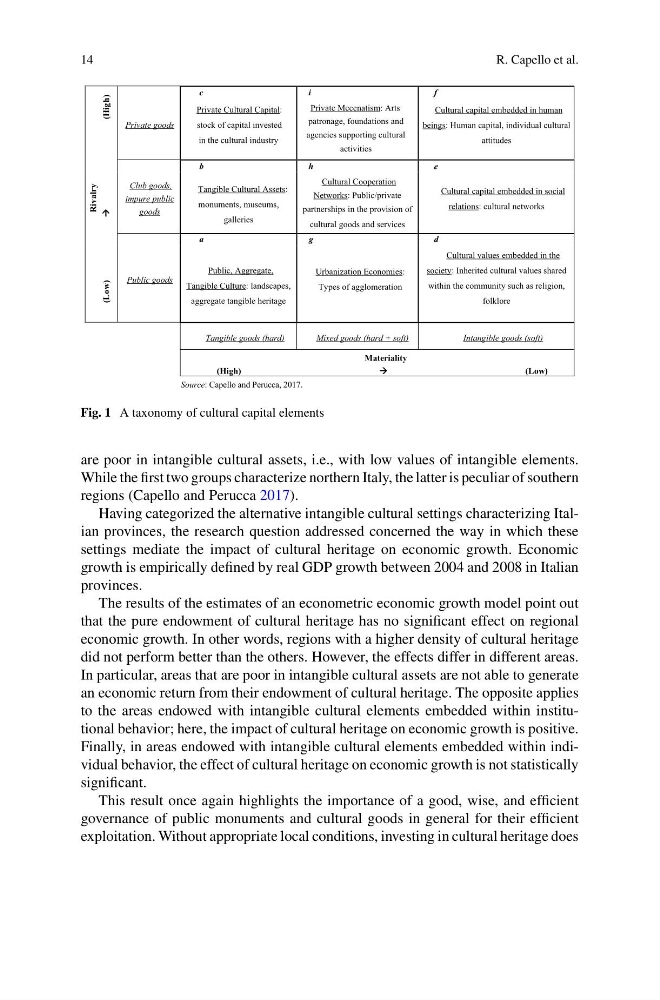
Private Cultural Capital:
stock of capital invested
in the cultural industry
Private Mecenatism: Arts
patronage, foundations and
agencies supporting cultural
activities
Cultural capital embedded in human
beings: Human capital, individual cultural
attitudes
Club goods,
impure public
goods
b
h
e
Tangible Cultural Assets:
monuments, museums,
galleries
Cultural Cooperation
Networks: Public/private
partnerships in the provision of
cultural goods and services
Cultural capital embedded in social
relations: cultural networks
Public goods
a
g
d
Public, Aggregate,
Tangible Culture: landscapes,
aggregate tangible heritage
Urbanization Economies:
Types of agglomeration
Cultural values embedded in the
society: Inherited cultural values shared
within the community such as religion,
folklore
Tangible goods (hard)
Mixed goods (hard + soft)
Intangible goods (soft)
Materiality
(High)
(Low)
Source: Capello and Perucca, 2017.
Fig. 1 A taxonomy of cultural capital elements
are poor in intangible cultural assets, i.e., with low values of intangible elements.
While the first two groups characterize northern Italy, the latter is peculiar of southern
regions (Capello and Perucca 2017).
Having categorized the alternative intangible cultural settings characterizing Italian provinces, the research question addressed concerned the way in which these
settings mediate the impact of cultural heritage on economic growth. Economic
growth is empirically defined by real GDP growth between 2004 and 2008 in Italian
provinces.
The results of the estimates of an econometric economic growth model point out
that the pure endowment of cultural heritage has no significant effect on regional
economic growth. In other words, regions with a higher density of cultural heritage
did not perform better than the others. However, the effects differ in different areas.
In particular, areas that are poor in intangible cultural assets are not able to generate
an economic return from their endowment of cultural heritage. The opposite applies
to the areas endowed with intangible cultural elements embedded within institutional behavior; here, the impact of cultural heritage on economic growth is positive.
Finally, in areas endowed with intangible cultural elements embedded within individual behavior, the effect of cultural heritage on economic growth is not statistically
significant.
This result once again highlights the importance of a good, wise, and efficient
governance of public monuments and cultural goods in general for their efficient
exploitation. Without appropriate local conditions, investing in cultural heritage does
R. Capello et al.
Rivalry
(Low)
(High)
Private goods
c
i
f
Private Cultural Capital:
stock of capital invested
in the cultural industry
Private Mecenatism: Arts
patronage, foundations and
agencies supporting cultural
activities
Cultural capital embedded in human
beings: Human capital, individual cultural
attitudes
Club goods,
impure public
goods
b
h
e
Tangible Cultural Assets:
monuments, museums,
galleries
Cultural Cooperation
Networks: Public/private
partnerships in the provision of
cultural goods and services
Cultural capital embedded in social
relations: cultural networks
Public goods
a
g
d
Public, Aggregate,
Tangible Culture: landscapes,
aggregate tangible heritage
Urbanization Economies:
Types of agglomeration
Cultural values embedded in the
society: Inherited cultural values shared
within the community such as religion,
folklore
Tangible goods (hard)
Mixed goods (hard + soft)
Intangible goods (soft)
Materiality
(High)
(Low)
Source: Capello and Perucca, 2017.
Fig. 1 A taxonomy of cultural capital elements
are poor in intangible cultural assets, i.e., with low values of intangible elements.
While the first two groups characterize northern Italy, the latter is peculiar of southern
regions (Capello and Perucca 2017).
Having categorized the alternative intangible cultural settings characterizing Italian provinces, the research question addressed concerned the way in which these
settings mediate the impact of cultural heritage on economic growth. Economic
growth is empirically defined by real GDP growth between 2004 and 2008 in Italian
provinces.
The results of the estimates of an econometric economic growth model point out
that the pure endowment of cultural heritage has no significant effect on regional
economic growth. In other words, regions with a higher density of cultural heritage
did not perform better than the others. However, the effects differ in different areas.
In particular, areas that are poor in intangible cultural assets are not able to generate
an economic return from their endowment of cultural heritage. The opposite applies
to the areas endowed with intangible cultural elements embedded within institutional behavior; here, the impact of cultural heritage on economic growth is positive.
Finally, in areas endowed with intangible cultural elements embedded within individual behavior, the effect of cultural heritage on economic growth is not statistically
significant.
This result once again highlights the importance of a good, wise, and efficient
governance of public monuments and cultural goods in general for their efficient
exploitation. Without appropriate local conditions, investing in cultural heritage does