

278
S. Lupica Spagnolo and B. Daniotti
colours based on permanent mineral oxides. Different research activities have been
undertaken on artificial stones (Fatiguso et al. 2013; Martínez-Martínez et al. 2013;
Morillas et al. 2015; Stefanidou et al. 2015).
The catalogue of this product provides 32 different types of cast stone, inside of
which different types of shapes are reproduced using suitable moulds, in order to
replicate the same aesthetic effect given by the natural stone in the most realistic
manner possible.
Depending on the desired effect, the artificial stone can be laid with or without
joints and the product for grouting (a two-component lightened mortar) is available
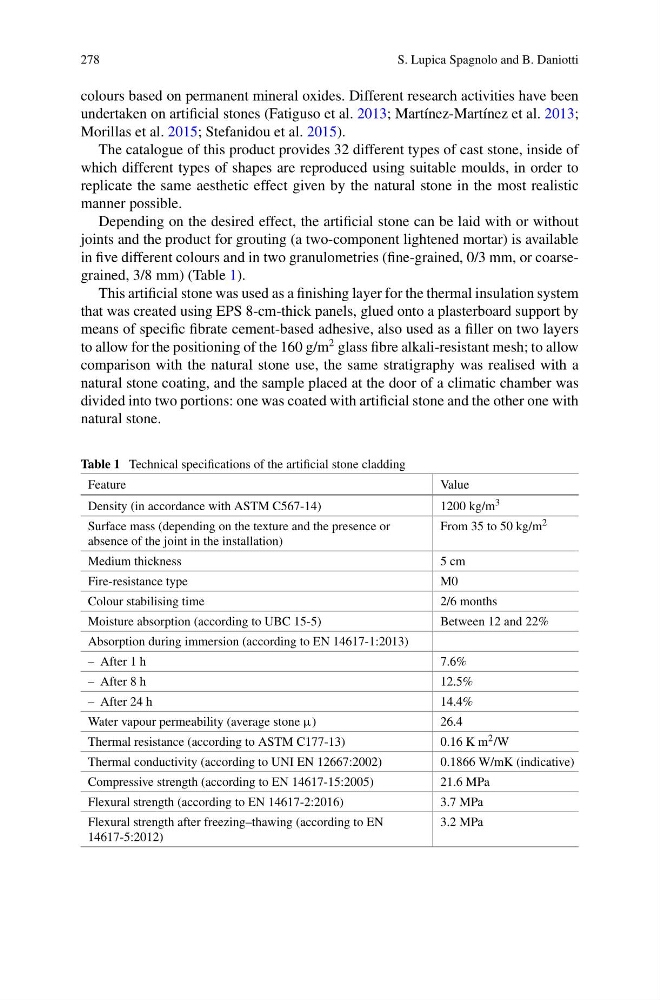
in five different colours and in two granulometries (fine-grained, 0/3 mm, or coarsegrained, 3/8 mm) (Table 1).
This artificial stone was used as a finishing layer for the thermal insulation system
that was created using EPS 8-cm-thick panels, glued onto a plasterboard support by
means of specific fibrate cement-based adhesive, also used as a filler on two layers
to allow for the positioning of the 160 g/m
2 glass fibre alkali-resistant mesh; to allow
comparison with the natural stone use, the same stratigraphy was realised with a
natural stone coating, and the sample placed at the door of a climatic chamber was
divided into two portions: one was coated with artificial stone and the other one with
natural stone.
Table 1 Technical specifications of the artificial stone cladding
Feature
Value
Density (in accordance with ASTM C567-14)
1200 kg/m 3
Surface mass (depending on the texture and the presence or
absence of the joint in the installation)
From 35 to 50 kg/m 2
Medium thickness
5 cm
Fire-resistance type
M0
Colour stabilising time
2/6 months
Moisture absorption (according to UBC 15-5)
Between 12 and 22%
Absorption during immersion (according to EN 14617-1:2013)
– After 1 h
7.6%
– After 8 h
12.5%
– After 24 h
14.4%
Water vapour permeability (average stone µ)
26.4
Thermal resistance (according to ASTM C177-13)
0.16 K m 2 /W
Thermal conductivity (according to UNI EN 12667:2002)
0.1866 W/mK (indicative)
Compressive strength (according to EN 14617-15:2005)
21.6 MPa
Flexural strength (according to EN 14617-2:2016)
3.7 MPa
Flexural strength after freezing–thawing (according to EN
14617-5:2012)
3.2 MPa
S. Lupica Spagnolo and B. Daniotti
colours based on permanent mineral oxides. Different research activities have been
undertaken on artificial stones (Fatiguso et al. 2013; Martínez-Martínez et al. 2013;
Morillas et al. 2015; Stefanidou et al. 2015).
The catalogue of this product provides 32 different types of cast stone, inside of
which different types of shapes are reproduced using suitable moulds, in order to
replicate the same aesthetic effect given by the natural stone in the most realistic
manner possible.
Depending on the desired effect, the artificial stone can be laid with or without
joints and the product for grouting (a two-component lightened mortar) is available
in five different colours and in two granulometries (fine-grained, 0/3 mm, or coarsegrained, 3/8 mm) (Table 1).
This artificial stone was used as a finishing layer for the thermal insulation system
that was created using EPS 8-cm-thick panels, glued onto a plasterboard support by
means of specific fibrate cement-based adhesive, also used as a filler on two layers
to allow for the positioning of the 160 g/m
2 glass fibre alkali-resistant mesh; to allow
comparison with the natural stone use, the same stratigraphy was realised with a
natural stone coating, and the sample placed at the door of a climatic chamber was
divided into two portions: one was coated with artificial stone and the other one with
natural stone.
Table 1 Technical specifications of the artificial stone cladding
Feature
Value
Density (in accordance with ASTM C567-14)
1200 kg/m 3
Surface mass (depending on the texture and the presence or
absence of the joint in the installation)
From 35 to 50 kg/m 2
Medium thickness
5 cm
Fire-resistance type
M0
Colour stabilising time
2/6 months
Moisture absorption (according to UBC 15-5)
Between 12 and 22%
Absorption during immersion (according to EN 14617-1:2013)
– After 1 h
7.6%
– After 8 h
12.5%
– After 24 h
14.4%
Water vapour permeability (average stone µ)
26.4
Thermal resistance (according to ASTM C177-13)
0.16 K m 2 /W
Thermal conductivity (according to UNI EN 12667:2002)
0.1866 W/mK (indicative)
Compressive strength (according to EN 14617-15:2005)
21.6 MPa
Flexural strength (according to EN 14617-2:2016)
3.7 MPa
Flexural strength after freezing–thawing (according to EN
14617-5:2012)
3.2 MPa