

Closing the Loops in Textile Architecture …
265
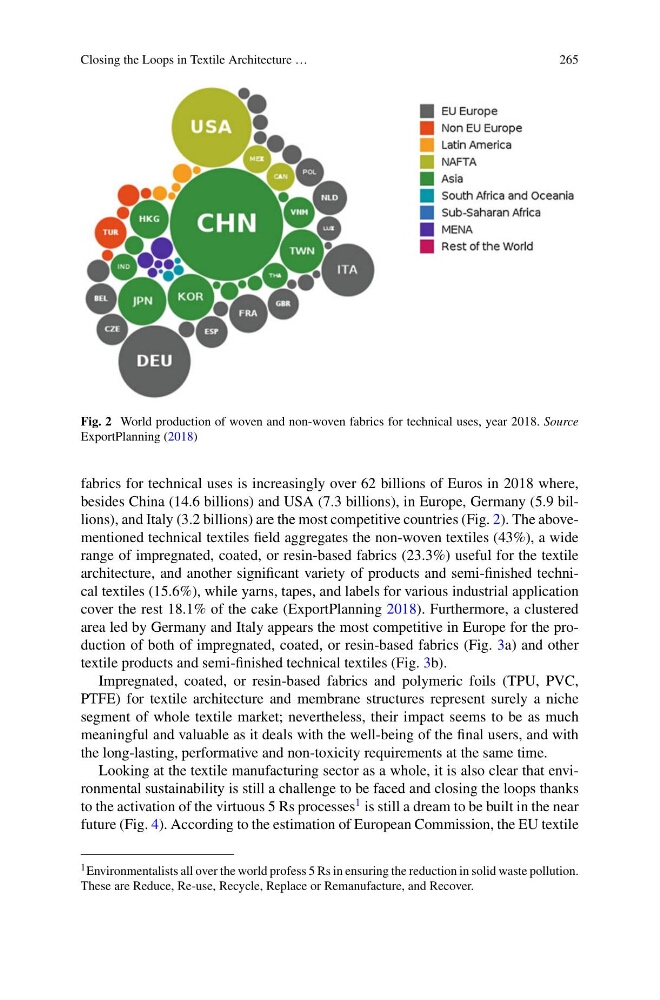
Fig. 2 World production of woven and non-woven fabrics for technical uses, year 2018. Source
ExportPlanning (2018)
fabrics for technical uses is increasingly over 62 billions of Euros in 2018 where,
besides China (14.6 billions) and USA (7.3 billions), in Europe, Germany (5.9 billions), and Italy (3.2 billions) are the most competitive countries (Fig. 2). The abovementioned technical textiles field aggregates the non-woven textiles (43%), a wide
range of impregnated, coated, or resin-based fabrics (23.3%) useful for the textile
architecture, and another significant variety of products and semi-finished technical textiles (15.6%), while yarns, tapes, and labels for various industrial application
cover the rest 18.1% of the cake (ExportPlanning 2018). Furthermore, a clustered
area led by Germany and Italy appears the most competitive in Europe for the production of both of impregnated, coated, or resin-based fabrics (Fig. 3a) and other
textile products and semi-finished technical textiles (Fig. 3b).
Impregnated, coated, or resin-based fabrics and polymeric foils (TPU, PVC,
PTFE) for textile architecture and membrane structures represent surely a niche
segment of whole textile market; nevertheless, their impact seems to be as much
meaningful and valuable as it deals with the well-being of the final users, and with
the long-lasting, performative and non-toxicity requirements at the same time.
Looking at the textile manufacturing sector as a whole, it is also clear that environmental sustainability is still a challenge to be faced and closing the loops thanks
to the activation of the virtuous 5 Rs processes
1 is still a dream to be built in the near
future (Fig. 4). According to the estimation of European Commission, the EU textile
1 Environmentalists all over the world profess 5 Rs in ensuring the reduction in solid waste pollution.
These are Reduce, Re-use, Recycle, Replace or Remanufacture, and Recover.
265
Fig. 2 World production of woven and non-woven fabrics for technical uses, year 2018. Source
ExportPlanning (2018)
fabrics for technical uses is increasingly over 62 billions of Euros in 2018 where,
besides China (14.6 billions) and USA (7.3 billions), in Europe, Germany (5.9 billions), and Italy (3.2 billions) are the most competitive countries (Fig. 2). The abovementioned technical textiles field aggregates the non-woven textiles (43%), a wide
range of impregnated, coated, or resin-based fabrics (23.3%) useful for the textile
architecture, and another significant variety of products and semi-finished technical textiles (15.6%), while yarns, tapes, and labels for various industrial application
cover the rest 18.1% of the cake (ExportPlanning 2018). Furthermore, a clustered
area led by Germany and Italy appears the most competitive in Europe for the production of both of impregnated, coated, or resin-based fabrics (Fig. 3a) and other
textile products and semi-finished technical textiles (Fig. 3b).
Impregnated, coated, or resin-based fabrics and polymeric foils (TPU, PVC,
PTFE) for textile architecture and membrane structures represent surely a niche
segment of whole textile market; nevertheless, their impact seems to be as much
meaningful and valuable as it deals with the well-being of the final users, and with
the long-lasting, performative and non-toxicity requirements at the same time.
Looking at the textile manufacturing sector as a whole, it is also clear that environmental sustainability is still a challenge to be faced and closing the loops thanks
to the activation of the virtuous 5 Rs processes
1 is still a dream to be built in the near
future (Fig. 4). According to the estimation of European Commission, the EU textile
1 Environmentalists all over the world profess 5 Rs in ensuring the reduction in solid waste pollution.
These are Reduce, Re-use, Recycle, Replace or Remanufacture, and Recover.