

Sustainable Concretes for Structural Applications
259
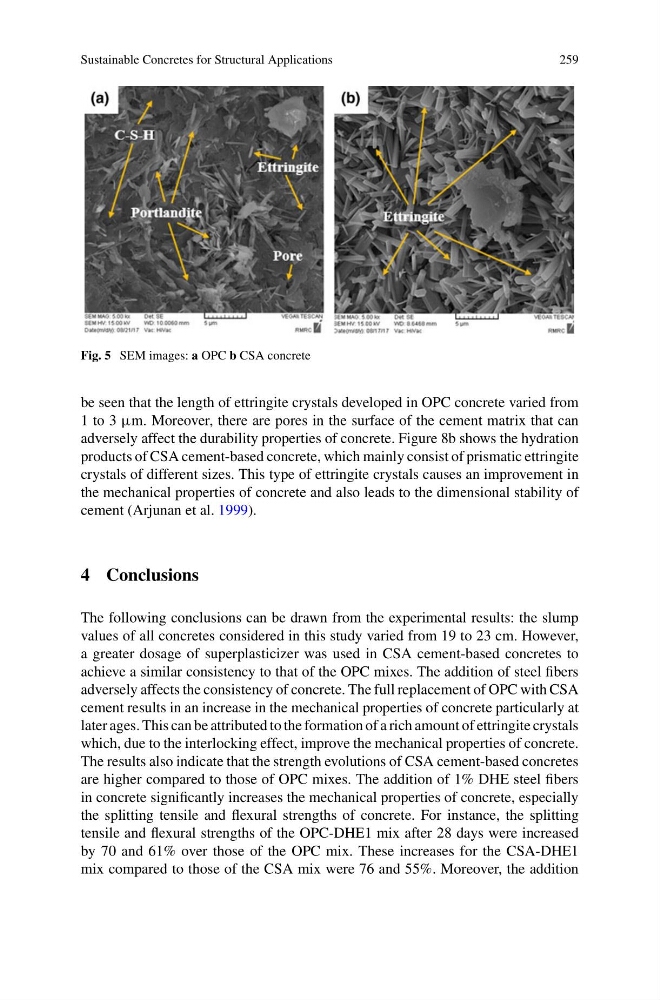
Fig. 5 SEM images: a OPC b CSA concrete
be seen that the length of ettringite crystals developed in OPC concrete varied from
1 to 3 µm. Moreover, there are pores in the surface of the cement matrix that can
adversely affect the durability properties of concrete. Figure 8b shows the hydration
products of CSA cement-based concrete, which mainly consist of prismatic ettringite
crystals of different sizes. This type of ettringite crystals causes an improvement in
the mechanical properties of concrete and also leads to the dimensional stability of
cement (Arjunan et al. 1999).
4 Conclusions
The following conclusions can be drawn from the experimental results: the slump
values of all concretes considered in this study varied from 19 to 23 cm. However,
a greater dosage of superplasticizer was used in CSA cement-based concretes to
achieve a similar consistency to that of the OPC mixes. The addition of steel fibers
adversely affects the consistency of concrete. The full replacement of OPC with CSA
cement results in an increase in the mechanical properties of concrete particularly at
later ages. This can be attributed to the formation of a rich amount of ettringite crystals
which, due to the interlocking effect, improve the mechanical properties of concrete.
The results also indicate that the strength evolutions of CSA cement-based concretes
are higher compared to those of OPC mixes. The addition of 1% DHE steel fibers
in concrete significantly increases the mechanical properties of concrete, especially
the splitting tensile and flexural strengths of concrete. For instance, the splitting
tensile and flexural strengths of the OPC-DHE1 mix after 28 days were increased
by 70 and 61% over those of the OPC mix. These increases for the CSA-DHE1
mix compared to those of the CSA mix were 76 and 55%. Moreover, the addition
259
Fig. 5 SEM images: a OPC b CSA concrete
be seen that the length of ettringite crystals developed in OPC concrete varied from
1 to 3 µm. Moreover, there are pores in the surface of the cement matrix that can
adversely affect the durability properties of concrete. Figure 8b shows the hydration
products of CSA cement-based concrete, which mainly consist of prismatic ettringite
crystals of different sizes. This type of ettringite crystals causes an improvement in
the mechanical properties of concrete and also leads to the dimensional stability of
cement (Arjunan et al. 1999).
4 Conclusions
The following conclusions can be drawn from the experimental results: the slump
values of all concretes considered in this study varied from 19 to 23 cm. However,
a greater dosage of superplasticizer was used in CSA cement-based concretes to
achieve a similar consistency to that of the OPC mixes. The addition of steel fibers
adversely affects the consistency of concrete. The full replacement of OPC with CSA
cement results in an increase in the mechanical properties of concrete particularly at
later ages. This can be attributed to the formation of a rich amount of ettringite crystals
which, due to the interlocking effect, improve the mechanical properties of concrete.
The results also indicate that the strength evolutions of CSA cement-based concretes
are higher compared to those of OPC mixes. The addition of 1% DHE steel fibers
in concrete significantly increases the mechanical properties of concrete, especially
the splitting tensile and flexural strengths of concrete. For instance, the splitting
tensile and flexural strengths of the OPC-DHE1 mix after 28 days were increased
by 70 and 61% over those of the OPC mix. These increases for the CSA-DHE1
mix compared to those of the CSA mix were 76 and 55%. Moreover, the addition