

244
O. B. Carcassi et al.
for the energy retrofitting of existing facades. Five alternative construction solutions
for the renovation of the exterior walls were taken as reference: I-joint frame with
pressed straw (STR), preassembled frame with injected hempcrete (HCF), timber
frame (TIF), hempcrete blocks (HCB) and expanded polystyrene for external thermal insulation composite system (EPS).
In particular, in order to properly consider the amount of carbon stored in products,
a dynamic life cycle assessment (DLCA) was introduced to verify the contribution
of different bio-based materials on the radiative forcing over time, which contributes
to restore the radiative balance of the Earth.
In fact, the lack of time dependence and the treatment of the biogenic CO 2 are
critical aspects in LCA and carbon footprint calculations, whereas the dynamic LCA
calculation model proposed by Levasseur et al. (Levasseur et al. 2010) allows to
take into account carbon uptake and GHG emissions over time. The instantaneous
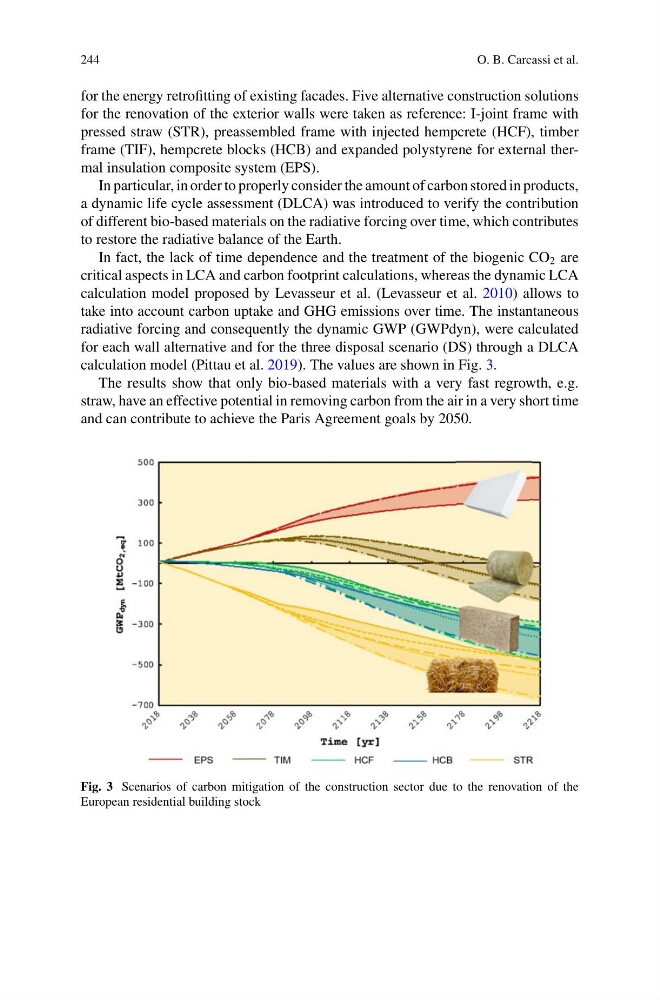
radiative forcing and consequently the dynamic GWP (GWPdyn), were calculated
for each wall alternative and for the three disposal scenario (DS) through a DLCA
calculation model (Pittau et al. 2019). The values are shown in Fig. 3.
The results show that only bio-based materials with a very fast regrowth, e.g.
straw, have an effective potential in removing carbon from the air in a very short time
and can contribute to achieve the Paris Agreement goals by 2050.
Fig. 3 Scenarios of carbon mitigation of the construction sector due to the renovation of the
European residential building stock
O. B. Carcassi et al.
for the energy retrofitting of existing facades. Five alternative construction solutions
for the renovation of the exterior walls were taken as reference: I-joint frame with
pressed straw (STR), preassembled frame with injected hempcrete (HCF), timber
frame (TIF), hempcrete blocks (HCB) and expanded polystyrene for external thermal insulation composite system (EPS).
In particular, in order to properly consider the amount of carbon stored in products,
a dynamic life cycle assessment (DLCA) was introduced to verify the contribution
of different bio-based materials on the radiative forcing over time, which contributes
to restore the radiative balance of the Earth.
In fact, the lack of time dependence and the treatment of the biogenic CO 2 are
critical aspects in LCA and carbon footprint calculations, whereas the dynamic LCA
calculation model proposed by Levasseur et al. (Levasseur et al. 2010) allows to
take into account carbon uptake and GHG emissions over time. The instantaneous
radiative forcing and consequently the dynamic GWP (GWPdyn), were calculated
for each wall alternative and for the three disposal scenario (DS) through a DLCA
calculation model (Pittau et al. 2019). The values are shown in Fig. 3.
The results show that only bio-based materials with a very fast regrowth, e.g.
straw, have an effective potential in removing carbon from the air in a very short time
and can contribute to achieve the Paris Agreement goals by 2050.
Fig. 3 Scenarios of carbon mitigation of the construction sector due to the renovation of the
European residential building stock