

240
O. B. Carcassi et al.
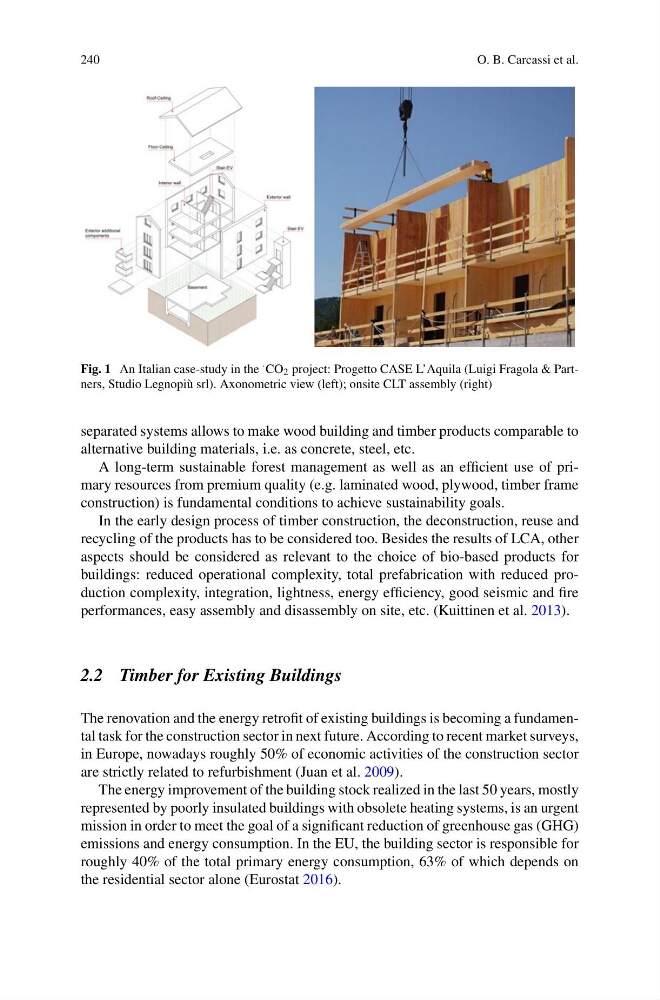
Fig. 1 An Italian case-study in the · CO 2 project: Progetto CASE L’Aquila (Luigi Fragola & Partners, Studio Legnopiù srl). Axonometric view (left); onsite CLT assembly (right)
separated systems allows to make wood building and timber products comparable to
alternative building materials, i.e. as concrete, steel, etc.
A long-term sustainable forest management as well as an efficient use of primary resources from premium quality (e.g. laminated wood, plywood, timber frame
construction) is fundamental conditions to achieve sustainability goals.
In the early design process of timber construction, the deconstruction, reuse and
recycling of the products has to be considered too. Besides the results of LCA, other
aspects should be considered as relevant to the choice of bio-based products for
buildings: reduced operational complexity, total prefabrication with reduced production complexity, integration, lightness, energy efficiency, good seismic and fire
performances, easy assembly and disassembly on site, etc. (Kuittinen et al. 2013).
2.2 Timber for Existing Buildings
The renovation and the energy retrofit of existing buildings is becoming a fundamental task for the construction sector in next future. According to recent market surveys,
in Europe, nowadays roughly 50% of economic activities of the construction sector
are strictly related to refurbishment (Juan et al. 2009).
The energy improvement of the building stock realized in the last 50 years, mostly
represented by poorly insulated buildings with obsolete heating systems, is an urgent
mission in order to meet the goal of a significant reduction of greenhouse gas (GHG)
emissions and energy consumption. In the EU, the building sector is responsible for
roughly 40% of the total primary energy consumption, 63% of which depends on
the residential sector alone (Eurostat 2016).
O. B. Carcassi et al.
Fig. 1 An Italian case-study in the · CO 2 project: Progetto CASE L’Aquila (Luigi Fragola & Partners, Studio Legnopiù srl). Axonometric view (left); onsite CLT assembly (right)
separated systems allows to make wood building and timber products comparable to
alternative building materials, i.e. as concrete, steel, etc.
A long-term sustainable forest management as well as an efficient use of primary resources from premium quality (e.g. laminated wood, plywood, timber frame
construction) is fundamental conditions to achieve sustainability goals.
In the early design process of timber construction, the deconstruction, reuse and
recycling of the products has to be considered too. Besides the results of LCA, other
aspects should be considered as relevant to the choice of bio-based products for
buildings: reduced operational complexity, total prefabrication with reduced production complexity, integration, lightness, energy efficiency, good seismic and fire
performances, easy assembly and disassembly on site, etc. (Kuittinen et al. 2013).
2.2 Timber for Existing Buildings
The renovation and the energy retrofit of existing buildings is becoming a fundamental task for the construction sector in next future. According to recent market surveys,
in Europe, nowadays roughly 50% of economic activities of the construction sector
are strictly related to refurbishment (Juan et al. 2009).
The energy improvement of the building stock realized in the last 50 years, mostly
represented by poorly insulated buildings with obsolete heating systems, is an urgent
mission in order to meet the goal of a significant reduction of greenhouse gas (GHG)
emissions and energy consumption. In the EU, the building sector is responsible for
roughly 40% of the total primary energy consumption, 63% of which depends on
the residential sector alone (Eurostat 2016).