

128
P. Caputo et al.
2 Main Energy and Environmental Figures of the Project
Area
At the beginning of the project, the area of Cascina Nosedo was investigated in order
to define the current performance of the built environment and its relation to the
natural one.
The main energy and environmental figures of the project area have been intended
for both the demand and the supply sides, as to follow the concept of a metabolic
analysis (Caputo et al. 2016), and have been assessed according to three different
spatial scales: the urban one, the whole district one (1-km radius around Cascina
Nosedo), and the one corresponding to the Cascina Nosedo buildings involved in the
project.
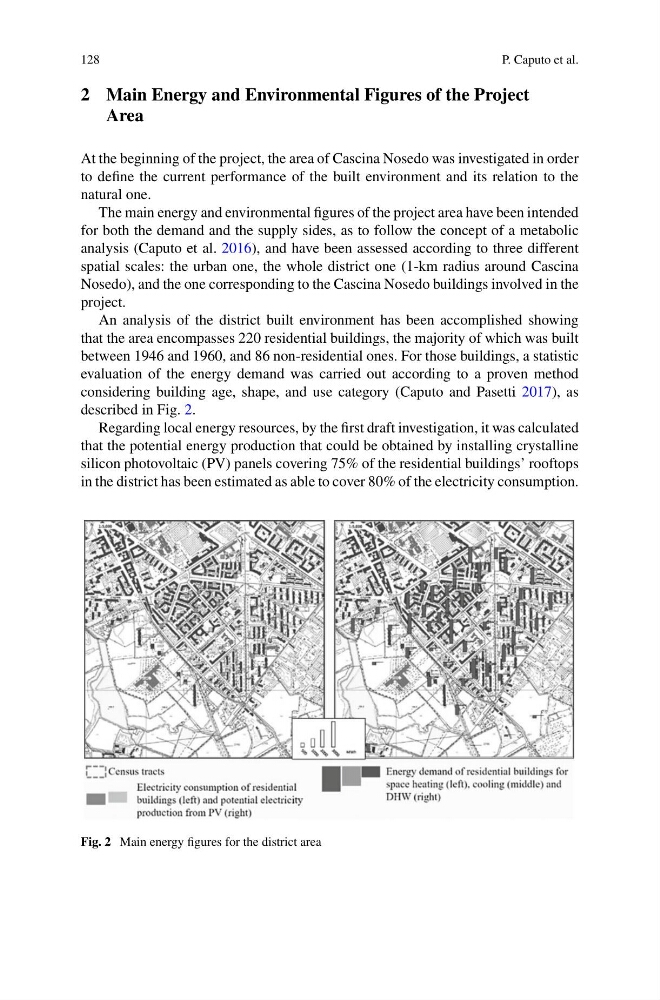
An analysis of the district built environment has been accomplished showing
that the area encompasses 220 residential buildings, the majority of which was built
between 1946 and 1960, and 86 non-residential ones. For those buildings, a statistic
evaluation of the energy demand was carried out according to a proven method
considering building age, shape, and use category (Caputo and Pasetti 2017), as
described in Fig. 2.
Regarding local energy resources, by the first draft investigation, it was calculated
that the potential energy production that could be obtained by installing crystalline
silicon photovoltaic (PV) panels covering 75% of the residential buildings’ rooftops
in the district has been estimated as able to cover 80% of the electricity consumption.
Fig. 2 Main energy figures for the district area
P. Caputo et al.
2 Main Energy and Environmental Figures of the Project
Area
At the beginning of the project, the area of Cascina Nosedo was investigated in order
to define the current performance of the built environment and its relation to the
natural one.
The main energy and environmental figures of the project area have been intended
for both the demand and the supply sides, as to follow the concept of a metabolic
analysis (Caputo et al. 2016), and have been assessed according to three different
spatial scales: the urban one, the whole district one (1-km radius around Cascina
Nosedo), and the one corresponding to the Cascina Nosedo buildings involved in the
project.
An analysis of the district built environment has been accomplished showing
that the area encompasses 220 residential buildings, the majority of which was built
between 1946 and 1960, and 86 non-residential ones. For those buildings, a statistic
evaluation of the energy demand was carried out according to a proven method
considering building age, shape, and use category (Caputo and Pasetti 2017), as
described in Fig. 2.
Regarding local energy resources, by the first draft investigation, it was calculated
that the potential energy production that could be obtained by installing crystalline
silicon photovoltaic (PV) panels covering 75% of the residential buildings’ rooftops
in the district has been estimated as able to cover 80% of the electricity consumption.
Fig. 2 Main energy figures for the district area