

120
G. Masera et al.
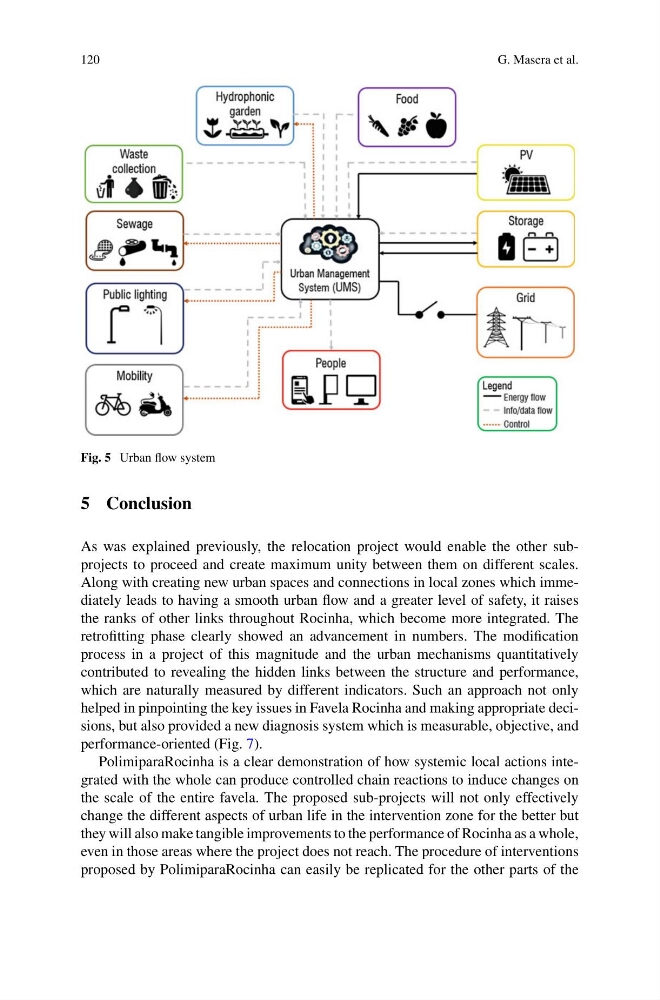
Fig. 5 Urban flow system
5 Conclusion
As was explained previously, the relocation project would enable the other subprojects to proceed and create maximum unity between them on different scales.
Along with creating new urban spaces and connections in local zones which immediately leads to having a smooth urban flow and a greater level of safety, it raises
the ranks of other links throughout Rocinha, which become more integrated. The
retrofitting phase clearly showed an advancement in numbers. The modification
process in a project of this magnitude and the urban mechanisms quantitatively
contributed to revealing the hidden links between the structure and performance,
which are naturally measured by different indicators. Such an approach not only
helped in pinpointing the key issues in Favela Rocinha and making appropriate decisions, but also provided a new diagnosis system which is measurable, objective, and
performance-oriented (Fig. 7).
PolimiparaRocinha is a clear demonstration of how systemic local actions integrated with the whole can produce controlled chain reactions to induce changes on
the scale of the entire favela. The proposed sub-projects will not only effectively
change the different aspects of urban life in the intervention zone for the better but
they will also make tangible improvements to the performance of Rocinha as a whole,
even in those areas where the project does not reach. The procedure of interventions
proposed by PolimiparaRocinha can easily be replicated for the other parts of the
G. Masera et al.
Fig. 5 Urban flow system
5 Conclusion
As was explained previously, the relocation project would enable the other subprojects to proceed and create maximum unity between them on different scales.
Along with creating new urban spaces and connections in local zones which immediately leads to having a smooth urban flow and a greater level of safety, it raises
the ranks of other links throughout Rocinha, which become more integrated. The
retrofitting phase clearly showed an advancement in numbers. The modification
process in a project of this magnitude and the urban mechanisms quantitatively
contributed to revealing the hidden links between the structure and performance,
which are naturally measured by different indicators. Such an approach not only
helped in pinpointing the key issues in Favela Rocinha and making appropriate decisions, but also provided a new diagnosis system which is measurable, objective, and
performance-oriented (Fig. 7).
PolimiparaRocinha is a clear demonstration of how systemic local actions integrated with the whole can produce controlled chain reactions to induce changes on
the scale of the entire favela. The proposed sub-projects will not only effectively
change the different aspects of urban life in the intervention zone for the better but
they will also make tangible improvements to the performance of Rocinha as a whole,
even in those areas where the project does not reach. The procedure of interventions
proposed by PolimiparaRocinha can easily be replicated for the other parts of the