

118
G. Masera et al.
4 Proposed Morphological Modification
According to the investigation phase, it is evident that the malfunctioning urban
element is the void layer and the most problematic key category is the interface.
Rocinha is suffering from not having enough empty spaces to provide sufficient
flexibility for urban flow and functional support. On the other hand, the street network
is a broken system unable to offer adequate connectivity for smooth movement.
However, minor changes can be made to improve the situation and overall functioning
of the system.
Accordingly, the initial concept is driven by the idea of providing more open
spaces, hence more integrity to the street networks by relocating a small number of
low buildings where it is possible and beneficial. A very conceptual change in the
interface analysis supports the idea that with a limited local modification, considerable global enhancement can be achieved.
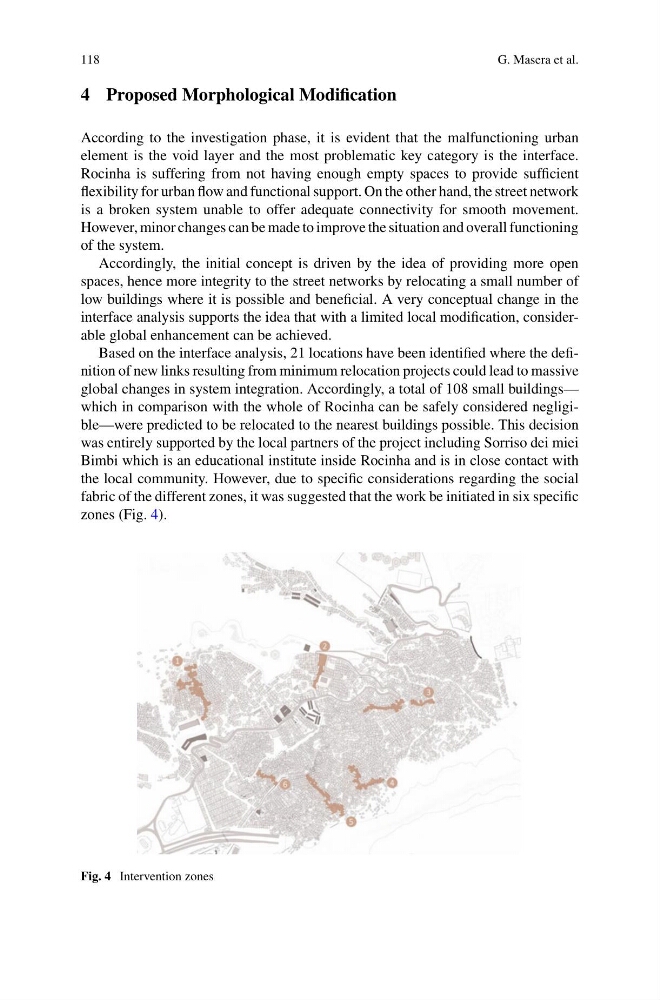
Based on the interface analysis, 21 locations have been identified where the definition of new links resulting from minimum relocation projects could lead to massive
global changes in system integration. Accordingly, a total of 108 small buildings—
which in comparison with the whole of Rocinha can be safely considered negligible—were predicted to be relocated to the nearest buildings possible. This decision
was entirely supported by the local partners of the project including Sorriso dei miei
Bimbi which is an educational institute inside Rocinha and is in close contact with
the local community. However, due to specific considerations regarding the social
fabric of the different zones, it was suggested that the work be initiated in six specific
zones (Fig. 4).
Fig. 4 Intervention zones
G. Masera et al.
4 Proposed Morphological Modification
According to the investigation phase, it is evident that the malfunctioning urban
element is the void layer and the most problematic key category is the interface.
Rocinha is suffering from not having enough empty spaces to provide sufficient
flexibility for urban flow and functional support. On the other hand, the street network
is a broken system unable to offer adequate connectivity for smooth movement.
However, minor changes can be made to improve the situation and overall functioning
of the system.
Accordingly, the initial concept is driven by the idea of providing more open
spaces, hence more integrity to the street networks by relocating a small number of
low buildings where it is possible and beneficial. A very conceptual change in the
interface analysis supports the idea that with a limited local modification, considerable global enhancement can be achieved.
Based on the interface analysis, 21 locations have been identified where the definition of new links resulting from minimum relocation projects could lead to massive
global changes in system integration. Accordingly, a total of 108 small buildings—
which in comparison with the whole of Rocinha can be safely considered negligible—were predicted to be relocated to the nearest buildings possible. This decision
was entirely supported by the local partners of the project including Sorriso dei miei
Bimbi which is an educational institute inside Rocinha and is in close contact with
the local community. However, due to specific considerations regarding the social
fabric of the different zones, it was suggested that the work be initiated in six specific
zones (Fig. 4).
Fig. 4 Intervention zones