

Living and Learning: A New Identity for Student Housing …
101
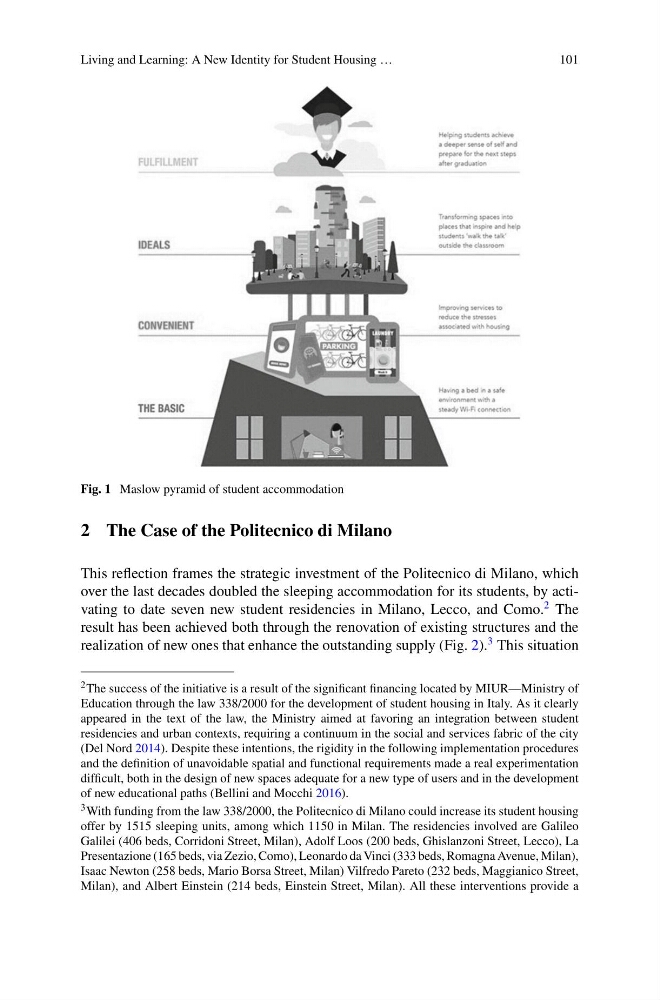
Fig. 1 Maslow pyramid of student accommodation
2 The Case of the Politecnico di Milano
This reflection frames the strategic investment of the Politecnico di Milano, which
over the last decades doubled the sleeping accommodation for its students, by activating to date seven new student residencies in Milano, Lecco, and Como.
2 The
result has been achieved both through the renovation of existing structures and the
realization of new ones that enhance the outstanding supply (Fig. 2).
3 This situation
2 The success of the initiative is a result of the significant financing located by MIUR—Ministry of
Education through the law 338/2000 for the development of student housing in Italy. As it clearly
appeared in the text of the law, the Ministry aimed at favoring an integration between student
residencies and urban contexts, requiring a continuum in the social and services fabric of the city
(Del Nord 2014). Despite these intentions, the rigidity in the following implementation procedures
and the definition of unavoidable spatial and functional requirements made a real experimentation
difficult, both in the design of new spaces adequate for a new type of users and in the development
of new educational paths (Bellini and Mocchi 2016).
3 With funding from the law 338/2000, the Politecnico di Milano could increase its student housing
offer by 1515 sleeping units, among which 1150 in Milan. The residencies involved are Galileo
Galilei (406 beds, Corridoni Street, Milan), Adolf Loos (200 beds, Ghislanzoni Street, Lecco), La
Presentazione (165 beds, via Zezio, Como), Leonardo da Vinci (333 beds, Romagna Avenue, Milan),
Isaac Newton (258 beds, Mario Borsa Street, Milan) Vilfredo Pareto (232 beds, Maggianico Street,
Milan), and Albert Einstein (214 beds, Einstein Street, Milan). All these interventions provide a
101
Fig. 1 Maslow pyramid of student accommodation
2 The Case of the Politecnico di Milano
This reflection frames the strategic investment of the Politecnico di Milano, which
over the last decades doubled the sleeping accommodation for its students, by activating to date seven new student residencies in Milano, Lecco, and Como.
2 The
result has been achieved both through the renovation of existing structures and the
realization of new ones that enhance the outstanding supply (Fig. 2).
3 This situation
2 The success of the initiative is a result of the significant financing located by MIUR—Ministry of
Education through the law 338/2000 for the development of student housing in Italy. As it clearly
appeared in the text of the law, the Ministry aimed at favoring an integration between student
residencies and urban contexts, requiring a continuum in the social and services fabric of the city
(Del Nord 2014). Despite these intentions, the rigidity in the following implementation procedures
and the definition of unavoidable spatial and functional requirements made a real experimentation
difficult, both in the design of new spaces adequate for a new type of users and in the development
of new educational paths (Bellini and Mocchi 2016).
3 With funding from the law 338/2000, the Politecnico di Milano could increase its student housing
offer by 1515 sleeping units, among which 1150 in Milan. The residencies involved are Galileo
Galilei (406 beds, Corridoni Street, Milan), Adolf Loos (200 beds, Ghislanzoni Street, Lecco), La
Presentazione (165 beds, via Zezio, Como), Leonardo da Vinci (333 beds, Romagna Avenue, Milan),
Isaac Newton (258 beds, Mario Borsa Street, Milan) Vilfredo Pareto (232 beds, Maggianico Street,
Milan), and Albert Einstein (214 beds, Einstein Street, Milan). All these interventions provide a