

90
4 Motion of Microorganisms
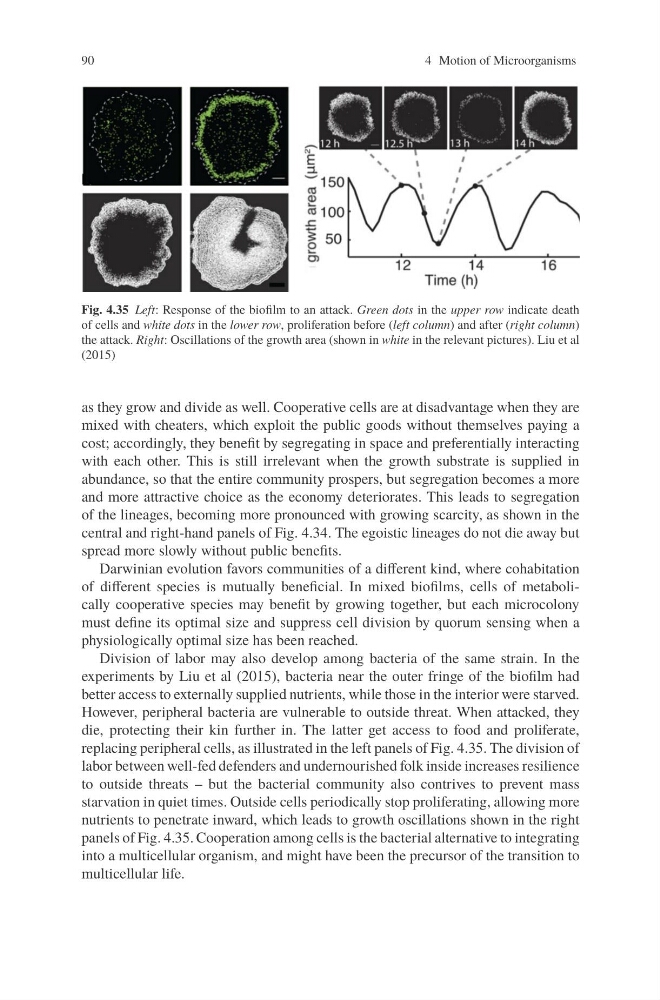
Fig. 4.35 Left: Response of the biofilm to an attack. Green dots in the upper row indicate death
of cells and white dots in the lower row, proliferation before (left column) and after (right column)
the attack. Right: Oscillations of the growth area (shown in white in the relevant pictures). Liu et al
(2015)
as they grow and divide as well. Cooperative cells are at disadvantage when they are
mixed with cheaters, which exploit the public goods without themselves paying a
cost; accordingly, they benefit by segregating in space and preferentially interacting
with each other. This is still irrelevant when the growth substrate is supplied in
abundance, so that the entire community prospers, but segregation becomes a more
and more attractive choice as the economy deteriorates. This leads to segregation
of the lineages, becoming more pronounced with growing scarcity, as shown in the
central and right-hand panels of Fig. 4.34. The egoistic lineages do not die away but
spread more slowly without public benefits.
Darwinian evolution favors communities of a different kind, where cohabitation
of different species is mutually beneficial. In mixed biofilms, cells of metabolically cooperative species may benefit by growing together, but each microcolony
must define its optimal size and suppress cell division by quorum sensing when a
physiologically optimal size has been reached.
Division of labor may also develop among bacteria of the same strain. In the
experiments by Liu et al (2015), bacteria near the outer fringe of the biofilm had
better access to externally supplied nutrients, while those in the interior were starved.
However, peripheral bacteria are vulnerable to outside threat. When attacked, they
die, protecting their kin further in. The latter get access to food and proliferate,
replacing peripheral cells, as illustrated in the left panels of Fig. 4.35. The division of
labor between well-fed defenders and undernourished folk inside increases resilience
to outside threats – but the bacterial community also contrives to prevent mass
starvation in quiet times. Outside cells periodically stop proliferating, allowing more
nutrients to penetrate inward, which leads to growth oscillations shown in the right
panels of Fig. 4.35. Cooperation among cells is the bacterial alternative to integrating
into a multicellular organism, and might have been the precursor of the transition to
multicellular life.
4 Motion of Microorganisms
Fig. 4.35 Left: Response of the biofilm to an attack. Green dots in the upper row indicate death
of cells and white dots in the lower row, proliferation before (left column) and after (right column)
the attack. Right: Oscillations of the growth area (shown in white in the relevant pictures). Liu et al
(2015)
as they grow and divide as well. Cooperative cells are at disadvantage when they are
mixed with cheaters, which exploit the public goods without themselves paying a
cost; accordingly, they benefit by segregating in space and preferentially interacting
with each other. This is still irrelevant when the growth substrate is supplied in
abundance, so that the entire community prospers, but segregation becomes a more
and more attractive choice as the economy deteriorates. This leads to segregation
of the lineages, becoming more pronounced with growing scarcity, as shown in the
central and right-hand panels of Fig. 4.34. The egoistic lineages do not die away but
spread more slowly without public benefits.
Darwinian evolution favors communities of a different kind, where cohabitation
of different species is mutually beneficial. In mixed biofilms, cells of metabolically cooperative species may benefit by growing together, but each microcolony
must define its optimal size and suppress cell division by quorum sensing when a
physiologically optimal size has been reached.
Division of labor may also develop among bacteria of the same strain. In the
experiments by Liu et al (2015), bacteria near the outer fringe of the biofilm had
better access to externally supplied nutrients, while those in the interior were starved.
However, peripheral bacteria are vulnerable to outside threat. When attacked, they
die, protecting their kin further in. The latter get access to food and proliferate,
replacing peripheral cells, as illustrated in the left panels of Fig. 4.35. The division of
labor between well-fed defenders and undernourished folk inside increases resilience
to outside threats – but the bacterial community also contrives to prevent mass
starvation in quiet times. Outside cells periodically stop proliferating, allowing more
nutrients to penetrate inward, which leads to growth oscillations shown in the right
panels of Fig. 4.35. Cooperation among cells is the bacterial alternative to integrating
into a multicellular organism, and might have been the precursor of the transition to
multicellular life.