

88
4 Motion of Microorganisms
a continuum view on a larger scale, illustrating the effect of mechanical instabilities
that generate the verticalization nuclei shown in Fig. 4.32d. These then grow as can
be seen in the other panels of this figure, both simulated and experimental. The
authors try to tie the vertical lift-off, driven by compressive stress, to propagation of
nematic defects, but this approach is questionable, since the topology of the defects
changes when the medium becomes three-dimensional (see Sect. 2.3).
Mature biofilms develop variegated morphologies, which are determined not only
by microbial gene expression programs, but also by contributions from mechanical
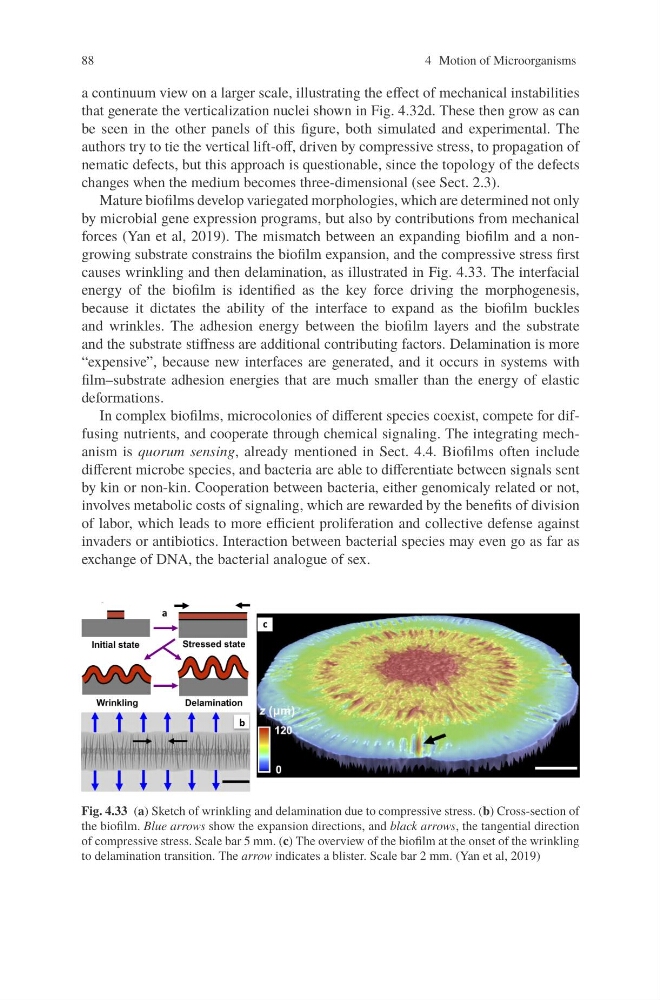
forces (Yan et al, 2019). The mismatch between an expanding biofilm and a nongrowing substrate constrains the biofilm expansion, and the compressive stress first
causes wrinkling and then delamination, as illustrated in Fig. 4.33. The interfacial
energy of the biofilm is identified as the key force driving the morphogenesis,
because it dictates the ability of the interface to expand as the biofilm buckles
and wrinkles. The adhesion energy between the biofilm layers and the substrate
and the substrate stiffness are additional contributing factors. Delamination is more
“expensive”, because new interfaces are generated, and it occurs in systems with
film–substrate adhesion energies that are much smaller than the energy of elastic
deformations.
In complex biofilms, microcolonies of different species coexist, compete for diffusing nutrients, and cooperate through chemical signaling. The integrating mechanism is quorum sensing, already mentioned in Sect. 4.4. Biofilms often include
different microbe species, and bacteria are able to differentiate between signals sent
by kin or non-kin. Cooperation between bacteria, either genomicaly related or not,
involves metabolic costs of signaling, which are rewarded by the benefits of division
of labor, which leads to more efficient proliferation and collective defense against
invaders or antibiotics. Interaction between bacterial species may even go as far as
exchange of DNA, the bacterial analogue of sex.
Fig. 4.33 (a) Sketch of wrinkling and delamination due to compressive stress. (b) Cross-section of
the biofilm. Blue arrows show the expansion directions, and black arrows, the tangential direction
of compressive stress. Scale bar 5 mm. (c) The overview of the biofilm at the onset of the wrinkling
to delamination transition. The arrow indicates a blister. Scale bar 2 mm. (Yan et al, 2019)
4 Motion of Microorganisms
a continuum view on a larger scale, illustrating the effect of mechanical instabilities
that generate the verticalization nuclei shown in Fig. 4.32d. These then grow as can
be seen in the other panels of this figure, both simulated and experimental. The
authors try to tie the vertical lift-off, driven by compressive stress, to propagation of
nematic defects, but this approach is questionable, since the topology of the defects
changes when the medium becomes three-dimensional (see Sect. 2.3).
Mature biofilms develop variegated morphologies, which are determined not only
by microbial gene expression programs, but also by contributions from mechanical
forces (Yan et al, 2019). The mismatch between an expanding biofilm and a nongrowing substrate constrains the biofilm expansion, and the compressive stress first
causes wrinkling and then delamination, as illustrated in Fig. 4.33. The interfacial
energy of the biofilm is identified as the key force driving the morphogenesis,
because it dictates the ability of the interface to expand as the biofilm buckles
and wrinkles. The adhesion energy between the biofilm layers and the substrate
and the substrate stiffness are additional contributing factors. Delamination is more
“expensive”, because new interfaces are generated, and it occurs in systems with
film–substrate adhesion energies that are much smaller than the energy of elastic
deformations.
In complex biofilms, microcolonies of different species coexist, compete for diffusing nutrients, and cooperate through chemical signaling. The integrating mechanism is quorum sensing, already mentioned in Sect. 4.4. Biofilms often include
different microbe species, and bacteria are able to differentiate between signals sent
by kin or non-kin. Cooperation between bacteria, either genomicaly related or not,
involves metabolic costs of signaling, which are rewarded by the benefits of division
of labor, which leads to more efficient proliferation and collective defense against
invaders or antibiotics. Interaction between bacterial species may even go as far as
exchange of DNA, the bacterial analogue of sex.
Fig. 4.33 (a) Sketch of wrinkling and delamination due to compressive stress. (b) Cross-section of
the biofilm. Blue arrows show the expansion directions, and black arrows, the tangential direction
of compressive stress. Scale bar 5 mm. (c) The overview of the biofilm at the onset of the wrinkling
to delamination transition. The arrow indicates a blister. Scale bar 2 mm. (Yan et al, 2019)