

2.7 Active Fluids with Different Symmetries
39
2.7 Active Fluids with Different Symmetries
Although only nematics are featured in the title of this chapter, it is proper to mention
here active ordered fluids with different symmetries treated in a similar way. Tjhung
et al (2011) and Bonelli et al (2016) combined tensile or contractile activity with selfadvection, thereby converting a nematic medium to a polar one. There is a certain
freedom in relating vectorial self-advection to the direction of active extending or
contracting forces. It has been chosen differently in the cited works, and different
patterns can be obtained thereby; patterns also depend on boundary conditions.
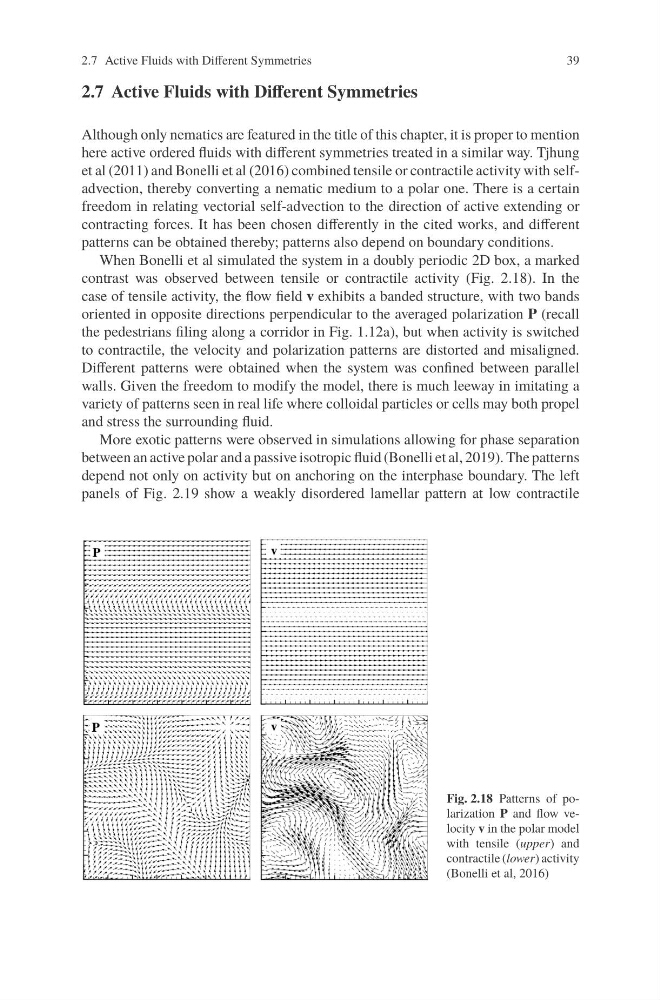
When Bonelli et al simulated the system in a doubly periodic 2D box, a marked
contrast was observed between tensile or contractile activity (Fig. 2.18). In the
case of tensile activity, the flow field v exhibits a banded structure, with two bands
oriented in opposite directions perpendicular to the averaged polarization P (recall
the pedestrians filing along a corridor in Fig. 1.12a), but when activity is switched
to contractile, the velocity and polarization patterns are distorted and misaligned.
Different patterns were obtained when the system was confined between parallel
walls. Given the freedom to modify the model, there is much leeway in imitating a
variety of patterns seen in real life where colloidal particles or cells may both propel
and stress the surrounding fluid.
More exotic patterns were observed in simulations allowing for phase separation
between an active polar and a passive isotropic fluid (Bonelli et al, 2019). The patterns
depend not only on activity but on anchoring on the interphase boundary. The left
panels of Fig. 2.19 show a weakly disordered lamellar pattern at low contractile
Fig. 2.18 Patterns of polarization P and flow velocity v in the polar model
with tensile (upper) and
contractile (lower) activity
(Bonelli et al, 2016)
39
2.7 Active Fluids with Different Symmetries
Although only nematics are featured in the title of this chapter, it is proper to mention
here active ordered fluids with different symmetries treated in a similar way. Tjhung
et al (2011) and Bonelli et al (2016) combined tensile or contractile activity with selfadvection, thereby converting a nematic medium to a polar one. There is a certain
freedom in relating vectorial self-advection to the direction of active extending or
contracting forces. It has been chosen differently in the cited works, and different
patterns can be obtained thereby; patterns also depend on boundary conditions.
When Bonelli et al simulated the system in a doubly periodic 2D box, a marked
contrast was observed between tensile or contractile activity (Fig. 2.18). In the
case of tensile activity, the flow field v exhibits a banded structure, with two bands
oriented in opposite directions perpendicular to the averaged polarization P (recall
the pedestrians filing along a corridor in Fig. 1.12a), but when activity is switched
to contractile, the velocity and polarization patterns are distorted and misaligned.
Different patterns were obtained when the system was confined between parallel
walls. Given the freedom to modify the model, there is much leeway in imitating a
variety of patterns seen in real life where colloidal particles or cells may both propel
and stress the surrounding fluid.
More exotic patterns were observed in simulations allowing for phase separation
between an active polar and a passive isotropic fluid (Bonelli et al, 2019). The patterns
depend not only on activity but on anchoring on the interphase boundary. The left
panels of Fig. 2.19 show a weakly disordered lamellar pattern at low contractile
Fig. 2.18 Patterns of polarization P and flow velocity v in the polar model
with tensile (upper) and
contractile (lower) activity
(Bonelli et al, 2016)