

30
2 Active Nematics
equation reflected the unusual combination of 2D geometry with 3D orientations
of the rods. It included the cubic term −n|n| 2 limiting the absolute value of the
2D projection n of the 3D director, with |n| equal to zero for vertical and unity
for horizontal rods. The 2D orientation is now polar rather than nematic, and the
influence of splay and bend distortions is accounted for by the Laplacian of n and the
gradient of its divergence. The alignment is also coupled to the gradient of density
in this model. This realistic model is too complicated for analysis, but computations
faithfully reproduce the qualitative features of experimental observations.
The motion is inhibited when 3D alignment is suppressed by restricting the
layer of rods by a lid that leaves the particles only a little vertical room to move
(Narayan et al, 2006). The particles arranged themselves in a variety of almost static
patterns: not only nematic but smectic or tetradic, depending on details of their
shape; layers of cylindrical particles turned out to be more disordered than more
easily rearranging layers of rice grains. The authors attributed a tendency to slow
global rotation to some “stray chirality” rather than to the spontaneous breaking of
chiral symmetry that naturally occurs in a layer of rods free to align in the vertical
direction. Only small tapered rods, probably less restricted by the lid, showed a
strongly distorted dynamic swirling pattern. Experiments by Aranson et al (2007)
have also shown great sensitivity of swirling to the shape of the particles, but swirling
motion of horizontally aligned particles was shown to be caused by an unintended
and uncontrolled horizontal vibration component. Sensitivity to details is natural in
real-life problems but unwelcome in studies of no practical significance.
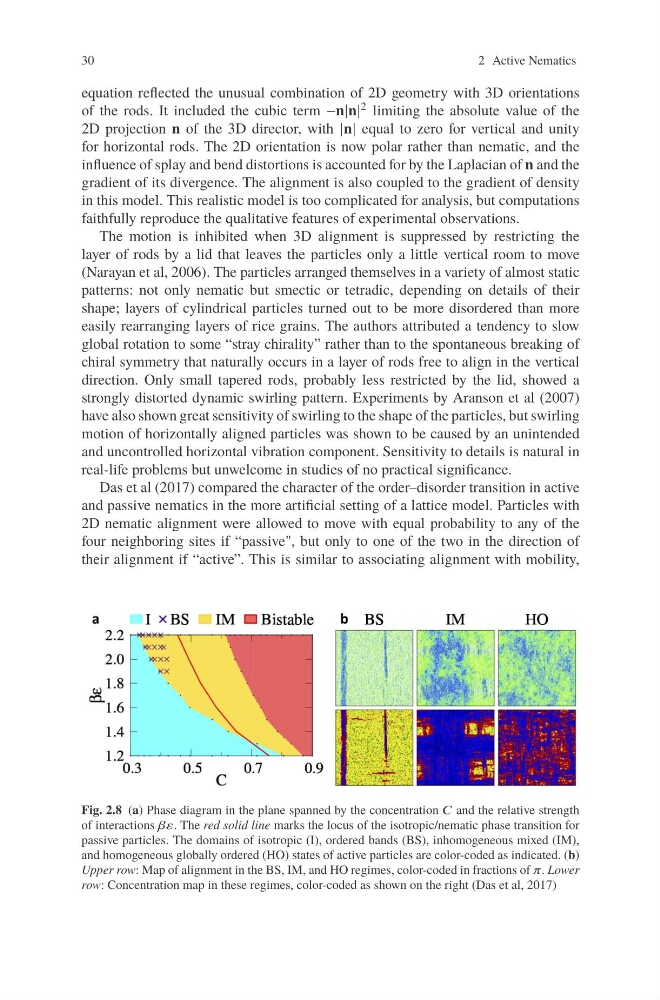
Das et al (2017) compared the character of the order–disorder transition in active
and passive nematics in the more artificial setting of a lattice model. Particles with
2D nematic alignment were allowed to move with equal probability to any of the
four neighboring sites if “passive", but only to one of the two in the direction of
their alignment if “active”. This is similar to associating alignment with mobility,
Fig. 2.8 (a) Phase diagram in the plane spanned by the concentration C and the relative strength
of interactions βε. The red solid line marks the locus of the isotropic/nematic phase transition for
passive particles. The domains of isotropic (I), ordered bands (BS), inhomogeneous mixed (IM),
and homogeneous globally ordered (HO) states of active particles are color-coded as indicated. (b)
Upper row: Map of alignment in the BS, IM, and HO regimes, color-coded in fractions of π. Lower
row: Concentration map in these regimes, color-coded as shown on the right (Das et al, 2017)
2 Active Nematics
equation reflected the unusual combination of 2D geometry with 3D orientations
of the rods. It included the cubic term −n|n| 2 limiting the absolute value of the
2D projection n of the 3D director, with |n| equal to zero for vertical and unity
for horizontal rods. The 2D orientation is now polar rather than nematic, and the
influence of splay and bend distortions is accounted for by the Laplacian of n and the
gradient of its divergence. The alignment is also coupled to the gradient of density
in this model. This realistic model is too complicated for analysis, but computations
faithfully reproduce the qualitative features of experimental observations.
The motion is inhibited when 3D alignment is suppressed by restricting the
layer of rods by a lid that leaves the particles only a little vertical room to move
(Narayan et al, 2006). The particles arranged themselves in a variety of almost static
patterns: not only nematic but smectic or tetradic, depending on details of their
shape; layers of cylindrical particles turned out to be more disordered than more
easily rearranging layers of rice grains. The authors attributed a tendency to slow
global rotation to some “stray chirality” rather than to the spontaneous breaking of
chiral symmetry that naturally occurs in a layer of rods free to align in the vertical
direction. Only small tapered rods, probably less restricted by the lid, showed a
strongly distorted dynamic swirling pattern. Experiments by Aranson et al (2007)
have also shown great sensitivity of swirling to the shape of the particles, but swirling
motion of horizontally aligned particles was shown to be caused by an unintended
and uncontrolled horizontal vibration component. Sensitivity to details is natural in
real-life problems but unwelcome in studies of no practical significance.
Das et al (2017) compared the character of the order–disorder transition in active
and passive nematics in the more artificial setting of a lattice model. Particles with
2D nematic alignment were allowed to move with equal probability to any of the
four neighboring sites if “passive", but only to one of the two in the direction of
their alignment if “active”. This is similar to associating alignment with mobility,
Fig. 2.8 (a) Phase diagram in the plane spanned by the concentration C and the relative strength
of interactions βε. The red solid line marks the locus of the isotropic/nematic phase transition for
passive particles. The domains of isotropic (I), ordered bands (BS), inhomogeneous mixed (IM),
and homogeneous globally ordered (HO) states of active particles are color-coded as indicated. (b)
Upper row: Map of alignment in the BS, IM, and HO regimes, color-coded in fractions of π. Lower
row: Concentration map in these regimes, color-coded as shown on the right (Das et al, 2017)