

12
1 Polar Flocks
and the phase transition happens with a changing temperature that determines the
level of random noise. Liquid and gas can coexist, as dense (ordered) and dilute
(disordered) domains in Fig. 1.4. Even giant intermittent fluctuations are possible in
common fluids near a critical point.
Another passive system similar in some respects to the Vicsek model is the magnetic XY model describing interactions of spins on a lattice (Kosterlitz and Thouless,
1973). Its microscopic “particles” are vectors of a fixed length, like Vicsek’s “birds”,
and likewise the orientation of these vectors tends to adjust to their immediate environment, but there are no density inhomogeneities and, of course, no active motion. It
is known that fluctuations at any non-zero temperature prevent formation of a phase
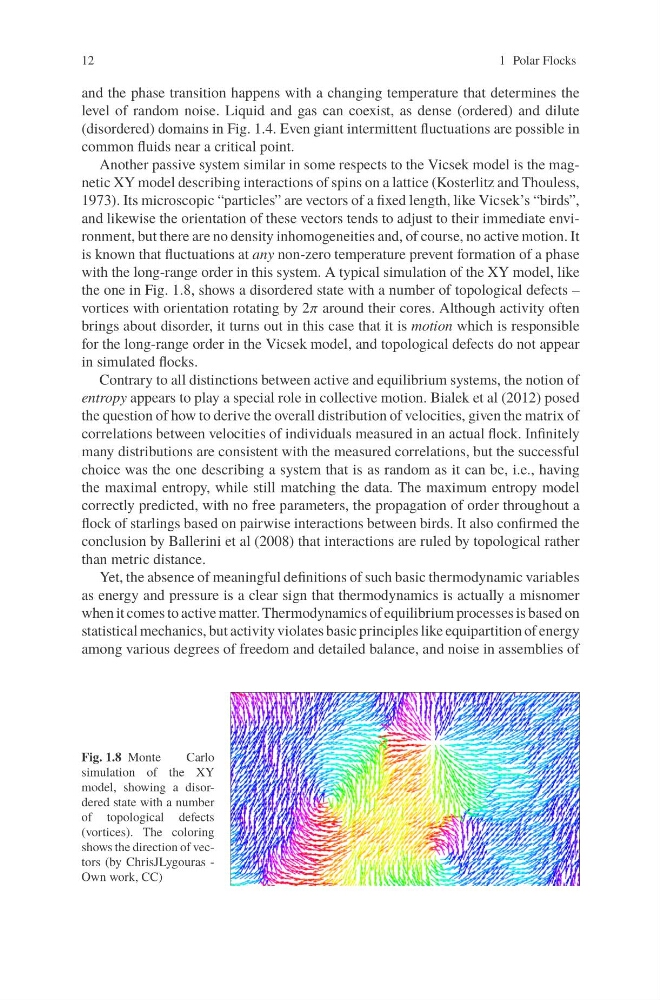
with the long-range order in this system. A typical simulation of the XY model, like
the one in Fig. 1.8, shows a disordered state with a number of topological defects –
vortices with orientation rotating by 2π around their cores. Although activity often
brings about disorder, it turns out in this case that it is motion which is responsible
for the long-range order in the Vicsek model, and topological defects do not appear
in simulated flocks.
Contrary to all distinctions between active and equilibrium systems, the notion of
entropy appears to play a special role in collective motion. Bialek et al (2012) posed
the question of how to derive the overall distribution of velocities, given the matrix of
correlations between velocities of individuals measured in an actual flock. Infinitely
many distributions are consistent with the measured correlations, but the successful
choice was the one describing a system that is as random as it can be, i.e., having
the maximal entropy, while still matching the data. The maximum entropy model
correctly predicted, with no free parameters, the propagation of order throughout a
flock of starlings based on pairwise interactions between birds. It also confirmed the
conclusion by Ballerini et al (2008) that interactions are ruled by topological rather
than metric distance.
Yet, the absence of meaningful definitions of such basic thermodynamic variables
as energy and pressure is a clear sign that thermodynamics is actually a misnomer
when it comes to active matter. Thermodynamics of equilibrium processes is based on
statistical mechanics, but activity violates basic principles like equipartition of energy
among various degrees of freedom and detailed balance, and noise in assemblies of
Fig. 1.8 Monte
Carlo
simulation of the XY
model, showing a disordered state with a number
of topological defects
(vortices). The coloring
shows the direction of vectors (by ChrisJLygouras -
Own work, CC)
1 Polar Flocks
and the phase transition happens with a changing temperature that determines the
level of random noise. Liquid and gas can coexist, as dense (ordered) and dilute
(disordered) domains in Fig. 1.4. Even giant intermittent fluctuations are possible in
common fluids near a critical point.
Another passive system similar in some respects to the Vicsek model is the magnetic XY model describing interactions of spins on a lattice (Kosterlitz and Thouless,
1973). Its microscopic “particles” are vectors of a fixed length, like Vicsek’s “birds”,
and likewise the orientation of these vectors tends to adjust to their immediate environment, but there are no density inhomogeneities and, of course, no active motion. It
is known that fluctuations at any non-zero temperature prevent formation of a phase
with the long-range order in this system. A typical simulation of the XY model, like
the one in Fig. 1.8, shows a disordered state with a number of topological defects –
vortices with orientation rotating by 2π around their cores. Although activity often
brings about disorder, it turns out in this case that it is motion which is responsible
for the long-range order in the Vicsek model, and topological defects do not appear
in simulated flocks.
Contrary to all distinctions between active and equilibrium systems, the notion of
entropy appears to play a special role in collective motion. Bialek et al (2012) posed
the question of how to derive the overall distribution of velocities, given the matrix of
correlations between velocities of individuals measured in an actual flock. Infinitely
many distributions are consistent with the measured correlations, but the successful
choice was the one describing a system that is as random as it can be, i.e., having
the maximal entropy, while still matching the data. The maximum entropy model
correctly predicted, with no free parameters, the propagation of order throughout a
flock of starlings based on pairwise interactions between birds. It also confirmed the
conclusion by Ballerini et al (2008) that interactions are ruled by topological rather
than metric distance.
Yet, the absence of meaningful definitions of such basic thermodynamic variables
as energy and pressure is a clear sign that thermodynamics is actually a misnomer
when it comes to active matter. Thermodynamics of equilibrium processes is based on
statistical mechanics, but activity violates basic principles like equipartition of energy
among various degrees of freedom and detailed balance, and noise in assemblies of
Fig. 1.8 Monte
Carlo
simulation of the XY
model, showing a disordered state with a number
of topological defects
(vortices). The coloring
shows the direction of vectors (by ChrisJLygouras -
Own work, CC)