

170
7 Live Tissues
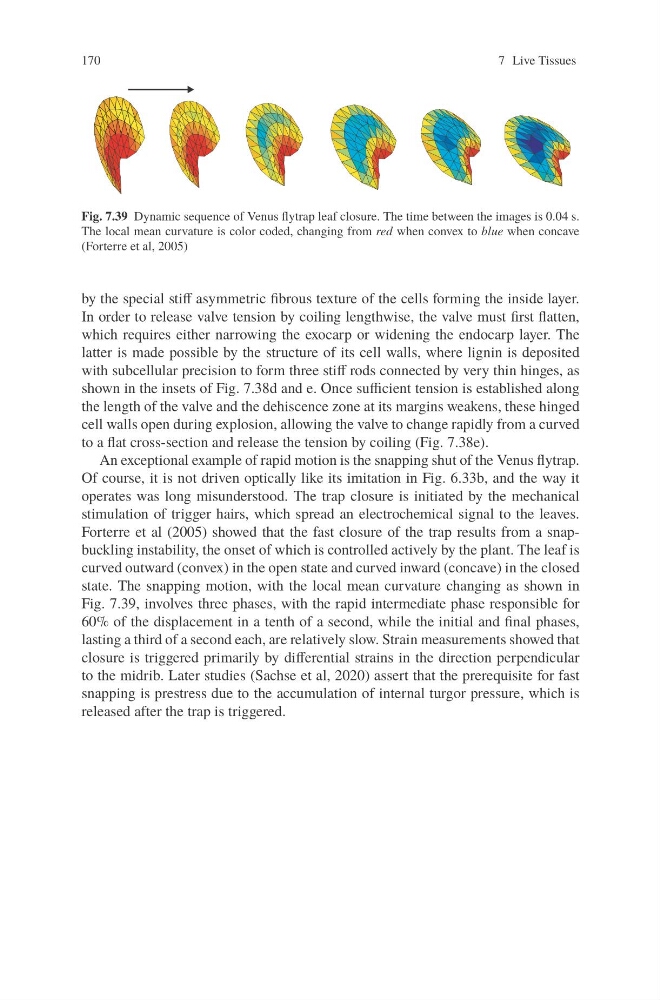
Fig. 7.39 Dynamic sequence of Venus flytrap leaf closure. The time between the images is 0.04 s.
The local mean curvature is color coded, changing from red when convex to blue when concave
(Forterre et al, 2005)
by the special stiff asymmetric fibrous texture of the cells forming the inside layer.
In order to release valve tension by coiling lengthwise, the valve must first flatten,
which requires either narrowing the exocarp or widening the endocarp layer. The
latter is made possible by the structure of its cell walls, where lignin is deposited
with subcellular precision to form three stiff rods connected by very thin hinges, as
shown in the insets of Fig. 7.38d and e. Once sufficient tension is established along
the length of the valve and the dehiscence zone at its margins weakens, these hinged
cell walls open during explosion, allowing the valve to change rapidly from a curved
to a flat cross-section and release the tension by coiling (Fig. 7.38e).
An exceptional example of rapid motion is the snapping shut of the Venus flytrap.
Of course, it is not driven optically like its imitation in Fig. 6.33b, and the way it
operates was long misunderstood. The trap closure is initiated by the mechanical
stimulation of trigger hairs, which spread an electrochemical signal to the leaves.
Forterre et al (2005) showed that the fast closure of the trap results from a snapbuckling instability, the onset of which is controlled actively by the plant. The leaf is
curved outward (convex) in the open state and curved inward (concave) in the closed
state. The snapping motion, with the local mean curvature changing as shown in
Fig. 7.39, involves three phases, with the rapid intermediate phase responsible for
60% of the displacement in a tenth of a second, while the initial and final phases,
lasting a third of a second each, are relatively slow. Strain measurements showed that
closure is triggered primarily by differential strains in the direction perpendicular
to the midrib. Later studies (Sachse et al, 2020) assert that the prerequisite for fast
snapping is prestress due to the accumulation of internal turgor pressure, which is
released after the trap is triggered.
7 Live Tissues
Fig. 7.39 Dynamic sequence of Venus flytrap leaf closure. The time between the images is 0.04 s.
The local mean curvature is color coded, changing from red when convex to blue when concave
(Forterre et al, 2005)
by the special stiff asymmetric fibrous texture of the cells forming the inside layer.
In order to release valve tension by coiling lengthwise, the valve must first flatten,
which requires either narrowing the exocarp or widening the endocarp layer. The
latter is made possible by the structure of its cell walls, where lignin is deposited
with subcellular precision to form three stiff rods connected by very thin hinges, as
shown in the insets of Fig. 7.38d and e. Once sufficient tension is established along
the length of the valve and the dehiscence zone at its margins weakens, these hinged
cell walls open during explosion, allowing the valve to change rapidly from a curved
to a flat cross-section and release the tension by coiling (Fig. 7.38e).
An exceptional example of rapid motion is the snapping shut of the Venus flytrap.
Of course, it is not driven optically like its imitation in Fig. 6.33b, and the way it
operates was long misunderstood. The trap closure is initiated by the mechanical
stimulation of trigger hairs, which spread an electrochemical signal to the leaves.
Forterre et al (2005) showed that the fast closure of the trap results from a snapbuckling instability, the onset of which is controlled actively by the plant. The leaf is
curved outward (convex) in the open state and curved inward (concave) in the closed
state. The snapping motion, with the local mean curvature changing as shown in
Fig. 7.39, involves three phases, with the rapid intermediate phase responsible for
60% of the displacement in a tenth of a second, while the initial and final phases,
lasting a third of a second each, are relatively slow. Strain measurements showed that
closure is triggered primarily by differential strains in the direction perpendicular
to the midrib. Later studies (Sachse et al, 2020) assert that the prerequisite for fast
snapping is prestress due to the accumulation of internal turgor pressure, which is
released after the trap is triggered.