

118
6 Active Gels
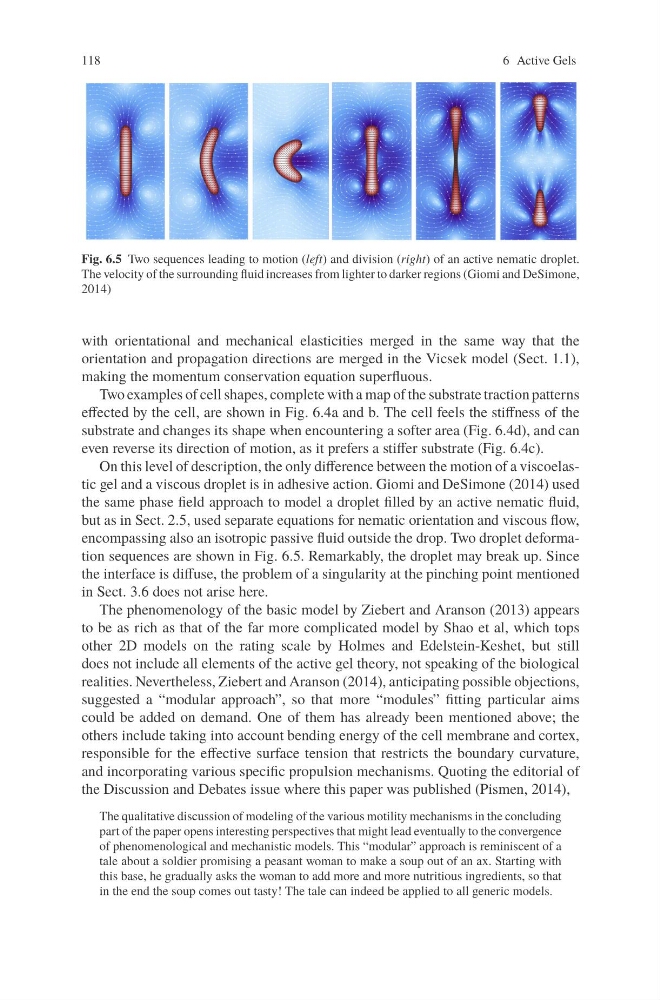
Fig. 6.5 Two sequences leading to motion (left) and division (right) of an active nematic droplet.
The velocity of the surrounding fluid increases from lighter to darker regions (Giomi and DeSimone,
2014)
with orientational and mechanical elasticities merged in the same way that the
orientation and propagation directions are merged in the Vicsek model (Sect. 1.1),
making the momentum conservation equation superfluous.
Two examples of cell shapes, complete with a map of the substrate traction patterns
effected by the cell, are shown in Fig. 6.4a and b. The cell feels the stiffness of the
substrate and changes its shape when encountering a softer area (Fig. 6.4d), and can
even reverse its direction of motion, as it prefers a stiffer substrate (Fig. 6.4c).
On this level of description, the only difference between the motion of a viscoelastic gel and a viscous droplet is in adhesive action. Giomi and DeSimone (2014) used
the same phase field approach to model a droplet filled by an active nematic fluid,
but as in Sect. 2.5, used separate equations for nematic orientation and viscous flow,
encompassing also an isotropic passive fluid outside the drop. Two droplet deformation sequences are shown in Fig. 6.5. Remarkably, the droplet may break up. Since
the interface is diffuse, the problem of a singularity at the pinching point mentioned
in Sect. 3.6 does not arise here.
The phenomenology of the basic model by Ziebert and Aranson (2013) appears
to be as rich as that of the far more complicated model by Shao et al, which tops
other 2D models on the rating scale by Holmes and Edelstein-Keshet, but still
does not include all elements of the active gel theory, not speaking of the biological
realities. Nevertheless, Ziebert and Aranson (2014), anticipating possible objections,
suggested a “modular approach”, so that more “modules” fitting particular aims
could be added on demand. One of them has already been mentioned above; the
others include taking into account bending energy of the cell membrane and cortex,
responsible for the effective surface tension that restricts the boundary curvature,
and incorporating various specific propulsion mechanisms. Quoting the editorial of
the Discussion and Debates issue where this paper was published (Pismen, 2014),
The qualitative discussion of modeling of the various motility mechanisms in the concluding
part of the paper opens interesting perspectives that might lead eventually to the convergence
of phenomenological and mechanistic models. This “modular” approach is reminiscent of a
tale about a soldier promising a peasant woman to make a soup out of an ax. Starting with
this base, he gradually asks the woman to add more and more nutritious ingredients, so that
in the end the soup comes out tasty! The tale can indeed be applied to all generic models.
6 Active Gels
Fig. 6.5 Two sequences leading to motion (left) and division (right) of an active nematic droplet.
The velocity of the surrounding fluid increases from lighter to darker regions (Giomi and DeSimone,
2014)
with orientational and mechanical elasticities merged in the same way that the
orientation and propagation directions are merged in the Vicsek model (Sect. 1.1),
making the momentum conservation equation superfluous.
Two examples of cell shapes, complete with a map of the substrate traction patterns
effected by the cell, are shown in Fig. 6.4a and b. The cell feels the stiffness of the
substrate and changes its shape when encountering a softer area (Fig. 6.4d), and can
even reverse its direction of motion, as it prefers a stiffer substrate (Fig. 6.4c).
On this level of description, the only difference between the motion of a viscoelastic gel and a viscous droplet is in adhesive action. Giomi and DeSimone (2014) used
the same phase field approach to model a droplet filled by an active nematic fluid,
but as in Sect. 2.5, used separate equations for nematic orientation and viscous flow,
encompassing also an isotropic passive fluid outside the drop. Two droplet deformation sequences are shown in Fig. 6.5. Remarkably, the droplet may break up. Since
the interface is diffuse, the problem of a singularity at the pinching point mentioned
in Sect. 3.6 does not arise here.
The phenomenology of the basic model by Ziebert and Aranson (2013) appears
to be as rich as that of the far more complicated model by Shao et al, which tops
other 2D models on the rating scale by Holmes and Edelstein-Keshet, but still
does not include all elements of the active gel theory, not speaking of the biological
realities. Nevertheless, Ziebert and Aranson (2014), anticipating possible objections,
suggested a “modular approach”, so that more “modules” fitting particular aims
could be added on demand. One of them has already been mentioned above; the
others include taking into account bending energy of the cell membrane and cortex,
responsible for the effective surface tension that restricts the boundary curvature,
and incorporating various specific propulsion mechanisms. Quoting the editorial of
the Discussion and Debates issue where this paper was published (Pismen, 2014),
The qualitative discussion of modeling of the various motility mechanisms in the concluding
part of the paper opens interesting perspectives that might lead eventually to the convergence
of phenomenological and mechanistic models. This “modular” approach is reminiscent of a
tale about a soldier promising a peasant woman to make a soup out of an ax. Starting with
this base, he gradually asks the woman to add more and more nutritious ingredients, so that
in the end the soup comes out tasty! The tale can indeed be applied to all generic models.