

116
6 Active Gels
rather stiff filaments, which is in the range of 10 μm. Therefore the pattern in Fig. 5.8
rather than the cytoskeleton could be a testing ground for the particular prediction
in Fig. 6.2.
6.2 Crawling Cells
The testing ground for the active gel theory is the description of cell motion. Various studies have approached this problem using different variants of a continuous
theory and at a different level of detail. In a review encompassing both continuous
models and those based on direct description of growing actin filaments, Holmes
and Edelstein-Keshet (2012) graded prior work by the level of biological detail and
computational complexity, with the latter sometimes going down to 1D, hardly a
physically relevant setting, and topped by 3D two-phase computations (Herant and
Dembo, 2010).
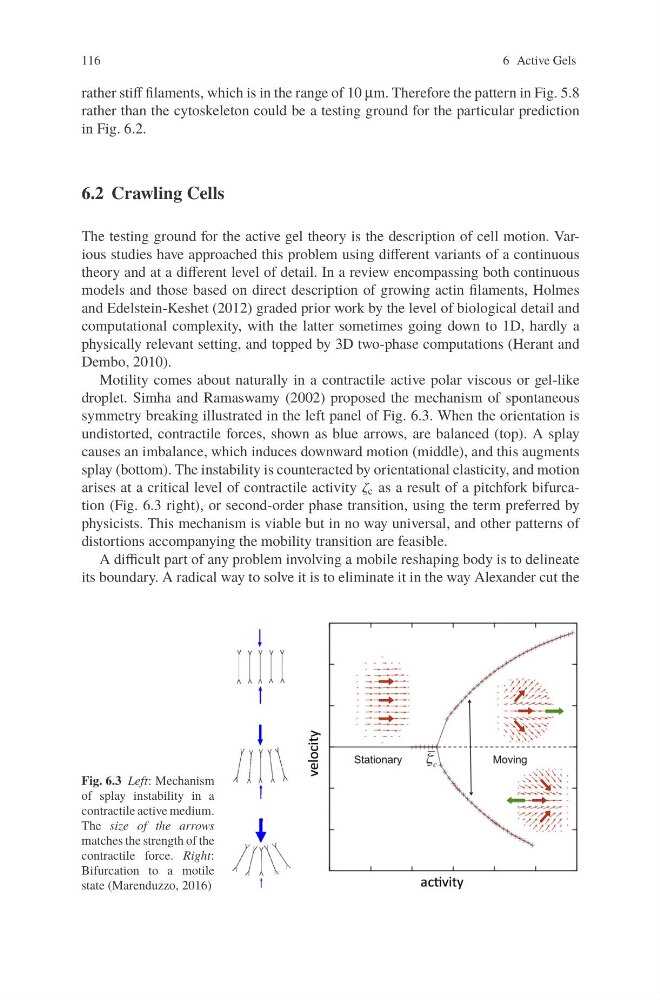
Motility comes about naturally in a contractile active polar viscous or gel-like
droplet. Simha and Ramaswamy (2002) proposed the mechanism of spontaneous
symmetry breaking illustrated in the left panel of Fig. 6.3. When the orientation is
undistorted, contractile forces, shown as blue arrows, are balanced (top). A splay
causes an imbalance, which induces downward motion (middle), and this augments
splay (bottom). The instability is counteracted by orientational elasticity, and motion
arises at a critical level of contractile activity ζ c as a result of a pitchfork bifurcation (Fig. 6.3 right), or second-order phase transition, using the term preferred by
physicists. This mechanism is viable but in no way universal, and other patterns of
distortions accompanying the mobility transition are feasible.
A difficult part of any problem involving a mobile reshaping body is to delineate
its boundary. A radical way to solve it is to eliminate it in the way Alexander cut the
Fig. 6.3 Left: Mechanism
of splay instability in a
contractile active medium.
The size of the arrows
matches the strength of the
contractile force. Right:
Bifurcation to a motile
state (Marenduzzo, 2016)
6 Active Gels
rather stiff filaments, which is in the range of 10 μm. Therefore the pattern in Fig. 5.8
rather than the cytoskeleton could be a testing ground for the particular prediction
in Fig. 6.2.
6.2 Crawling Cells
The testing ground for the active gel theory is the description of cell motion. Various studies have approached this problem using different variants of a continuous
theory and at a different level of detail. In a review encompassing both continuous
models and those based on direct description of growing actin filaments, Holmes
and Edelstein-Keshet (2012) graded prior work by the level of biological detail and
computational complexity, with the latter sometimes going down to 1D, hardly a
physically relevant setting, and topped by 3D two-phase computations (Herant and
Dembo, 2010).
Motility comes about naturally in a contractile active polar viscous or gel-like
droplet. Simha and Ramaswamy (2002) proposed the mechanism of spontaneous
symmetry breaking illustrated in the left panel of Fig. 6.3. When the orientation is
undistorted, contractile forces, shown as blue arrows, are balanced (top). A splay
causes an imbalance, which induces downward motion (middle), and this augments
splay (bottom). The instability is counteracted by orientational elasticity, and motion
arises at a critical level of contractile activity ζ c as a result of a pitchfork bifurcation (Fig. 6.3 right), or second-order phase transition, using the term preferred by
physicists. This mechanism is viable but in no way universal, and other patterns of
distortions accompanying the mobility transition are feasible.
A difficult part of any problem involving a mobile reshaping body is to delineate
its boundary. A radical way to solve it is to eliminate it in the way Alexander cut the
Fig. 6.3 Left: Mechanism
of splay instability in a
contractile active medium.
The size of the arrows
matches the strength of the
contractile force. Right:
Bifurcation to a motile
state (Marenduzzo, 2016)