

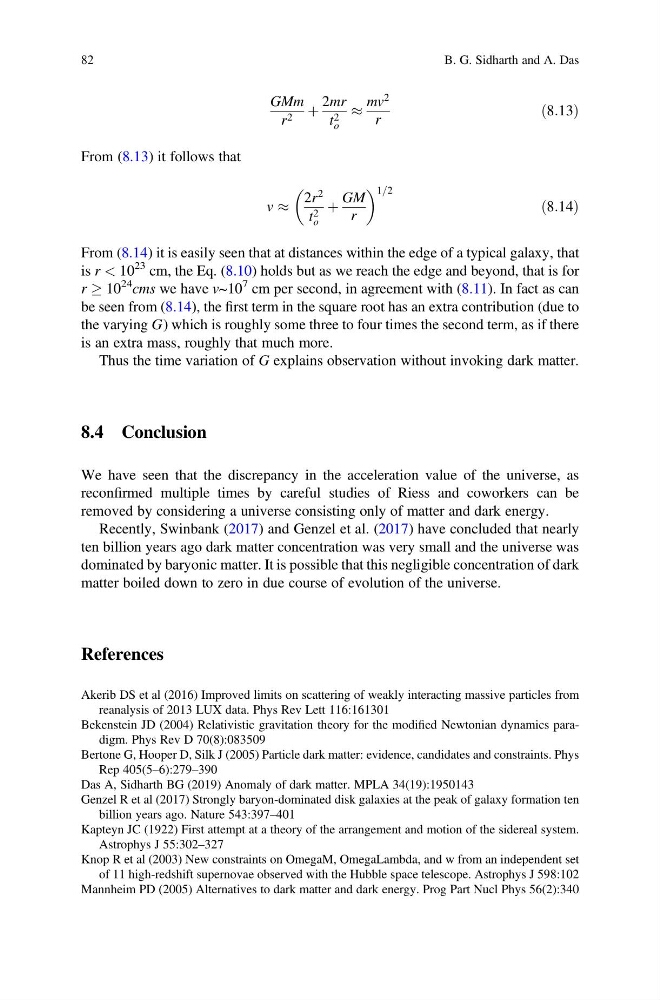
GMm
r 2 þ
2mr
t 2
o
%
mv
2
r
ð8:13Þ
From (8.13) it follows that
v %
2r
2
t 2
o
þ
GM
r
1=2
ð8:14Þ
From (8.14) it is easily seen that at distances within the edge of a typical galaxy, that
is r < 10
23 cm, the Eq. (8.10) holds but as we reach the edge and beyond, that is for
r ! 10
24 cms we have v~10
7 cm per second, in agreement with (8.11). In fact as can
be seen from (8.14), the first term in the square root has an extra contribution (due to
the varying G) which is roughly some three to four times the second term, as if there
is an extra mass, roughly that much more.
Thus the time variation of G explains observation without invoking dark matter.
8.4 Conclusion
We have seen that the discrepancy in the acceleration value of the universe, as
reconfirmed multiple times by careful studies of Riess and coworkers can be
removed by considering a universe consisting only of matter and dark energy.
Recently, Swinbank (2017) and Genzel et al. (2017) have concluded that nearly
ten billion years ago dark matter concentration was very small and the universe was
dominated by baryonic matter. It is possible that this negligible concentration of dark
matter boiled down to zero in due course of evolution of the universe.
References
Akerib DS et al (2016) Improved limits on scattering of weakly interacting massive particles from
reanalysis of 2013 LUX data. Phys Rev Lett 116:161301
Bekenstein JD (2004) Relativistic gravitation theory for the modified Newtonian dynamics paradigm. Phys Rev D 70(8):083509
Bertone G, Hooper D, Silk J (2005) Particle dark matter: evidence, candidates and constraints. Phys
Rep 405(5–6):279–390
Das A, Sidharth BG (2019) Anomaly of dark matter. MPLA 34(19):1950143
Genzel R et al (2017) Strongly baryon-dominated disk galaxies at the peak of galaxy formation ten
billion years ago. Nature 543:397–401
Kapteyn JC (1922) First attempt at a theory of the arrangement and motion of the sidereal system.
Astrophys J 55:302–327
Knop R et al (2003) New constraints on OmegaM, OmegaLambda, and w from an independent set
of 11 high-redshift supernovae observed with the Hubble space telescope. Astrophys J 598:102
Mannheim PD (2005) Alternatives to dark matter and dark energy. Prog Part Nucl Phys 56(2):340
82
B. G. Sidharth and A. Das
r 2 þ
2mr
t 2
o
%
mv
2
r
ð8:13Þ
From (8.13) it follows that
v %
2r
2
t 2
o
þ
GM
r
1=2
ð8:14Þ
From (8.14) it is easily seen that at distances within the edge of a typical galaxy, that
is r < 10
23 cm, the Eq. (8.10) holds but as we reach the edge and beyond, that is for
r ! 10
24 cms we have v~10
7 cm per second, in agreement with (8.11). In fact as can
be seen from (8.14), the first term in the square root has an extra contribution (due to
the varying G) which is roughly some three to four times the second term, as if there
is an extra mass, roughly that much more.
Thus the time variation of G explains observation without invoking dark matter.
8.4 Conclusion
We have seen that the discrepancy in the acceleration value of the universe, as
reconfirmed multiple times by careful studies of Riess and coworkers can be
removed by considering a universe consisting only of matter and dark energy.
Recently, Swinbank (2017) and Genzel et al. (2017) have concluded that nearly
ten billion years ago dark matter concentration was very small and the universe was
dominated by baryonic matter. It is possible that this negligible concentration of dark
matter boiled down to zero in due course of evolution of the universe.
References
Akerib DS et al (2016) Improved limits on scattering of weakly interacting massive particles from
reanalysis of 2013 LUX data. Phys Rev Lett 116:161301
Bekenstein JD (2004) Relativistic gravitation theory for the modified Newtonian dynamics paradigm. Phys Rev D 70(8):083509
Bertone G, Hooper D, Silk J (2005) Particle dark matter: evidence, candidates and constraints. Phys
Rep 405(5–6):279–390
Das A, Sidharth BG (2019) Anomaly of dark matter. MPLA 34(19):1950143
Genzel R et al (2017) Strongly baryon-dominated disk galaxies at the peak of galaxy formation ten
billion years ago. Nature 543:397–401
Kapteyn JC (1922) First attempt at a theory of the arrangement and motion of the sidereal system.
Astrophys J 55:302–327
Knop R et al (2003) New constraints on OmegaM, OmegaLambda, and w from an independent set
of 11 high-redshift supernovae observed with the Hubble space telescope. Astrophys J 598:102
Mannheim PD (2005) Alternatives to dark matter and dark energy. Prog Part Nucl Phys 56(2):340
82
B. G. Sidharth and A. Das