

nature, gravity is a residual or consequence of the other forces. In effect, the energy
left over from the rest of the universe radiating and expanding, and from quantum
fluctuations in the vacuum, supplies the force driving any two objects together. This
insight combines with the relation that as the universe expands it cools and the
observation that mixed gases undergo sequential liquefaction or fractionation when
cooled in this way. Different species condense at different rates or times. This is true
for the cosmos too. Condensed matter gives gravity something to act upon—surfaces
to push against and objects to push together—once the universe cools enough. We
see cohesive forces of fluids that make droplets bind together and coalesce—and the
quantum condensation of a BEC—are similar to gravity’s action upon matter. Dvali
and Gomez liken the quantum critical point of BEC formation to a Schwarzschild
event horizon, which is purely gravitational (having no charge or spin). Cosmology
shows that, regardless of the model we use, the universe employs this mechanism—
in its evolution to the present—where objects and forces congeal from the energy
soup of the early universe by phase transitions to become loci of action and
attraction.
A similar pattern occurs in pure Mathematics if we consider the geometrical
objects and spaces. Alain Connes, noted expert in non-commutative geometry, states
(2000) that if we examine the categories of forms and spaces, they form a hierarchy:
Sm > Top > Meas
here we see transitions as funnels constraining possibilities where smooth is the
largest category, topological forms and spaces a subset of those, and measurable
objects and spaces (which are most familiar) the most constrained. This is similar
(with some caveats) to the process described above; so we can write out in simile:
Gases > Liquids > Solids
Ideal gases are well-behaved or smooth. Liquids have a surface, so they are
topological, and solids have a constant shape and size, so they are measureable.
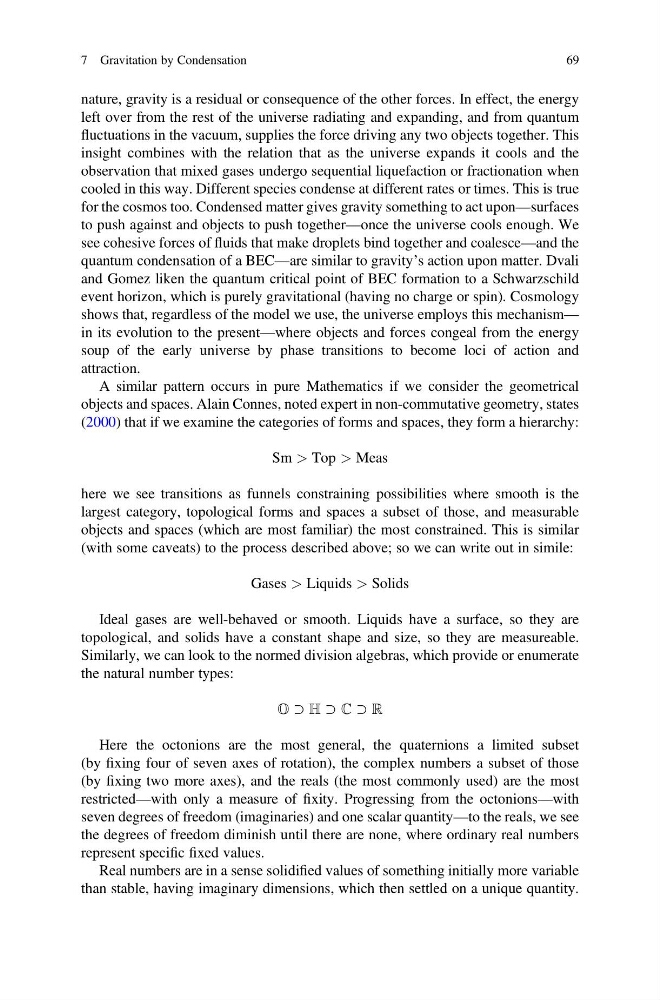
Similarly, we can look to the normed division algebras, which provide or enumerate
the natural number types:
⊃ ⊃ ⊃
Here the octonions are the most general, the quaternions a limited subset
(by fixing four of seven axes of rotation), the complex numbers a subset of those
(by fixing two more axes), and the reals (the most commonly used) are the most
restricted—with only a measure of fixity. Progressing from the octonions—with
seven degrees of freedom (imaginaries) and one scalar quantity—to the reals, we see
the degrees of freedom diminish until there are none, where ordinary real numbers
represent specific fixed values.
Real numbers are in a sense solidified values of something initially more variable
than stable, having imaginary dimensions, which then settled on a unique quantity.
7 Gravitation by Condensation
69
left over from the rest of the universe radiating and expanding, and from quantum
fluctuations in the vacuum, supplies the force driving any two objects together. This
insight combines with the relation that as the universe expands it cools and the
observation that mixed gases undergo sequential liquefaction or fractionation when
cooled in this way. Different species condense at different rates or times. This is true
for the cosmos too. Condensed matter gives gravity something to act upon—surfaces
to push against and objects to push together—once the universe cools enough. We
see cohesive forces of fluids that make droplets bind together and coalesce—and the
quantum condensation of a BEC—are similar to gravity’s action upon matter. Dvali
and Gomez liken the quantum critical point of BEC formation to a Schwarzschild
event horizon, which is purely gravitational (having no charge or spin). Cosmology
shows that, regardless of the model we use, the universe employs this mechanism—
in its evolution to the present—where objects and forces congeal from the energy
soup of the early universe by phase transitions to become loci of action and
attraction.
A similar pattern occurs in pure Mathematics if we consider the geometrical
objects and spaces. Alain Connes, noted expert in non-commutative geometry, states
(2000) that if we examine the categories of forms and spaces, they form a hierarchy:
Sm > Top > Meas
here we see transitions as funnels constraining possibilities where smooth is the
largest category, topological forms and spaces a subset of those, and measurable
objects and spaces (which are most familiar) the most constrained. This is similar
(with some caveats) to the process described above; so we can write out in simile:
Gases > Liquids > Solids
Ideal gases are well-behaved or smooth. Liquids have a surface, so they are
topological, and solids have a constant shape and size, so they are measureable.
Similarly, we can look to the normed division algebras, which provide or enumerate
the natural number types:
⊃ ⊃ ⊃
Here the octonions are the most general, the quaternions a limited subset
(by fixing four of seven axes of rotation), the complex numbers a subset of those
(by fixing two more axes), and the reals (the most commonly used) are the most
restricted—with only a measure of fixity. Progressing from the octonions—with
seven degrees of freedom (imaginaries) and one scalar quantity—to the reals, we see
the degrees of freedom diminish until there are none, where ordinary real numbers
represent specific fixed values.
Real numbers are in a sense solidified values of something initially more variable
than stable, having imaginary dimensions, which then settled on a unique quantity.
7 Gravitation by Condensation
69