

E ¼ eV
Again, if the uncertainty in energy is given by ΔE and the uncertainty in time is
given by Δt then we can write
ΔE:Δt ¼ e
2 V=I % h
Now, exploiting relation (6.1) we have
ΔE:Δt ¼ e
2 G % h
ð6:2Þ
Now, we know that the chemical potential of an electron is given as
μ ¼ δE=δN
where ‘N’ is the number of electrons. Suppose, that ΔE represents the uncertainty in
the energy and ΔN does the uncertainty in the electron concentration, then we may
write
μ ¼ ΔE=ΔN
Again, consider that the Fermi velocity of an electron can be expressed as
v f ¼ Δx=Δt
where we assume that Δx is the uncertainty in the position of the electron. Therefore,
using the last two equations in relation (6.2) we derive
Δx:ΔN
μ
v f
¼ e
2
=G
ð6:3Þ
Now, let the uncertainty in momentum be expressed as
Δp x ¼ Δmv f
where the uncertainty in the mass arises due to the magnetic field that arises due to
the electric field. Now, it has been found recently (Liu et al. 2016) that a magnetic
field can impart mass to an electron. We are merely exploiting that phenomenon.
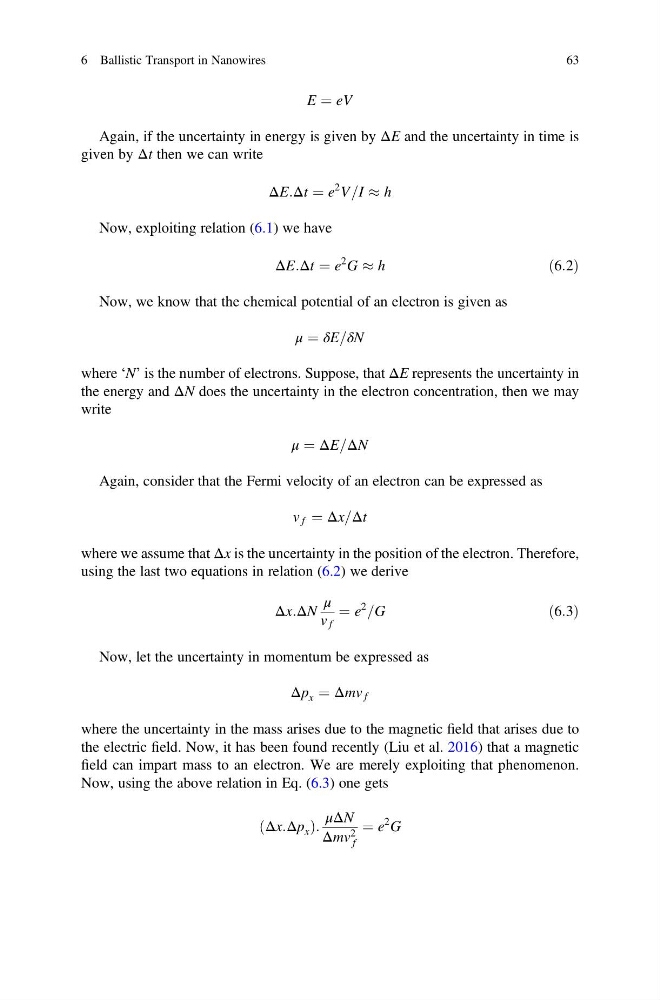
Now, using the above relation in Eq. (6.3) one gets
Δx:Δp x
ð
Þ:
μΔN
Δmv 2
f
¼ e
2 G
6 Ballistic Transport in Nanowires
63
Again, if the uncertainty in energy is given by ΔE and the uncertainty in time is
given by Δt then we can write
ΔE:Δt ¼ e
2 V=I % h
Now, exploiting relation (6.1) we have
ΔE:Δt ¼ e
2 G % h
ð6:2Þ
Now, we know that the chemical potential of an electron is given as
μ ¼ δE=δN
where ‘N’ is the number of electrons. Suppose, that ΔE represents the uncertainty in
the energy and ΔN does the uncertainty in the electron concentration, then we may
write
μ ¼ ΔE=ΔN
Again, consider that the Fermi velocity of an electron can be expressed as
v f ¼ Δx=Δt
where we assume that Δx is the uncertainty in the position of the electron. Therefore,
using the last two equations in relation (6.2) we derive
Δx:ΔN
μ
v f
¼ e
2
=G
ð6:3Þ
Now, let the uncertainty in momentum be expressed as
Δp x ¼ Δmv f
where the uncertainty in the mass arises due to the magnetic field that arises due to
the electric field. Now, it has been found recently (Liu et al. 2016) that a magnetic
field can impart mass to an electron. We are merely exploiting that phenomenon.
Now, using the above relation in Eq. (6.3) one gets
Δx:Δp x
ð
Þ:
μΔN
Δmv 2
f
¼ e
2 G
6 Ballistic Transport in Nanowires
63