

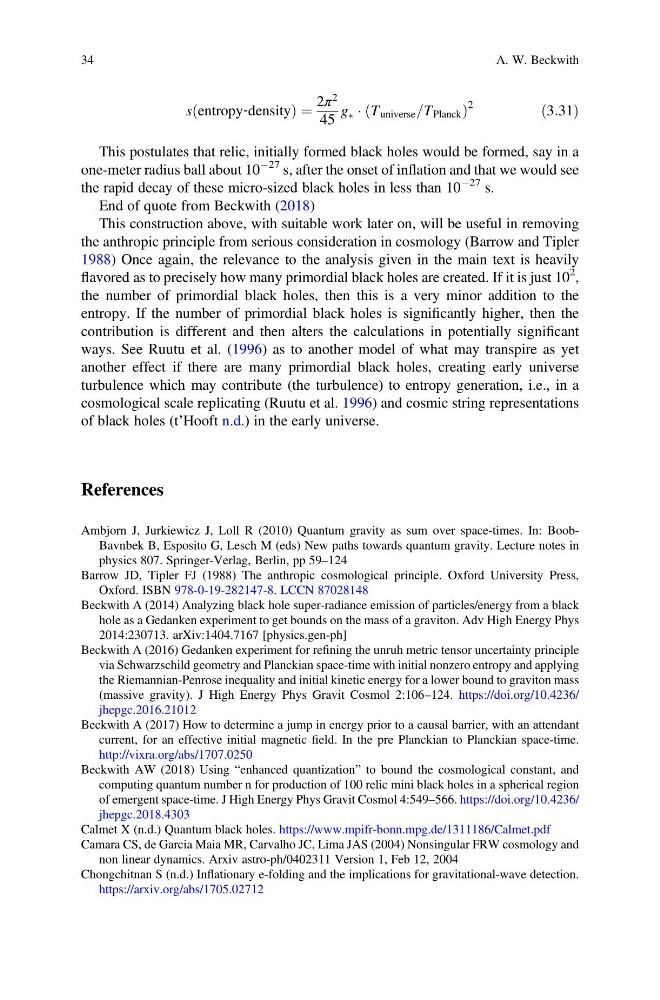
s entropy‐density
ð
Þ ¼
2π
2
45
g à Á T universe =T Planck
ð
Þ
2
ð3:31Þ
This postulates that relic, initially formed black holes would be formed, say in a
one-meter radius ball about 10
À27 s, after the onset of inflation and that we would see
the rapid decay of these micro-sized black holes in less than 10
À27 s.
End of quote from Beckwith (2018)
This construction above, with suitable work later on, will be useful in removing
the anthropic principle from serious consideration in cosmology (Barrow and Tipler
1988) Once again, the relevance to the analysis given in the main text is heavily
flavored as to precisely how many primordial black holes are created. If it is just 10
2 ,
the number of primordial black holes, then this is a very minor addition to the
entropy. If the number of primordial black holes is significantly higher, then the
contribution is different and then alters the calculations in potentially significant
ways. See Ruutu et al. (1996) as to another model of what may transpire as yet
another effect if there are many primordial black holes, creating early universe
turbulence which may contribute (the turbulence) to entropy generation, i.e., in a
cosmological scale replicating (Ruutu et al. 1996) and cosmic string representations
of black holes (t’Hooft n.d.) in the early universe.
References
Ambjorn J, Jurkiewicz J, Loll R (2010) Quantum gravity as sum over space-times. In: BoobBavnbek B, Esposito G, Lesch M (eds) New paths towards quantum gravity. Lecture notes in
physics 807. Springer-Verlag, Berlin, pp 59–124
Barrow JD, Tipler FJ (1988) The anthropic cosmological principle. Oxford University Press,
Oxford. ISBN 978-0-19-282147-8. LCCN 87028148
Beckwith A (2014) Analyzing black hole super-radiance emission of particles/energy from a black
hole as a Gedanken experiment to get bounds on the mass of a graviton. Adv High Energy Phys
2014:230713. arXiv:1404.7167 [physics.gen-ph]
Beckwith A (2016) Gedanken experiment for refining the unruh metric tensor uncertainty principle
via Schwarzschild geometry and Planckian space-time with initial nonzero entropy and applying
the Riemannian-Penrose inequality and initial kinetic energy for a lower bound to graviton mass
(massive gravity). J High Energy Phys Gravit Cosmol 2:106–124. https://doi.org/10.4236/
jhepgc.2016.21012
Beckwith A (2017) How to determine a jump in energy prior to a causal barrier, with an attendant
current, for an effective initial magnetic field. In the pre Planckian to Planckian space-time.
http://vixra.org/abs/1707.0250
Beckwith AW (2018) Using “enhanced quantization” to bound the cosmological constant, and
computing quantum number n for production of 100 relic mini black holes in a spherical region
of emergent space-time. J High Energy Phys Gravit Cosmol 4:549–566. https://doi.org/10.4236/
jhepgc.2018.4303
Calmet X (n.d.) Quantum black holes. https://www.mpifr-bonn.mpg.de/1311186/Calmet.pdf
Camara CS, de Garcia Maia MR, Carvalho JC, Lima JAS (2004) Nonsingular FRW cosmology and
non linear dynamics. Arxiv astro-ph/0402311 Version 1, Feb 12, 2004
Chongchitnan S (n.d.) Inflationary e-folding and the implications for gravitational-wave detection.
https://arxiv.org/abs/1705.02712
34
A. W. Beckwith
ð
Þ ¼
2π
2
45
g à Á T universe =T Planck
ð
Þ
2
ð3:31Þ
This postulates that relic, initially formed black holes would be formed, say in a
one-meter radius ball about 10
À27 s, after the onset of inflation and that we would see
the rapid decay of these micro-sized black holes in less than 10
À27 s.
End of quote from Beckwith (2018)
This construction above, with suitable work later on, will be useful in removing
the anthropic principle from serious consideration in cosmology (Barrow and Tipler
1988) Once again, the relevance to the analysis given in the main text is heavily
flavored as to precisely how many primordial black holes are created. If it is just 10
2 ,
the number of primordial black holes, then this is a very minor addition to the
entropy. If the number of primordial black holes is significantly higher, then the
contribution is different and then alters the calculations in potentially significant
ways. See Ruutu et al. (1996) as to another model of what may transpire as yet
another effect if there are many primordial black holes, creating early universe
turbulence which may contribute (the turbulence) to entropy generation, i.e., in a
cosmological scale replicating (Ruutu et al. 1996) and cosmic string representations
of black holes (t’Hooft n.d.) in the early universe.
References
Ambjorn J, Jurkiewicz J, Loll R (2010) Quantum gravity as sum over space-times. In: BoobBavnbek B, Esposito G, Lesch M (eds) New paths towards quantum gravity. Lecture notes in
physics 807. Springer-Verlag, Berlin, pp 59–124
Barrow JD, Tipler FJ (1988) The anthropic cosmological principle. Oxford University Press,
Oxford. ISBN 978-0-19-282147-8. LCCN 87028148
Beckwith A (2014) Analyzing black hole super-radiance emission of particles/energy from a black
hole as a Gedanken experiment to get bounds on the mass of a graviton. Adv High Energy Phys
2014:230713. arXiv:1404.7167 [physics.gen-ph]
Beckwith A (2016) Gedanken experiment for refining the unruh metric tensor uncertainty principle
via Schwarzschild geometry and Planckian space-time with initial nonzero entropy and applying
the Riemannian-Penrose inequality and initial kinetic energy for a lower bound to graviton mass
(massive gravity). J High Energy Phys Gravit Cosmol 2:106–124. https://doi.org/10.4236/
jhepgc.2016.21012
Beckwith A (2017) How to determine a jump in energy prior to a causal barrier, with an attendant
current, for an effective initial magnetic field. In the pre Planckian to Planckian space-time.
http://vixra.org/abs/1707.0250
Beckwith AW (2018) Using “enhanced quantization” to bound the cosmological constant, and
computing quantum number n for production of 100 relic mini black holes in a spherical region
of emergent space-time. J High Energy Phys Gravit Cosmol 4:549–566. https://doi.org/10.4236/
jhepgc.2018.4303
Calmet X (n.d.) Quantum black holes. https://www.mpifr-bonn.mpg.de/1311186/Calmet.pdf
Camara CS, de Garcia Maia MR, Carvalho JC, Lima JAS (2004) Nonsingular FRW cosmology and
non linear dynamics. Arxiv astro-ph/0402311 Version 1, Feb 12, 2004
Chongchitnan S (n.d.) Inflationary e-folding and the implications for gravitational-wave detection.
https://arxiv.org/abs/1705.02712
34
A. W. Beckwith