

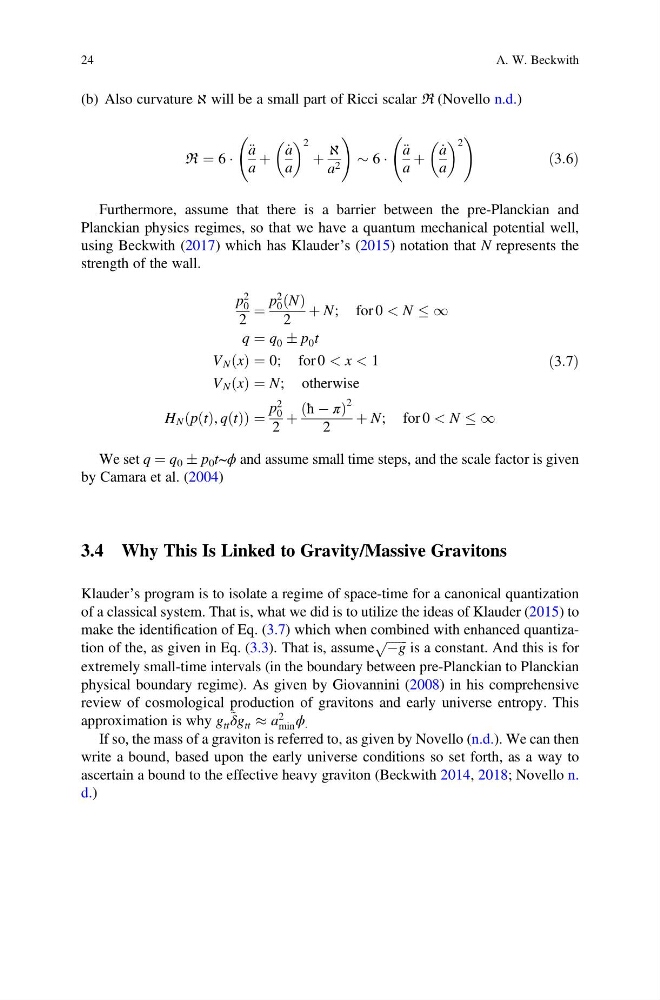
(b) Also curvature ℵ will be a small part of Ricci scalar ℜ (Novello n.d.)
ℜ ¼ 6 Á
€ a
a
þ
_
a
a
2
þ
ℵ
a 2
!
$ 6 Á
€ a
a
þ
_
a
a
2
!
ð3:6Þ
Furthermore, assume that there is a barrier between the pre-Planckian and
Planckian physics regimes, so that we have a quantum mechanical potential well,
using Beckwith (2017) which has Klauder’s (2015) notation that N represents the
strength of the wall.
p
2
0
2
¼
p
2
0 N
ð Þ
2
þ N; for 0 < N 1
q ¼ q 0 Æ p 0 t
V N x
ð Þ ¼ 0; for 0 < x < 1
V N x
ð Þ ¼ N; otherwise
H N p t
ð Þ, q t
ð Þ
ð
Þ¼
p
2
0
2
þ
ħ À π
ð
Þ
2
2
þ N; for 0 < N 1
ð3:7Þ
We set q ¼ q 0 Æ p 0 t~ϕ and assume small time steps, and the scale factor is given
by Camara et al. (2004)
3.4 Why This Is Linked to Gravity/Massive Gravitons
Klauder’s program is to isolate a regime of space-time for a canonical quantization
of a classical system. That is, what we did is to utilize the ideas of Klauder (2015) to
make the identification of Eq. (3.7) which when combined with enhanced quantization of the, as given in Eq. (3.3). That is, assume
ffiffiffiffiffiffi ffi
Àg
p
is a constant. And this is for
extremely small-time intervals (in the boundary between pre-Planckian to Planckian
physical boundary regime). As given by Giovannini (2008) in his comprehensive
review of cosmological production of gravitons and early universe entropy. This
approximation is why g tt ~ δg tt % a
2
min ϕ .
If so, the mass of a graviton is referred to, as given by Novello (n.d.). We can then
write a bound, based upon the early universe conditions so set forth, as a way to
ascertain a bound to the effective heavy graviton (Beckwith 2014, 2018; Novello n.
d.)
24
A. W. Beckwith
ℜ ¼ 6 Á
€ a
a
þ
_
a
a
2
þ
ℵ
a 2
!
$ 6 Á
€ a
a
þ
_
a
a
2
!
ð3:6Þ
Furthermore, assume that there is a barrier between the pre-Planckian and
Planckian physics regimes, so that we have a quantum mechanical potential well,
using Beckwith (2017) which has Klauder’s (2015) notation that N represents the
strength of the wall.
p
2
0
2
¼
p
2
0 N
ð Þ
2
þ N; for 0 < N 1
q ¼ q 0 Æ p 0 t
V N x
ð Þ ¼ 0; for 0 < x < 1
V N x
ð Þ ¼ N; otherwise
H N p t
ð Þ, q t
ð Þ
ð
Þ¼
p
2
0
2
þ
ħ À π
ð
Þ
2
2
þ N; for 0 < N 1
ð3:7Þ
We set q ¼ q 0 Æ p 0 t~ϕ and assume small time steps, and the scale factor is given
by Camara et al. (2004)
3.4 Why This Is Linked to Gravity/Massive Gravitons
Klauder’s program is to isolate a regime of space-time for a canonical quantization
of a classical system. That is, what we did is to utilize the ideas of Klauder (2015) to
make the identification of Eq. (3.7) which when combined with enhanced quantization of the, as given in Eq. (3.3). That is, assume
ffiffiffiffiffiffi ffi
Àg
p
is a constant. And this is for
extremely small-time intervals (in the boundary between pre-Planckian to Planckian
physical boundary regime). As given by Giovannini (2008) in his comprehensive
review of cosmological production of gravitons and early universe entropy. This
approximation is why g tt ~ δg tt % a
2
min ϕ .
If so, the mass of a graviton is referred to, as given by Novello (n.d.). We can then
write a bound, based upon the early universe conditions so set forth, as a way to
ascertain a bound to the effective heavy graviton (Beckwith 2014, 2018; Novello n.
d.)
24
A. W. Beckwith