

3.1 Basic Idea, Can Two First Integrals Give Equivalent
Information? This Is Due to the First Reference
We use a construction for a mass of a graviton from Beckwith (2018). Instead of
Hamber’s (Beckwith 2018; Hamber 2009) first integral, we use what John Klauder
wrote in Klauder (2015) to form a first integral in Beckwith (2018) so as to make a
1 to 1 equivalence with the first integral of general relativity (Dalarsson and
Dalarsson 2005; Weinberg 1972). As in Beckwith (2018) we have a 1 to 1 relationship between two first action integrals. We avoid starting with a cosmic singularity,
and use the cosmic bounce, as given in Rovelli and Vidotto (2015). In doing so, from
Beckwith (2017, 2018) we use a barrier between interior and exterior space-time, to
set up a cosmological constant. Our goal is to set up arguments which have no
connection to the anthropic principle (Barrow and Tipler 1988) which the author
regards as crackpot science of the worst sort. Having a clean break from the
anthropic principle is a main goal of our enterprise.
3.1.1 This Is Our Argument for the GR First Integral: From
Beckwith (2018)
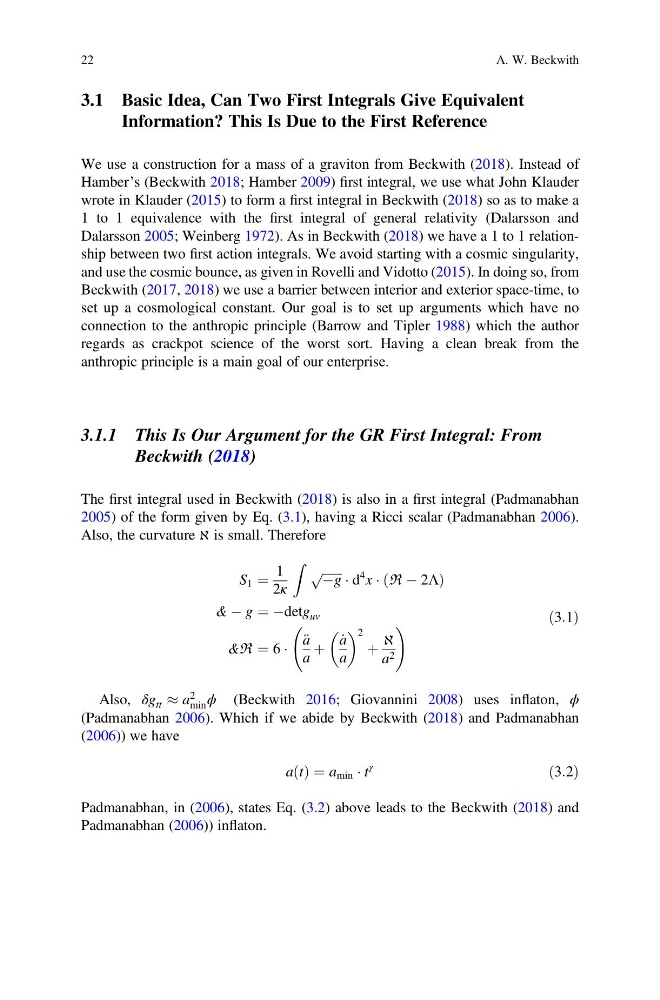
The first integral used in Beckwith (2018) is also in a first integral (Padmanabhan
2005) of the form given by Eq. (3.1), having a Ricci scalar (Padmanabhan 2006).
Also, the curvature ℵ is small. Therefore
S 1 ¼
1
2κ
Z ffiffiffiffiffiffi ffi
Àg
p Á d
4 x Á ℜ À 2Λ
ð
Þ
& À g ¼ Àdetg uv
&ℜ ¼ 6 Á
€ a
a
þ
_
a
a
2
þ
ℵ
a 2
!
ð3:1Þ
Also, δg tt % a
2
min ϕ (Beckwith 2016; Giovannini 2008) uses inflaton, ϕ
(Padmanabhan 2006). Which if we abide by Beckwith (2018) and Padmanabhan
(2006)) we have
a t
ð Þ ¼ a min Á t
γ
ð3:2Þ
Padmanabhan, in (2006), states Eq. (3.2) above leads to the Beckwith (2018) and
Padmanabhan (2006)) inflaton.
22
A. W. Beckwith
Information? This Is Due to the First Reference
We use a construction for a mass of a graviton from Beckwith (2018). Instead of
Hamber’s (Beckwith 2018; Hamber 2009) first integral, we use what John Klauder
wrote in Klauder (2015) to form a first integral in Beckwith (2018) so as to make a
1 to 1 equivalence with the first integral of general relativity (Dalarsson and
Dalarsson 2005; Weinberg 1972). As in Beckwith (2018) we have a 1 to 1 relationship between two first action integrals. We avoid starting with a cosmic singularity,
and use the cosmic bounce, as given in Rovelli and Vidotto (2015). In doing so, from
Beckwith (2017, 2018) we use a barrier between interior and exterior space-time, to
set up a cosmological constant. Our goal is to set up arguments which have no
connection to the anthropic principle (Barrow and Tipler 1988) which the author
regards as crackpot science of the worst sort. Having a clean break from the
anthropic principle is a main goal of our enterprise.
3.1.1 This Is Our Argument for the GR First Integral: From
Beckwith (2018)
The first integral used in Beckwith (2018) is also in a first integral (Padmanabhan
2005) of the form given by Eq. (3.1), having a Ricci scalar (Padmanabhan 2006).
Also, the curvature ℵ is small. Therefore
S 1 ¼
1
2κ
Z ffiffiffiffiffiffi ffi
Àg
p Á d
4 x Á ℜ À 2Λ
ð
Þ
& À g ¼ Àdetg uv
&ℜ ¼ 6 Á
€ a
a
þ
_
a
a
2
þ
ℵ
a 2
!
ð3:1Þ
Also, δg tt % a
2
min ϕ (Beckwith 2016; Giovannini 2008) uses inflaton, ϕ
(Padmanabhan 2006). Which if we abide by Beckwith (2018) and Padmanabhan
(2006)) we have
a t
ð Þ ¼ a min Á t
γ
ð3:2Þ
Padmanabhan, in (2006), states Eq. (3.2) above leads to the Beckwith (2018) and
Padmanabhan (2006)) inflaton.
22
A. W. Beckwith