

E
2
À p
2
À m
2
þ αl
2 p
4
¼ 0
ð2:3Þ
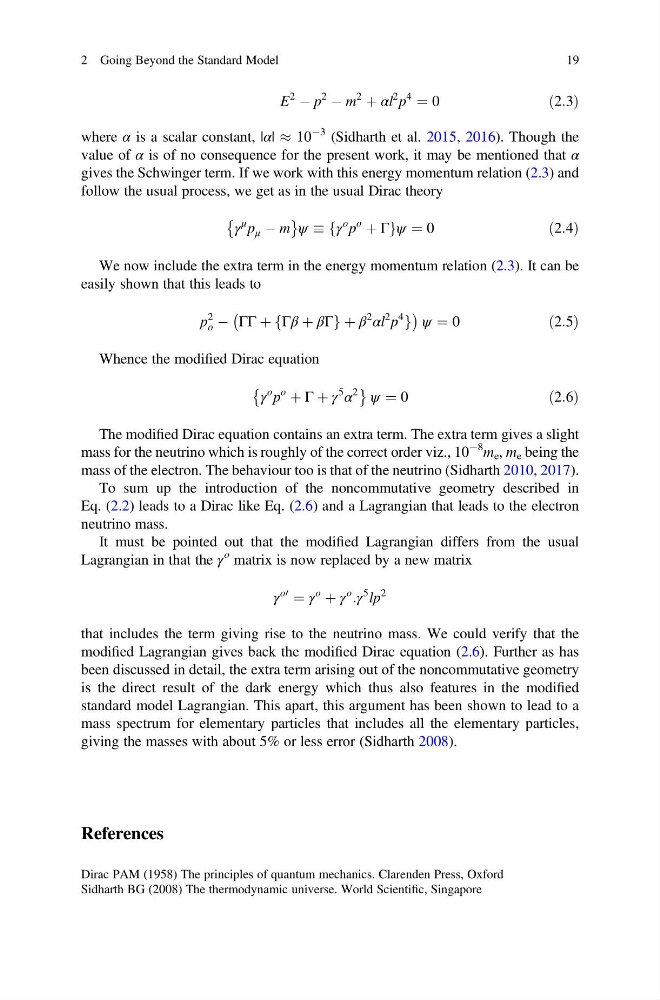
where α is a scalar constant, |α| % 10
À3 (Sidharth et al. 2015, 2016). Though the
value of α is of no consequence for the present work, it may be mentioned that α
gives the Schwinger term. If we work with this energy momentum relation (2.3) and
follow the usual process, we get as in the usual Dirac theory
γ
μ p μ À m
È
É ψ γ
o p
o
þ Γ
f
g ψ ¼ 0
ð2:4Þ
We now include the extra term in the energy momentum relation (2.3). It can be
easily shown that this leads to
p
2
o À ΓΓ þ Γβ þ βΓ
f
gþβ
2
αl
2 p
4
g
À
Á ψ ¼ 0
ð2:5Þ
Whence the modified Dirac equation
γ
o p
o
þ Γ þ γ
5
α
2
È
É ψ ¼ 0
ð2:6Þ
The modified Dirac equation contains an extra term. The extra term gives a slight
mass for the neutrino which is roughly of the correct order viz., 10
À8 m e , m e being the
mass of the electron. The behaviour too is that of the neutrino (Sidharth 2010, 2017).
To sum up the introduction of the noncommutative geometry described in
Eq. (2.2) leads to a Dirac like Eq. (2.6) and a Lagrangian that leads to the electron
neutrino mass.
It must be pointed out that the modified Lagrangian differs from the usual
Lagrangian in that the γ
o matrix is now replaced by a new matrix
γ
o0
¼ γ
o
þ γ
o
:γ
5 lp
2
that includes the term giving rise to the neutrino mass. We could verify that the
modified Lagrangian gives back the modified Dirac equation (2.6). Further as has
been discussed in detail, the extra term arising out of the noncommutative geometry
is the direct result of the dark energy which thus also features in the modified
standard model Lagrangian. This apart, this argument has been shown to lead to a
mass spectrum for elementary particles that includes all the elementary particles,
giving the masses with about 5% or less error (Sidharth 2008).
References
Dirac PAM (1958) The principles of quantum mechanics. Clarenden Press, Oxford
Sidharth BG (2008) The thermodynamic universe. World Scientific, Singapore
2 Going Beyond the Standard Model
19
2
À p
2
À m
2
þ αl
2 p
4
¼ 0
ð2:3Þ
where α is a scalar constant, |α| % 10
À3 (Sidharth et al. 2015, 2016). Though the
value of α is of no consequence for the present work, it may be mentioned that α
gives the Schwinger term. If we work with this energy momentum relation (2.3) and
follow the usual process, we get as in the usual Dirac theory
γ
μ p μ À m
È
É ψ γ
o p
o
þ Γ
f
g ψ ¼ 0
ð2:4Þ
We now include the extra term in the energy momentum relation (2.3). It can be
easily shown that this leads to
p
2
o À ΓΓ þ Γβ þ βΓ
f
gþβ
2
αl
2 p
4
g
À
Á ψ ¼ 0
ð2:5Þ
Whence the modified Dirac equation
γ
o p
o
þ Γ þ γ
5
α
2
È
É ψ ¼ 0
ð2:6Þ
The modified Dirac equation contains an extra term. The extra term gives a slight
mass for the neutrino which is roughly of the correct order viz., 10
À8 m e , m e being the
mass of the electron. The behaviour too is that of the neutrino (Sidharth 2010, 2017).
To sum up the introduction of the noncommutative geometry described in
Eq. (2.2) leads to a Dirac like Eq. (2.6) and a Lagrangian that leads to the electron
neutrino mass.
It must be pointed out that the modified Lagrangian differs from the usual
Lagrangian in that the γ
o matrix is now replaced by a new matrix
γ
o0
¼ γ
o
þ γ
o
:γ
5 lp
2
that includes the term giving rise to the neutrino mass. We could verify that the
modified Lagrangian gives back the modified Dirac equation (2.6). Further as has
been discussed in detail, the extra term arising out of the noncommutative geometry
is the direct result of the dark energy which thus also features in the modified
standard model Lagrangian. This apart, this argument has been shown to lead to a
mass spectrum for elementary particles that includes all the elementary particles,
giving the masses with about 5% or less error (Sidharth 2008).
References
Dirac PAM (1958) The principles of quantum mechanics. Clarenden Press, Oxford
Sidharth BG (2008) The thermodynamic universe. World Scientific, Singapore
2 Going Beyond the Standard Model
19