

21.3 Methodology and Materials
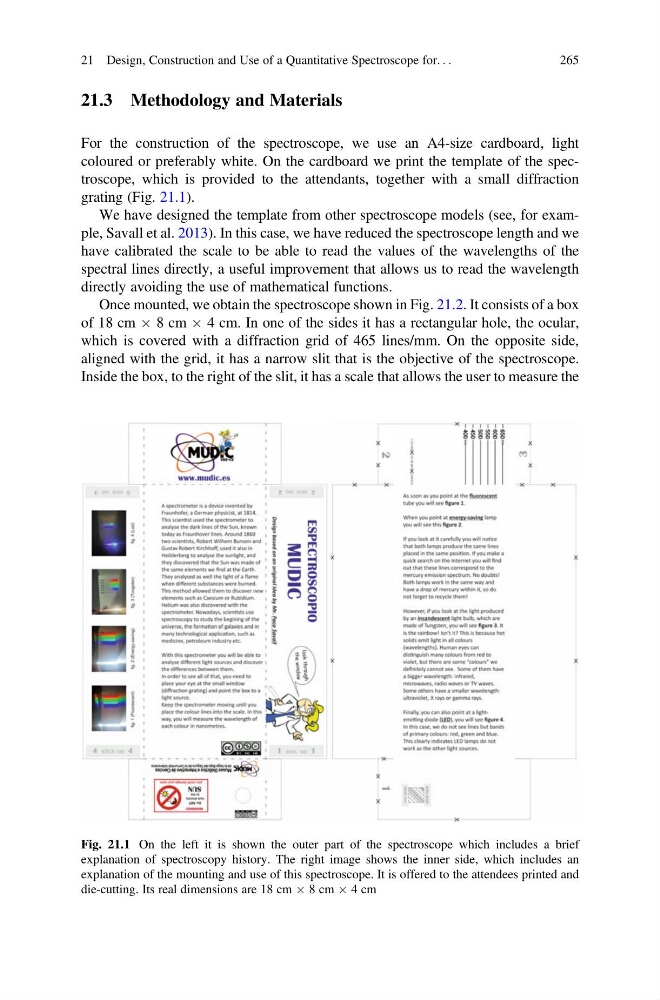
For the construction of the spectroscope, we use an A4-size cardboard, light
coloured or preferably white. On the cardboard we print the template of the spectroscope, which is provided to the attendants, together with a small diffraction
grating (Fig. 21.1).
We have designed the template from other spectroscope models (see, for example, Savall et al. 2013). In this case, we have reduced the spectroscope length and we
have calibrated the scale to be able to read the values of the wavelengths of the
spectral lines directly, a useful improvement that allows us to read the wavelength
directly avoiding the use of mathematical functions.
Once mounted, we obtain the spectroscope shown in Fig. 21.2. It consists of a box
of 18 cm  8 cm  4 cm. In one of the sides it has a rectangular hole, the ocular,
which is covered with a diffraction grid of 465 lines/mm. On the opposite side,
aligned with the grid, it has a narrow slit that is the objective of the spectroscope.
Inside the box, to the right of the slit, it has a scale that allows the user to measure the
Fig. 21.1 On the left it is shown the outer part of the spectroscope which includes a brief
explanation of spectroscopy history. The right image shows the inner side, which includes an
explanation of the mounting and use of this spectroscope. It is offered to the attendees printed and
die-cutting. Its real dimensions are 18 cm  8 cm  4 cm
21 Design, Construction and Use of a Quantitative Spectroscope for. . .
265
For the construction of the spectroscope, we use an A4-size cardboard, light
coloured or preferably white. On the cardboard we print the template of the spectroscope, which is provided to the attendants, together with a small diffraction
grating (Fig. 21.1).
We have designed the template from other spectroscope models (see, for example, Savall et al. 2013). In this case, we have reduced the spectroscope length and we
have calibrated the scale to be able to read the values of the wavelengths of the
spectral lines directly, a useful improvement that allows us to read the wavelength
directly avoiding the use of mathematical functions.
Once mounted, we obtain the spectroscope shown in Fig. 21.2. It consists of a box
of 18 cm  8 cm  4 cm. In one of the sides it has a rectangular hole, the ocular,
which is covered with a diffraction grid of 465 lines/mm. On the opposite side,
aligned with the grid, it has a narrow slit that is the objective of the spectroscope.
Inside the box, to the right of the slit, it has a scale that allows the user to measure the
Fig. 21.1 On the left it is shown the outer part of the spectroscope which includes a brief
explanation of spectroscopy history. The right image shows the inner side, which includes an
explanation of the mounting and use of this spectroscope. It is offered to the attendees printed and
die-cutting. Its real dimensions are 18 cm  8 cm  4 cm
21 Design, Construction and Use of a Quantitative Spectroscope for. . .
265