

Acknowledgements The authors would like to thank: the graphic artist Ben Satchel for his
beautiful drawings, the editor and proof-reader Bridget Leary-Georgiadi for her valuable contributions, as well as the Chaos’ researcher and teacher Kostas Karamanos for the important and
delightful discussions that we shared about chaotic systems!
20.6 Appendix
The exact excerpts from Poincaré and Lorentz, used in the teaching sequence.
20.6.1 Extract from Poincaré
. . .it seems that chance alone will decide. If the cone were perfectly symmetrical, if
its axis were perfectly vertical, if it were subject to no other force but gravity, it
would not fall at all. But the slightest defect of symmetry will make it lean slightly to
one side or other, and as soon as it leans, be it ever so little, it will fall altogether to
that side. Even if the symmetry is perfect, a very slight trepidation, or a breath of air,
may make it incline a few seconds of arc, and that will be enough to determine its fall
and even the direction of its fall, which will be that of the original inclination.
A very small cause which escapes our notice determines a considerable effect that
we cannot fail to see, and then we say that that effect is due to chance. If we knew
exactly the laws of nature and the situation of the universe at the initial moment, we
could predict exactly the situation of that same universe at a succeeding moment.
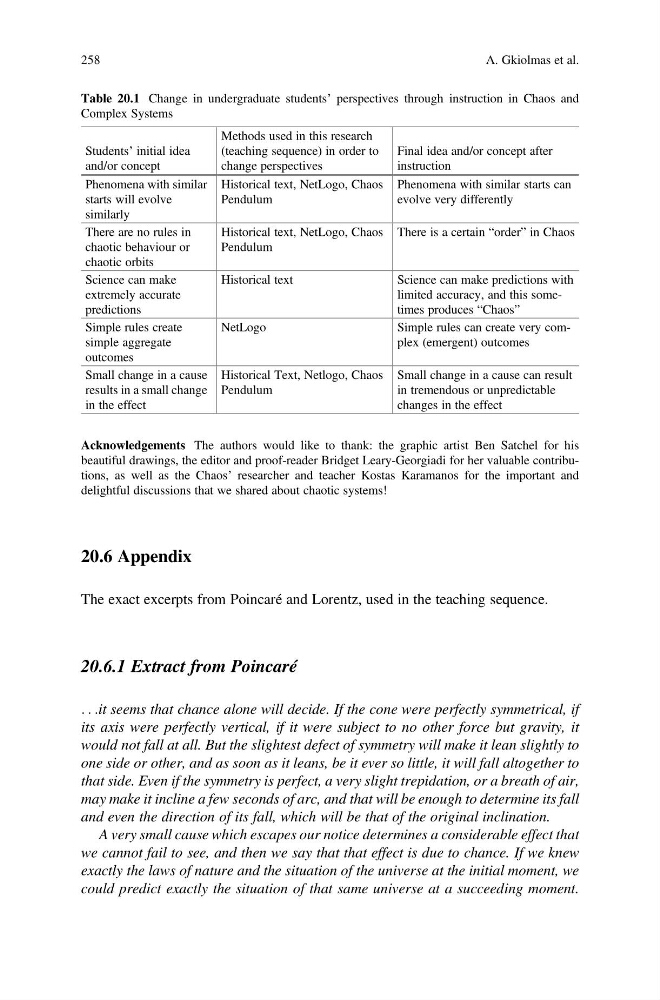
Table 20.1 Change in undergraduate students’ perspectives through instruction in Chaos and
Complex Systems
Students’ initial idea
and/or concept
Methods used in this research
(teaching sequence) in order to
change perspectives
Final idea and/or concept after
instruction
Phenomena with similar
starts will evolve
similarly
Historical text, NetLogo, Chaos
Pendulum
Phenomena with similar starts can
evolve very differently
There are no rules in
chaotic behaviour or
chaotic orbits
Historical text, NetLogo, Chaos
Pendulum
There is a certain “order” in Chaos
Science can make
extremely accurate
predictions
Historical text
Science can make predictions with
limited accuracy, and this sometimes produces “Chaos”
Simple rules create
simple aggregate
outcomes
NetLogo
Simple rules can create very complex (emergent) outcomes
Small change in a cause
results in a small change
in the effect
Historical Text, Netlogo, Chaos
Pendulum
Small change in a cause can result
in tremendous or unpredictable
changes in the effect
258
A. Gkiolmas et al.
beautiful drawings, the editor and proof-reader Bridget Leary-Georgiadi for her valuable contributions, as well as the Chaos’ researcher and teacher Kostas Karamanos for the important and
delightful discussions that we shared about chaotic systems!
20.6 Appendix
The exact excerpts from Poincaré and Lorentz, used in the teaching sequence.
20.6.1 Extract from Poincaré
. . .it seems that chance alone will decide. If the cone were perfectly symmetrical, if
its axis were perfectly vertical, if it were subject to no other force but gravity, it
would not fall at all. But the slightest defect of symmetry will make it lean slightly to
one side or other, and as soon as it leans, be it ever so little, it will fall altogether to
that side. Even if the symmetry is perfect, a very slight trepidation, or a breath of air,
may make it incline a few seconds of arc, and that will be enough to determine its fall
and even the direction of its fall, which will be that of the original inclination.
A very small cause which escapes our notice determines a considerable effect that
we cannot fail to see, and then we say that that effect is due to chance. If we knew
exactly the laws of nature and the situation of the universe at the initial moment, we
could predict exactly the situation of that same universe at a succeeding moment.
Table 20.1 Change in undergraduate students’ perspectives through instruction in Chaos and
Complex Systems
Students’ initial idea
and/or concept
Methods used in this research
(teaching sequence) in order to
change perspectives
Final idea and/or concept after
instruction
Phenomena with similar
starts will evolve
similarly
Historical text, NetLogo, Chaos
Pendulum
Phenomena with similar starts can
evolve very differently
There are no rules in
chaotic behaviour or
chaotic orbits
Historical text, NetLogo, Chaos
Pendulum
There is a certain “order” in Chaos
Science can make
extremely accurate
predictions
Historical text
Science can make predictions with
limited accuracy, and this sometimes produces “Chaos”
Simple rules create
simple aggregate
outcomes
NetLogo
Simple rules can create very complex (emergent) outcomes
Small change in a cause
results in a small change
in the effect
Historical Text, Netlogo, Chaos
Pendulum
Small change in a cause can result
in tremendous or unpredictable
changes in the effect
258
A. Gkiolmas et al.