

20.2 The Learning Subjects of This Teaching Method
The persons chosen here for instruction in Chaos are prospective primary school
teachers (undergraduate students). This is an audience that possesses a mathematical
and scientific background but is of great research interest, we believe, because these
are the individuals who will transfer knowledge and stances about scientific fields to
primary school students, thus placing the foundations for the latter’s affection for
and understanding of Science.
Additionally, it is considered a challenge to instruct in Chaos using extremely
limited mathematical formulation and Physics terminology. A teaching sequence
must therefore be created which relies on optical representations, simulations,
activities and narrations.
20.3 Methodology and Tools of Instruction
Central to the methodology are texts and documents written by scientists themselves
on facing Chaos for the first time. The two scientists studied for this purpose are
Poincaré and Lorenz (Poincaré 1914, 2017a; Diacu 1996; Lorenz 2005a). Using
these resources, students are guided to the contradictions, the gridlocks, the unexpected facts and the inexplicable results that led the scientists to the new scientific
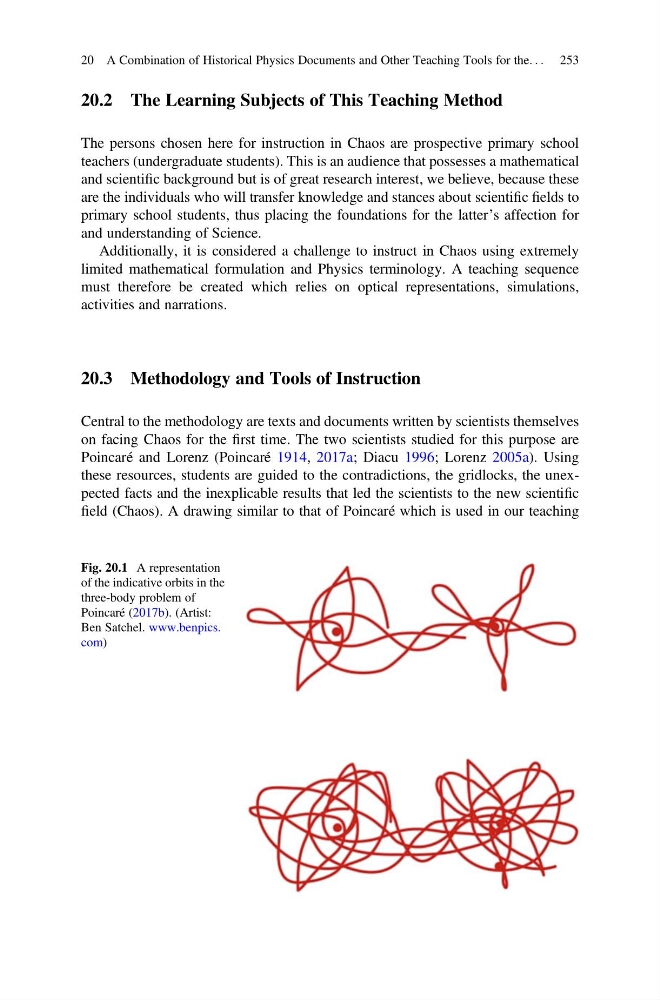
field (Chaos). A drawing similar to that of Poincaré which is used in our teaching
Fig. 20.1 A representation
of the indicative orbits in the
three-body problem of
Poincaré (2017b). (Artist:
Ben Satchel. www.benpics.
com)
20 A Combination of Historical Physics Documents and Other Teaching Tools for the. . . 253
The persons chosen here for instruction in Chaos are prospective primary school
teachers (undergraduate students). This is an audience that possesses a mathematical
and scientific background but is of great research interest, we believe, because these
are the individuals who will transfer knowledge and stances about scientific fields to
primary school students, thus placing the foundations for the latter’s affection for
and understanding of Science.
Additionally, it is considered a challenge to instruct in Chaos using extremely
limited mathematical formulation and Physics terminology. A teaching sequence
must therefore be created which relies on optical representations, simulations,
activities and narrations.
20.3 Methodology and Tools of Instruction
Central to the methodology are texts and documents written by scientists themselves
on facing Chaos for the first time. The two scientists studied for this purpose are
Poincaré and Lorenz (Poincaré 1914, 2017a; Diacu 1996; Lorenz 2005a). Using
these resources, students are guided to the contradictions, the gridlocks, the unexpected facts and the inexplicable results that led the scientists to the new scientific
field (Chaos). A drawing similar to that of Poincaré which is used in our teaching
Fig. 20.1 A representation
of the indicative orbits in the
three-body problem of
Poincaré (2017b). (Artist:
Ben Satchel. www.benpics.
com)
20 A Combination of Historical Physics Documents and Other Teaching Tools for the. . . 253