

metallic bar, transverse to an electric current and to an external magnetic field
perpendicular to the current (Persano-Adorno et al. 2018b). It occurs also at room
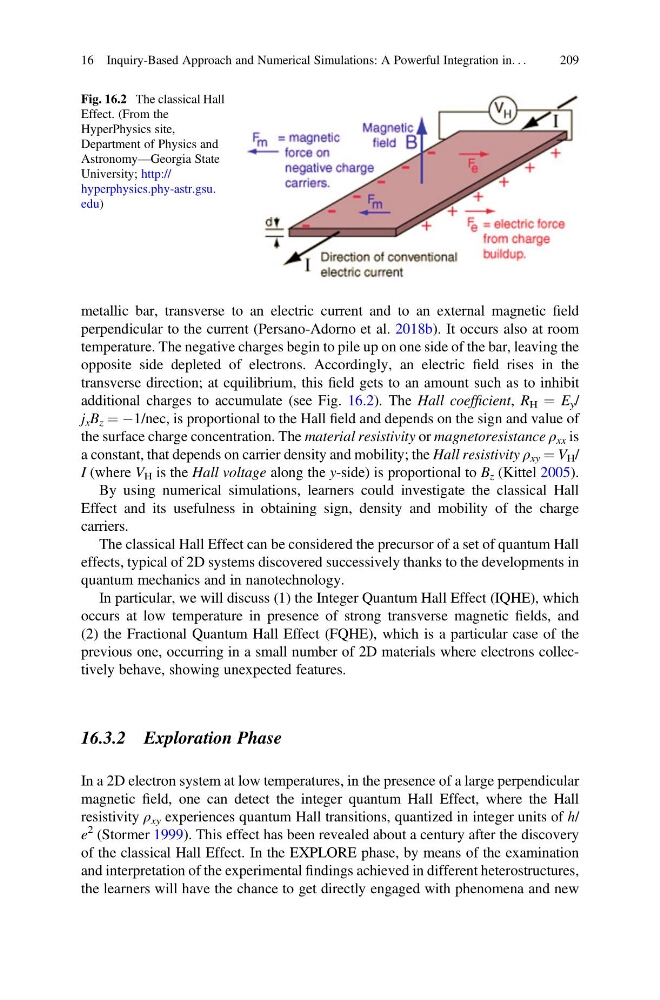
temperature. The negative charges begin to pile up on one side of the bar, leaving the
opposite side depleted of electrons. Accordingly, an electric field rises in the
transverse direction; at equilibrium, this field gets to an amount such as to inhibit
additional charges to accumulate (see Fig. 16.2). The Hall coefficient, R H ¼ E y /
j x B z ¼ À1/nec, is proportional to the Hall field and depends on the sign and value of
the surface charge concentration. The material resistivity or magnetoresistance ρ xx is
a constant, that depends on carrier density and mobility; the Hall resistivity ρ xy ¼ V H /
I (where V H is the Hall voltage along the y-side) is proportional to B z (Kittel 2005).
By using numerical simulations, learners could investigate the classical Hall
Effect and its usefulness in obtaining sign, density and mobility of the charge
carriers.
The classical Hall Effect can be considered the precursor of a set of quantum Hall
effects, typical of 2D systems discovered successively thanks to the developments in
quantum mechanics and in nanotechnology.
In particular, we will discuss (1) the Integer Quantum Hall Effect (IQHE), which
occurs at low temperature in presence of strong transverse magnetic fields, and
(2) the Fractional Quantum Hall Effect (FQHE), which is a particular case of the
previous one, occurring in a small number of 2D materials where electrons collectively behave, showing unexpected features.
16.3.2 Exploration Phase
In a 2D electron system at low temperatures, in the presence of a large perpendicular
magnetic field, one can detect the integer quantum Hall Effect, where the Hall
resistivity ρ xy experiences quantum Hall transitions, quantized in integer units of h/
e
2 (Stormer 1999). This effect has been revealed about a century after the discovery
of the classical Hall Effect. In the EXPLORE phase, by means of the examination
and interpretation of the experimental findings achieved in different heterostructures,
the learners will have the chance to get directly engaged with phenomena and new
Fig. 16.2 The classical Hall
Effect. (From the
HyperPhysics site,
Department of Physics and
Astronomy—Georgia State
University; http://
hyperphysics.phy-astr.gsu.
edu)
16 Inquiry-Based Approach and Numerical Simulations: A Powerful Integration in. . .
209
perpendicular to the current (Persano-Adorno et al. 2018b). It occurs also at room
temperature. The negative charges begin to pile up on one side of the bar, leaving the
opposite side depleted of electrons. Accordingly, an electric field rises in the
transverse direction; at equilibrium, this field gets to an amount such as to inhibit
additional charges to accumulate (see Fig. 16.2). The Hall coefficient, R H ¼ E y /
j x B z ¼ À1/nec, is proportional to the Hall field and depends on the sign and value of
the surface charge concentration. The material resistivity or magnetoresistance ρ xx is
a constant, that depends on carrier density and mobility; the Hall resistivity ρ xy ¼ V H /
I (where V H is the Hall voltage along the y-side) is proportional to B z (Kittel 2005).
By using numerical simulations, learners could investigate the classical Hall
Effect and its usefulness in obtaining sign, density and mobility of the charge
carriers.
The classical Hall Effect can be considered the precursor of a set of quantum Hall
effects, typical of 2D systems discovered successively thanks to the developments in
quantum mechanics and in nanotechnology.
In particular, we will discuss (1) the Integer Quantum Hall Effect (IQHE), which
occurs at low temperature in presence of strong transverse magnetic fields, and
(2) the Fractional Quantum Hall Effect (FQHE), which is a particular case of the
previous one, occurring in a small number of 2D materials where electrons collectively behave, showing unexpected features.
16.3.2 Exploration Phase
In a 2D electron system at low temperatures, in the presence of a large perpendicular
magnetic field, one can detect the integer quantum Hall Effect, where the Hall
resistivity ρ xy experiences quantum Hall transitions, quantized in integer units of h/
e
2 (Stormer 1999). This effect has been revealed about a century after the discovery
of the classical Hall Effect. In the EXPLORE phase, by means of the examination
and interpretation of the experimental findings achieved in different heterostructures,
the learners will have the chance to get directly engaged with phenomena and new
Fig. 16.2 The classical Hall
Effect. (From the
HyperPhysics site,
Department of Physics and
Astronomy—Georgia State
University; http://
hyperphysics.phy-astr.gsu.
edu)
16 Inquiry-Based Approach and Numerical Simulations: A Powerful Integration in. . .
209