

active force” or “velocity proportional to active force” (Hestenes and Jackson 2007)
and the scientifically accepted one that considers force as a quantity to model
interactions between bodies. Finally, they are able to give correct answers for
question 29 in which a static situation is considered.
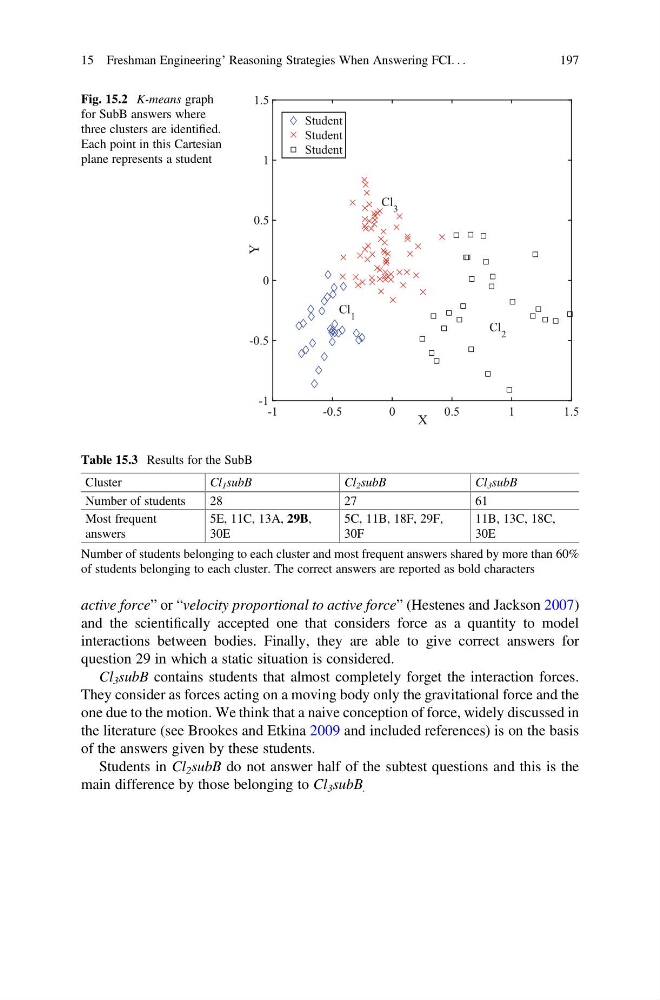
Cl 3 subB contains students that almost completely forget the interaction forces.
They consider as forces acting on a moving body only the gravitational force and the
one due to the motion. We think that a naive conception of force, widely discussed in
the literature (see Brookes and Etkina 2009 and included references) is on the basis
of the answers given by these students.
Students in Cl 2 subB do not answer half of the subtest questions and this is the
main difference by those belonging to Cl 3 subB .
-1
-0.5
0
0.5
1
1.5
X
-1
-0.5
0
0.5
1
1.5
Y
Student
Student
Student
Cl 3
Cl 1
Cl 2
Fig. 15.2 K-means graph
for SubB answers where
three clusters are identified.
Each point in this Cartesian
plane represents a student
Table 15.3 Results for the SubB
Cluster
Cl 1 subB
Cl 2 subB
Cl 3 subB
Number of students
28
27
61
Most frequent
answers
5E, 11C, 13A, 29B,
30E
5C, 11B, 18F, 29F,
30F
11B, 13C, 18C,
30E
Number of students belonging to each cluster and most frequent answers shared by more than 60%
of students belonging to each cluster. The correct answers are reported as bold characters
15 Freshman Engineering’ Reasoning Strategies When Answering FCI. . .
197
and the scientifically accepted one that considers force as a quantity to model
interactions between bodies. Finally, they are able to give correct answers for
question 29 in which a static situation is considered.
Cl 3 subB contains students that almost completely forget the interaction forces.
They consider as forces acting on a moving body only the gravitational force and the
one due to the motion. We think that a naive conception of force, widely discussed in
the literature (see Brookes and Etkina 2009 and included references) is on the basis
of the answers given by these students.
Students in Cl 2 subB do not answer half of the subtest questions and this is the
main difference by those belonging to Cl 3 subB .
-1
-0.5
0
0.5
1
1.5
X
-1
-0.5
0
0.5
1
1.5
Y
Student
Student
Student
Cl 3
Cl 1
Cl 2
Fig. 15.2 K-means graph
for SubB answers where
three clusters are identified.
Each point in this Cartesian
plane represents a student
Table 15.3 Results for the SubB
Cluster
Cl 1 subB
Cl 2 subB
Cl 3 subB
Number of students
28
27
61
Most frequent
answers
5E, 11C, 13A, 29B,
30E
5C, 11B, 18F, 29F,
30F
11B, 13C, 18C,
30E
Number of students belonging to each cluster and most frequent answers shared by more than 60%
of students belonging to each cluster. The correct answers are reported as bold characters
15 Freshman Engineering’ Reasoning Strategies When Answering FCI. . .
197