

light sources by color and intensity of the emitted light. No one of the formal
constructs is addressed before entering into the discussion on the nature of colors,
white light peculiar characteristics or the nature of light and its description in
energetic terms. In particular, among the main addressed constructs, Bohr’s model,
Table 14.2 Rubric for the analysis of contents included by teachers in the designed educational
projects on modern physics
A. Crucial experiments
A1: photoelectric effect
A2: Compton effect
A3: Franck and Hertz experiment
A4: black body spectrum
A5: Devisson and Germer experiment
A6: Atomic spectra
D. Properties of a massless particle
D1: energy
D2: speed
D3: momentum
B. Key aspects of quantum physics
B1: de Broglie wavelength
B2: Schrodinger equation
B3: Heisenberg’s uncertainty principle
B4: quantized energy exchanges
E. EM waves + spectra
E1: Maxwell equation
E2: EM spectra
C. Interpretative hypothesis
C1: Planck’s hypothesis
C2: Einstein’s photoelectric effect interpretation
C3: Bohr’s model
C4: Balmer’s formula
C5: energy level model
F. Case studies
F1: tunneling
F2: potential well
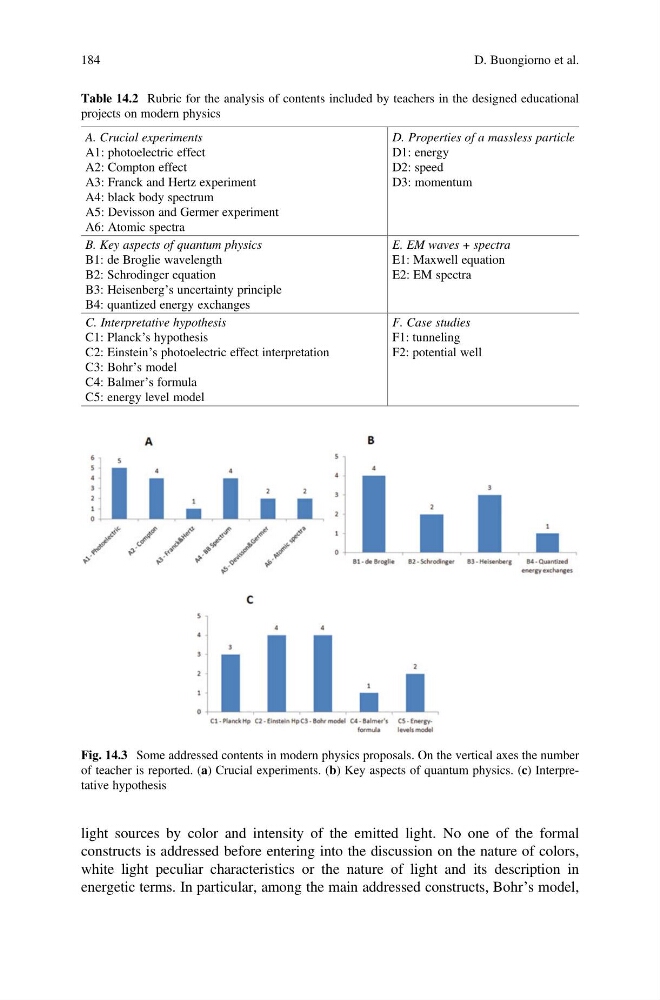
Fig. 14.3 Some addressed contents in modern physics proposals. On the vertical axes the number
of teacher is reported. (a) Crucial experiments. (b) Key aspects of quantum physics. (c) Interpretative hypothesis
184
D. Buongiorno et al.
constructs is addressed before entering into the discussion on the nature of colors,
white light peculiar characteristics or the nature of light and its description in
energetic terms. In particular, among the main addressed constructs, Bohr’s model,
Table 14.2 Rubric for the analysis of contents included by teachers in the designed educational
projects on modern physics
A. Crucial experiments
A1: photoelectric effect
A2: Compton effect
A3: Franck and Hertz experiment
A4: black body spectrum
A5: Devisson and Germer experiment
A6: Atomic spectra
D. Properties of a massless particle
D1: energy
D2: speed
D3: momentum
B. Key aspects of quantum physics
B1: de Broglie wavelength
B2: Schrodinger equation
B3: Heisenberg’s uncertainty principle
B4: quantized energy exchanges
E. EM waves + spectra
E1: Maxwell equation
E2: EM spectra
C. Interpretative hypothesis
C1: Planck’s hypothesis
C2: Einstein’s photoelectric effect interpretation
C3: Bohr’s model
C4: Balmer’s formula
C5: energy level model
F. Case studies
F1: tunneling
F2: potential well
Fig. 14.3 Some addressed contents in modern physics proposals. On the vertical axes the number
of teacher is reported. (a) Crucial experiments. (b) Key aspects of quantum physics. (c) Interpretative hypothesis
184
D. Buongiorno et al.