

included in the proposal only by one teacher. Every teacher quotes at least two
crucial experiments and only one quotes them all. The majority of the involved
teachers includes crucial theoretical aspects of quantum physics (Fig. 14.3b) quoting
at least two aspects, the most addressed one is de Broglie’s contribution to the
interpretation of the wave nature of matter. Only one teacher does not consider
important to integrate any of those aspects in the proposal. A bigger importance is
given to the interpretative hypothesis or models accounting for the different phenomenology as Bohr, Einstein, or Plank’s hypothesis (Fig. 14.3c): every teacher
quote at least one of those aspects and one of them quotes them all. The analysis of
relativistic dynamic is taken into account only from three teachers, addressing
concepts like energy, velocity and momentum for a photon, while the other two do
not believe to be an important part of the proposal. Two teachers begin the educational proposal on modern physics addressing the electromagnetic spectrum and the
wave nature of light using the Maxwell’s equations. Three teachers include specific
case studies and applications as the tunneling effect and the potential well phenomenology for a massive particle in the middle or at the end of the proposal.
14.6 Discussion
The emission mechanism is one of the most quoted arguments in the proposal on
optical spectroscopy. In the proposal structure, it is placed at the beginning, usually
at the first, second or third place; this is quite surprisingly since, in our educational
path, it is presented as an arrival point of a sequence of reasoning and not presented
directly to students. Technological aspects are included by five teachers: this is not a
natural setting, since generally applicative aspects are addressed at the end of
standard lessons. Probably this peculiar characteristic is due to our setting, in
which technological aspects of different light sources are used as an approach. A
general tendency of focusing on light sources and emitted light characteristics at the
beginning is clearly recognizable. Only in one case the characteristics of the emitted
light come before the sources, and in this peculiar case, because characterization of
the emitted light is given a big importance. Analysis of incandescent emission
occupy an equally relevant position in teachers’ proposals and it is placed immediately after approaches to phenomena, sometimes alone, sometimes accompanied
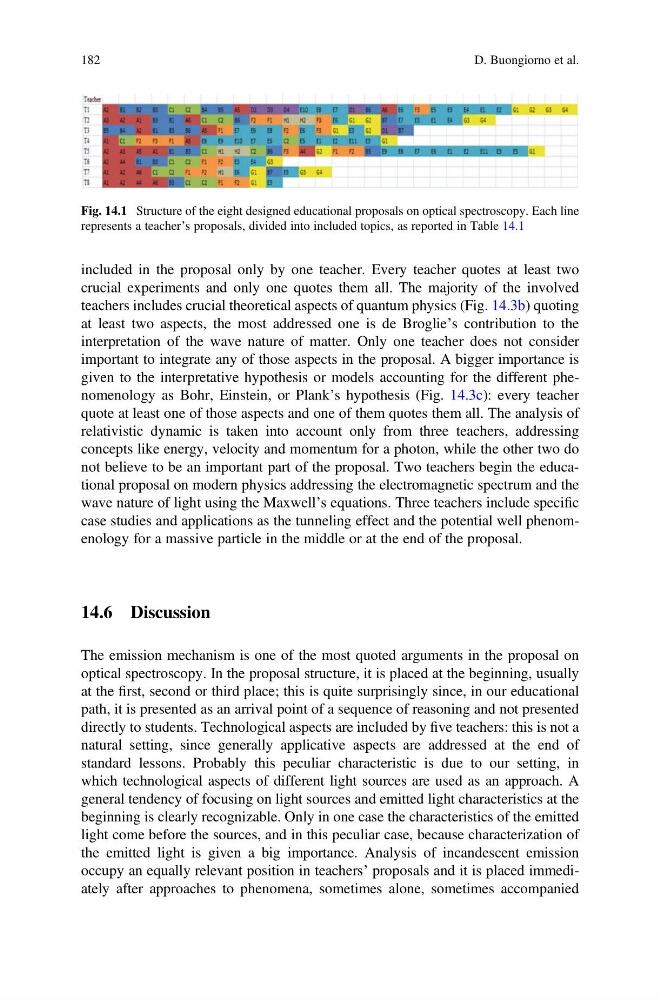
Fig. 14.1 Structure of the eight designed educational proposals on optical spectroscopy. Each line
represents a teacher’s proposals, divided into included topics, as reported in Table 14.1
182
D. Buongiorno et al.
crucial experiments and only one quotes them all. The majority of the involved
teachers includes crucial theoretical aspects of quantum physics (Fig. 14.3b) quoting
at least two aspects, the most addressed one is de Broglie’s contribution to the
interpretation of the wave nature of matter. Only one teacher does not consider
important to integrate any of those aspects in the proposal. A bigger importance is
given to the interpretative hypothesis or models accounting for the different phenomenology as Bohr, Einstein, or Plank’s hypothesis (Fig. 14.3c): every teacher
quote at least one of those aspects and one of them quotes them all. The analysis of
relativistic dynamic is taken into account only from three teachers, addressing
concepts like energy, velocity and momentum for a photon, while the other two do
not believe to be an important part of the proposal. Two teachers begin the educational proposal on modern physics addressing the electromagnetic spectrum and the
wave nature of light using the Maxwell’s equations. Three teachers include specific
case studies and applications as the tunneling effect and the potential well phenomenology for a massive particle in the middle or at the end of the proposal.
14.6 Discussion
The emission mechanism is one of the most quoted arguments in the proposal on
optical spectroscopy. In the proposal structure, it is placed at the beginning, usually
at the first, second or third place; this is quite surprisingly since, in our educational
path, it is presented as an arrival point of a sequence of reasoning and not presented
directly to students. Technological aspects are included by five teachers: this is not a
natural setting, since generally applicative aspects are addressed at the end of
standard lessons. Probably this peculiar characteristic is due to our setting, in
which technological aspects of different light sources are used as an approach. A
general tendency of focusing on light sources and emitted light characteristics at the
beginning is clearly recognizable. Only in one case the characteristics of the emitted
light come before the sources, and in this peculiar case, because characterization of
the emitted light is given a big importance. Analysis of incandescent emission
occupy an equally relevant position in teachers’ proposals and it is placed immediately after approaches to phenomena, sometimes alone, sometimes accompanied
Fig. 14.1 Structure of the eight designed educational proposals on optical spectroscopy. Each line
represents a teacher’s proposals, divided into included topics, as reported in Table 14.1
182
D. Buongiorno et al.