

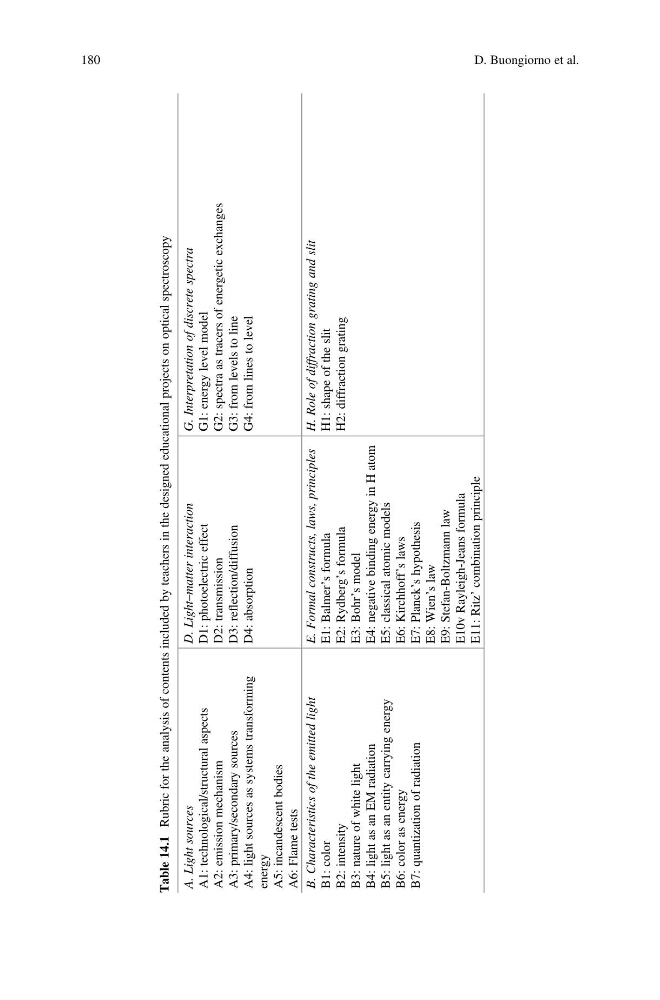
Table 14.1
Rubric for the analysis of contents included by teachers in the designed educational projects on optical spectroscopy
A. Light sources
A1: technological/structural aspects
A2: emission mechanism
A3: primary/secondary sources
A4: light sources as systems transforming
energy
A5: incandescent bodies
A6: Flame tests
D. Light–matter interaction
D1: photoelectric effect
D2: transmission
D3: reflection/diffusion
D4: absorption
G. Interpretation of discrete spectra
G1: energy level model
G2: spectra as tracers of energetic exchanges
G3: from levels to line
G4: from lines to level
B. Characteristics of the emitted light
B1: color
B2: intensity
B3: nature of white light
B4: light as an EM radiation
B5: light as an entity carrying energy
B6: color as energy
B7: quantization of radiation
E. Formal constructs, laws, principles
E1: Balmer’s formula
E2: Rydberg’s formula
E3: Bohr’s model
E4: negative binding energy in H atom
E5: classical atomic models
E6: Kirchhoff’s laws
E7: Planck’s hypothesis
E8: Wien’s law
E9: Stefan-Boltzmann law
E10v Rayleigh-Jeans formula
E11: Ritz’ combination principle
H. Role of diffraction grating and slit
H1: shape of the slit
H2: diffraction grating
180
D. Buongiorno et al.
Rubric for the analysis of contents included by teachers in the designed educational projects on optical spectroscopy
A. Light sources
A1: technological/structural aspects
A2: emission mechanism
A3: primary/secondary sources
A4: light sources as systems transforming
energy
A5: incandescent bodies
A6: Flame tests
D. Light–matter interaction
D1: photoelectric effect
D2: transmission
D3: reflection/diffusion
D4: absorption
G. Interpretation of discrete spectra
G1: energy level model
G2: spectra as tracers of energetic exchanges
G3: from levels to line
G4: from lines to level
B. Characteristics of the emitted light
B1: color
B2: intensity
B3: nature of white light
B4: light as an EM radiation
B5: light as an entity carrying energy
B6: color as energy
B7: quantization of radiation
E. Formal constructs, laws, principles
E1: Balmer’s formula
E2: Rydberg’s formula
E3: Bohr’s model
E4: negative binding energy in H atom
E5: classical atomic models
E6: Kirchhoff’s laws
E7: Planck’s hypothesis
E8: Wien’s law
E9: Stefan-Boltzmann law
E10v Rayleigh-Jeans formula
E11: Ritz’ combination principle
H. Role of diffraction grating and slit
H1: shape of the slit
H2: diffraction grating
180
D. Buongiorno et al.