

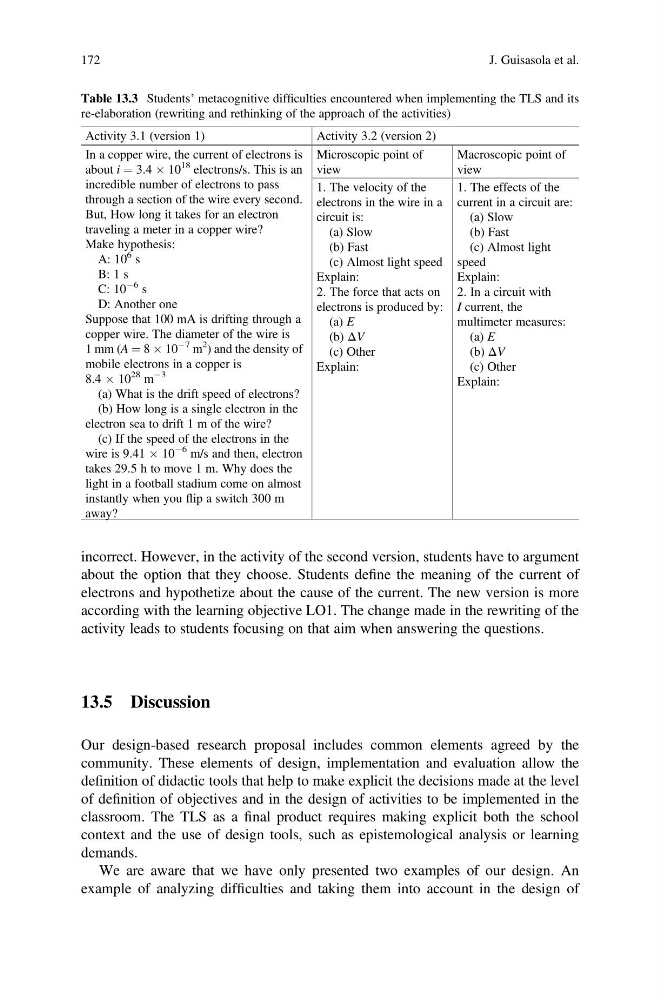
incorrect. However, in the activity of the second version, students have to argument
about the option that they choose. Students define the meaning of the current of
electrons and hypothetize about the cause of the current. The new version is more
according with the learning objective LO1. The change made in the rewriting of the
activity leads to students focusing on that aim when answering the questions.
13.5 Discussion
Our design-based research proposal includes common elements agreed by the
community. These elements of design, implementation and evaluation allow the
definition of didactic tools that help to make explicit the decisions made at the level
of definition of objectives and in the design of activities to be implemented in the
classroom. The TLS as a final product requires making explicit both the school
context and the use of design tools, such as epistemological analysis or learning
demands.
We are aware that we have only presented two examples of our design. An
example of analyzing difficulties and taking them into account in the design of
Table 13.3 Students’ metacognitive difficulties encountered when implementing the TLS and its
re-elaboration (rewriting and rethinking of the approach of the activities)
Activity 3.1 (version 1)
Activity 3.2 (version 2)
In a copper wire, the current of electrons is
about i ¼ 3.4 Â 10
18 electrons/s. This is an
incredible number of electrons to pass
through a section of the wire every second.
But, How long it takes for an electron
traveling a meter in a copper wire?
Make hypothesis:
A: 10
6 s
B: 1 s
C: 10
À6 s
D: Another one
Suppose that 100 mA is drifting through a
copper wire. The diameter of the wire is
1 mm (A ¼ 8 Â 10
À7 m
2
) and the density of
mobile electrons in a copper is
8.4 Â 10
28 m
À3
(a) What is the drift speed of electrons?
(b) How long is a single electron in the
electron sea to drift 1 m of the wire?
(c) If the speed of the electrons in the
wire is 9.41 Â 10
À6 m/s and then, electron
takes 29.5 h to move 1 m. Why does the
light in a football stadium come on almost
instantly when you flip a switch 300 m
away?
Microscopic point of
view
Macroscopic point of
view
1. The velocity of the
electrons in the wire in a
circuit is:
(a) Slow
(b) Fast
(c) Almost light speed
Explain:
2. The force that acts on
electrons is produced by:
(a) E
(b) ΔV
(c) Other
Explain:
1. The effects of the
current in a circuit are:
(a) Slow
(b) Fast
(c) Almost light
speed
Explain:
2. In a circuit with
I current, the
multimeter measures:
(a) E
(b) ΔV
(c) Other
Explain:
172
J. Guisasola et al.
about the option that they choose. Students define the meaning of the current of
electrons and hypothetize about the cause of the current. The new version is more
according with the learning objective LO1. The change made in the rewriting of the
activity leads to students focusing on that aim when answering the questions.
13.5 Discussion
Our design-based research proposal includes common elements agreed by the
community. These elements of design, implementation and evaluation allow the
definition of didactic tools that help to make explicit the decisions made at the level
of definition of objectives and in the design of activities to be implemented in the
classroom. The TLS as a final product requires making explicit both the school
context and the use of design tools, such as epistemological analysis or learning
demands.
We are aware that we have only presented two examples of our design. An
example of analyzing difficulties and taking them into account in the design of
Table 13.3 Students’ metacognitive difficulties encountered when implementing the TLS and its
re-elaboration (rewriting and rethinking of the approach of the activities)
Activity 3.1 (version 1)
Activity 3.2 (version 2)
In a copper wire, the current of electrons is
about i ¼ 3.4 Â 10
18 electrons/s. This is an
incredible number of electrons to pass
through a section of the wire every second.
But, How long it takes for an electron
traveling a meter in a copper wire?
Make hypothesis:
A: 10
6 s
B: 1 s
C: 10
À6 s
D: Another one
Suppose that 100 mA is drifting through a
copper wire. The diameter of the wire is
1 mm (A ¼ 8 Â 10
À7 m
2
) and the density of
mobile electrons in a copper is
8.4 Â 10
28 m
À3
(a) What is the drift speed of electrons?
(b) How long is a single electron in the
electron sea to drift 1 m of the wire?
(c) If the speed of the electrons in the
wire is 9.41 Â 10
À6 m/s and then, electron
takes 29.5 h to move 1 m. Why does the
light in a football stadium come on almost
instantly when you flip a switch 300 m
away?
Microscopic point of
view
Macroscopic point of
view
1. The velocity of the
electrons in the wire in a
circuit is:
(a) Slow
(b) Fast
(c) Almost light speed
Explain:
2. The force that acts on
electrons is produced by:
(a) E
(b) ΔV
(c) Other
Explain:
1. The effects of the
current in a circuit are:
(a) Slow
(b) Fast
(c) Almost light
speed
Explain:
2. In a circuit with
I current, the
multimeter measures:
(a) E
(b) ΔV
(c) Other
Explain:
172
J. Guisasola et al.