

(b) To evaluate students ‘difficulties; (c) To define the learning demands. We will
finish with a discussion on the advantages of the DBR methodology in order to make
the TLS design criteria explicit. Making these criteria explicit helps teachers to
understand the advantages and usefulness of the TLS and, furthermore, contributes
to developing their pedagogical content knowledge.
13.2 DBR Phases and the TLS Design
DBR is a cyclical process that typically comprises three phases: design, teaching
experiments (implementation), and retrospective analysis (assessment) (Anderson
and Shattuck 2012; Easterday et al. 2014; Barab and Squire 2004).
The design phase leads to an initial product (the TLS) that includes a hypothetical
learning path consistent with the theory. This phase starts with an evaluation of the
learning goals for the target audience and the epistemological analysis of the topic. In
the design phase, the clear and explicit definition of the learning objectives is key if
we want to evaluate the achievements obtained. The epistemological analysis and
findings about students ‘difficulties guide the formulation of provisional learning
objectives, which in turn shape the learning path of the TLS. Next, we use the
“learning demand design tool” (Ametller et al. 2007) to analyze the ontological and
epistemic differences between the students’ ideas and the defined learning objectives. These gaps will guide the TLS learning path by highlighting both the type and
degree of difficulty that we can expect the students to encounter.
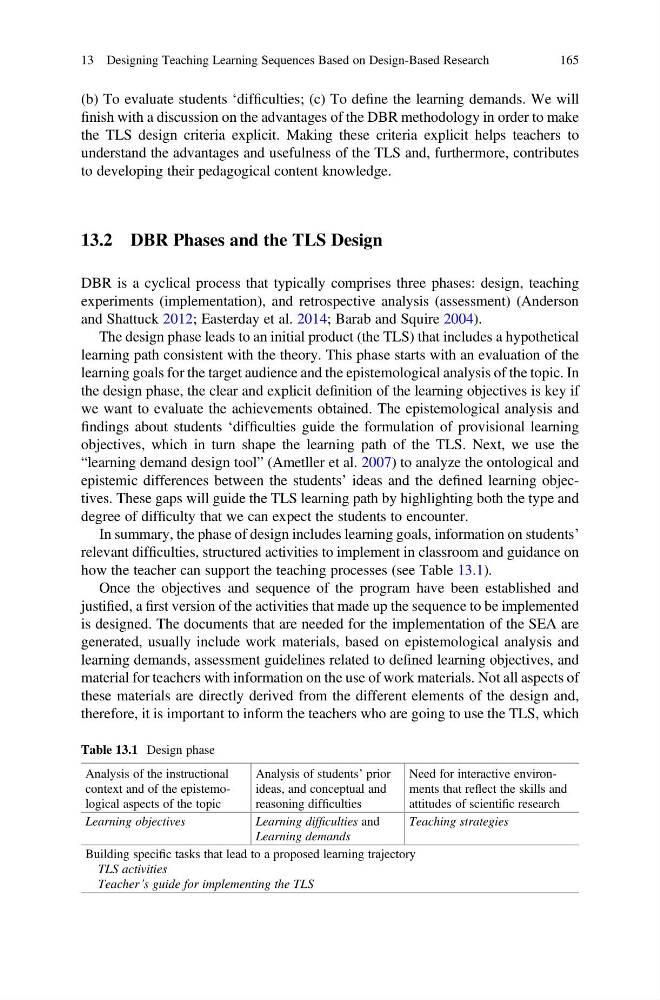
In summary, the phase of design includes learning goals, information on students’
relevant difficulties, structured activities to implement in classroom and guidance on
how the teacher can support the teaching processes (see Table 13.1).
Once the objectives and sequence of the program have been established and
justified, a first version of the activities that made up the sequence to be implemented
is designed. The documents that are needed for the implementation of the SEA are
generated, usually include work materials, based on epistemological analysis and
learning demands, assessment guidelines related to defined learning objectives, and
material for teachers with information on the use of work materials. Not all aspects of
these materials are directly derived from the different elements of the design and,
therefore, it is important to inform the teachers who are going to use the TLS, which
Table 13.1 Design phase
Analysis of the instructional
context and of the epistemological aspects of the topic
Analysis of students’ prior
ideas, and conceptual and
reasoning difficulties
Need for interactive environments that reflect the skills and
attitudes of scientific research
Learning objectives
Learning difficulties and
Learning demands
Teaching strategies
Building specific tasks that lead to a proposed learning trajectory
TLS activities
Teacher’s guide for implementing the TLS
13 Designing Teaching Learning Sequences Based on Design-Based Research
165
finish with a discussion on the advantages of the DBR methodology in order to make
the TLS design criteria explicit. Making these criteria explicit helps teachers to
understand the advantages and usefulness of the TLS and, furthermore, contributes
to developing their pedagogical content knowledge.
13.2 DBR Phases and the TLS Design
DBR is a cyclical process that typically comprises three phases: design, teaching
experiments (implementation), and retrospective analysis (assessment) (Anderson
and Shattuck 2012; Easterday et al. 2014; Barab and Squire 2004).
The design phase leads to an initial product (the TLS) that includes a hypothetical
learning path consistent with the theory. This phase starts with an evaluation of the
learning goals for the target audience and the epistemological analysis of the topic. In
the design phase, the clear and explicit definition of the learning objectives is key if
we want to evaluate the achievements obtained. The epistemological analysis and
findings about students ‘difficulties guide the formulation of provisional learning
objectives, which in turn shape the learning path of the TLS. Next, we use the
“learning demand design tool” (Ametller et al. 2007) to analyze the ontological and
epistemic differences between the students’ ideas and the defined learning objectives. These gaps will guide the TLS learning path by highlighting both the type and
degree of difficulty that we can expect the students to encounter.
In summary, the phase of design includes learning goals, information on students’
relevant difficulties, structured activities to implement in classroom and guidance on
how the teacher can support the teaching processes (see Table 13.1).
Once the objectives and sequence of the program have been established and
justified, a first version of the activities that made up the sequence to be implemented
is designed. The documents that are needed for the implementation of the SEA are
generated, usually include work materials, based on epistemological analysis and
learning demands, assessment guidelines related to defined learning objectives, and
material for teachers with information on the use of work materials. Not all aspects of
these materials are directly derived from the different elements of the design and,
therefore, it is important to inform the teachers who are going to use the TLS, which
Table 13.1 Design phase
Analysis of the instructional
context and of the epistemological aspects of the topic
Analysis of students’ prior
ideas, and conceptual and
reasoning difficulties
Need for interactive environments that reflect the skills and
attitudes of scientific research
Learning objectives
Learning difficulties and
Learning demands
Teaching strategies
Building specific tasks that lead to a proposed learning trajectory
TLS activities
Teacher’s guide for implementing the TLS
13 Designing Teaching Learning Sequences Based on Design-Based Research
165