

an inquiry phase in which pupils themselves have to make decisions on how to use
the new tools in their investigations.
12.5.3.2 Limited Preparation Time and Limited Curriculum Time
In many countries including Slovakia and Vietnam, teachers are pressed to teach all
the content standards within a tightly structured, explicitly expressed syllabus
(Woolnough 2001). In the Netherlands, the school science curricula are rather
overloaded with standardised requirements, too; except that the way to attain these
requirements is mostly left open to the teacher. In such constrained circumstances,
teachers tend to get through the content (Bencze and Hodson 1999) rather than
engaging pupils in investigations with the ICT tools. This is because these investigations require ample time and aim at not only conceptual learning but also other
goals. Incorporating the ICT tools in school science might add extra problems to
time-constraint situations, considering that teachers need extra time, effort, and/or
training to learn to handle the ICT tools and to practice their use. Logistics of
organising the use of hardware and software cause extra preparation time for
teachers. The constraints on preparation time and curriculum time can be a factor
explaining for the fact that: although the ICT tools have many innovative features
that stimulate pupils’ authentic inquiry practices, really authentic inquiry learning is
limited to a few special projects, for example in Dutch schools, once in junior
secondary and once in senior secondary.
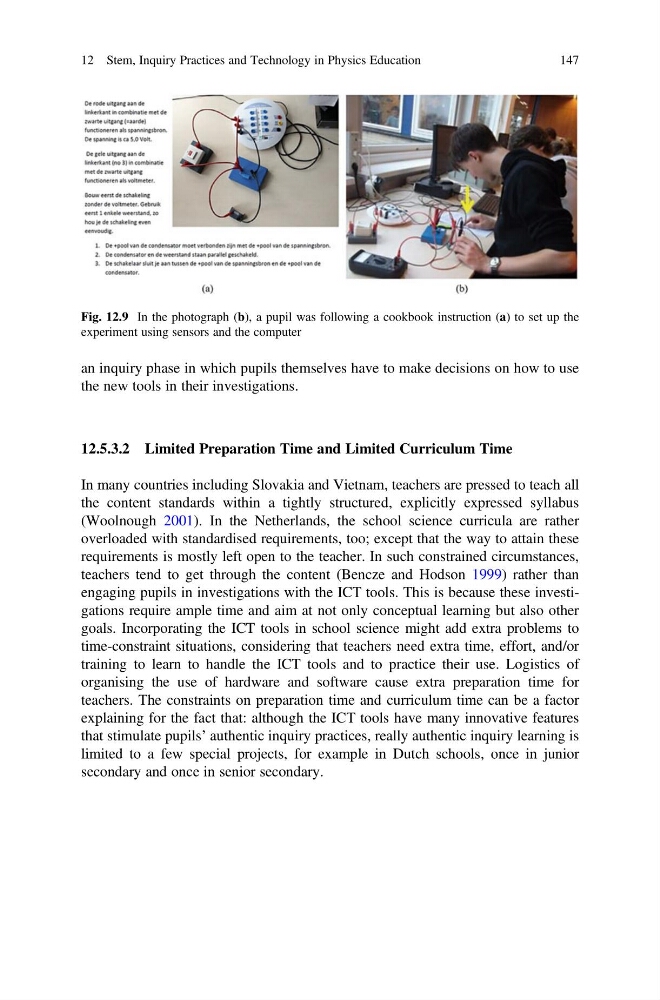
Fig. 12.9 In the photograph (b), a pupil was following a cookbook instruction (a) to set up the
experiment using sensors and the computer
12 Stem, Inquiry Practices and Technology in Physics Education
147
the new tools in their investigations.
12.5.3.2 Limited Preparation Time and Limited Curriculum Time
In many countries including Slovakia and Vietnam, teachers are pressed to teach all
the content standards within a tightly structured, explicitly expressed syllabus
(Woolnough 2001). In the Netherlands, the school science curricula are rather
overloaded with standardised requirements, too; except that the way to attain these
requirements is mostly left open to the teacher. In such constrained circumstances,
teachers tend to get through the content (Bencze and Hodson 1999) rather than
engaging pupils in investigations with the ICT tools. This is because these investigations require ample time and aim at not only conceptual learning but also other
goals. Incorporating the ICT tools in school science might add extra problems to
time-constraint situations, considering that teachers need extra time, effort, and/or
training to learn to handle the ICT tools and to practice their use. Logistics of
organising the use of hardware and software cause extra preparation time for
teachers. The constraints on preparation time and curriculum time can be a factor
explaining for the fact that: although the ICT tools have many innovative features
that stimulate pupils’ authentic inquiry practices, really authentic inquiry learning is
limited to a few special projects, for example in Dutch schools, once in junior
secondary and once in senior secondary.
Fig. 12.9 In the photograph (b), a pupil was following a cookbook instruction (a) to set up the
experiment using sensors and the computer
12 Stem, Inquiry Practices and Technology in Physics Education
147