

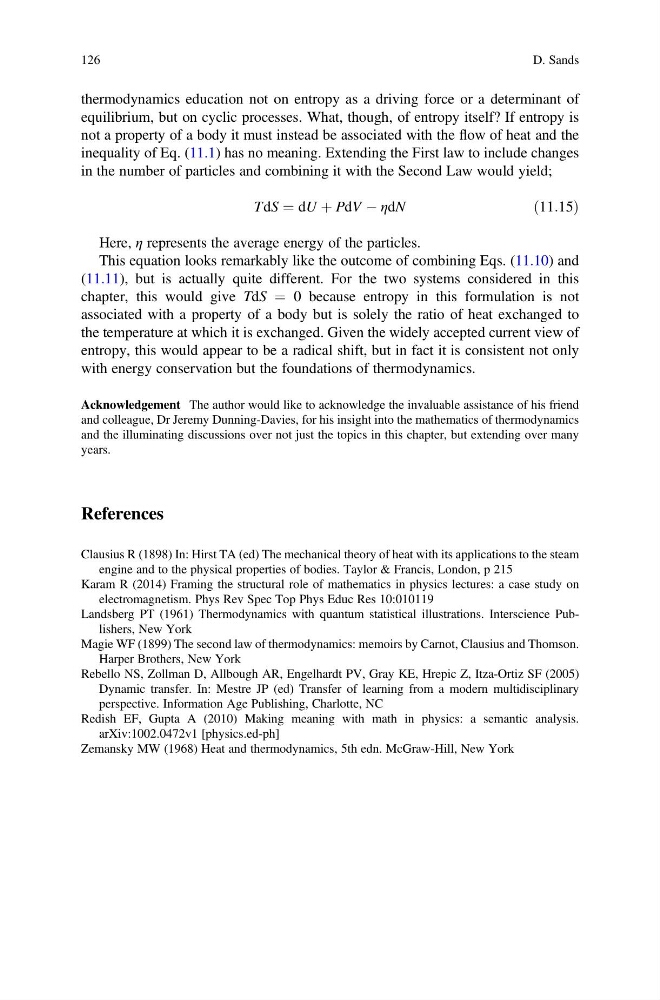
thermodynamics education not on entropy as a driving force or a determinant of
equilibrium, but on cyclic processes. What, though, of entropy itself? If entropy is
not a property of a body it must instead be associated with the flow of heat and the
inequality of Eq. (11.1) has no meaning. Extending the First law to include changes
in the number of particles and combining it with the Second Law would yield;
TdS ¼ dU þ PdV À ηdN
ð11:15Þ
Here, η represents the average energy of the particles.
This equation looks remarkably like the outcome of combining Eqs. (11.10) and
(11.11), but is actually quite different. For the two systems considered in this
chapter, this would give TdS ¼ 0 because entropy in this formulation is not
associated with a property of a body but is solely the ratio of heat exchanged to
the temperature at which it is exchanged. Given the widely accepted current view of
entropy, this would appear to be a radical shift, but in fact it is consistent not only
with energy conservation but the foundations of thermodynamics.
Acknowledgement The author would like to acknowledge the invaluable assistance of his friend
and colleague, Dr Jeremy Dunning-Davies, for his insight into the mathematics of thermodynamics
and the illuminating discussions over not just the topics in this chapter, but extending over many
years.
References
Clausius R (1898) In: Hirst TA (ed) The mechanical theory of heat with its applications to the steam
engine and to the physical properties of bodies. Taylor & Francis, London, p 215
Karam R (2014) Framing the structural role of mathematics in physics lectures: a case study on
electromagnetism. Phys Rev Spec Top Phys Educ Res 10:010119
Landsberg PT (1961) Thermodynamics with quantum statistical illustrations. Interscience Publishers, New York
Magie WF (1899) The second law of thermodynamics: memoirs by Carnot, Clausius and Thomson.
Harper Brothers, New York
Rebello NS, Zollman D, Allbough AR, Engelhardt PV, Gray KE, Hrepic Z, Itza-Ortiz SF (2005)
Dynamic transfer. In: Mestre JP (ed) Transfer of learning from a modern multidisciplinary
perspective. Information Age Publishing, Charlotte, NC
Redish EF, Gupta A (2010) Making meaning with math in physics: a semantic analysis.
arXiv:1002.0472v1 [physics.ed-ph]
Zemansky MW (1968) Heat and thermodynamics, 5th edn. McGraw-Hill, New York
126
D. Sands
equilibrium, but on cyclic processes. What, though, of entropy itself? If entropy is
not a property of a body it must instead be associated with the flow of heat and the
inequality of Eq. (11.1) has no meaning. Extending the First law to include changes
in the number of particles and combining it with the Second Law would yield;
TdS ¼ dU þ PdV À ηdN
ð11:15Þ
Here, η represents the average energy of the particles.
This equation looks remarkably like the outcome of combining Eqs. (11.10) and
(11.11), but is actually quite different. For the two systems considered in this
chapter, this would give TdS ¼ 0 because entropy in this formulation is not
associated with a property of a body but is solely the ratio of heat exchanged to
the temperature at which it is exchanged. Given the widely accepted current view of
entropy, this would appear to be a radical shift, but in fact it is consistent not only
with energy conservation but the foundations of thermodynamics.
Acknowledgement The author would like to acknowledge the invaluable assistance of his friend
and colleague, Dr Jeremy Dunning-Davies, for his insight into the mathematics of thermodynamics
and the illuminating discussions over not just the topics in this chapter, but extending over many
years.
References
Clausius R (1898) In: Hirst TA (ed) The mechanical theory of heat with its applications to the steam
engine and to the physical properties of bodies. Taylor & Francis, London, p 215
Karam R (2014) Framing the structural role of mathematics in physics lectures: a case study on
electromagnetism. Phys Rev Spec Top Phys Educ Res 10:010119
Landsberg PT (1961) Thermodynamics with quantum statistical illustrations. Interscience Publishers, New York
Magie WF (1899) The second law of thermodynamics: memoirs by Carnot, Clausius and Thomson.
Harper Brothers, New York
Rebello NS, Zollman D, Allbough AR, Engelhardt PV, Gray KE, Hrepic Z, Itza-Ortiz SF (2005)
Dynamic transfer. In: Mestre JP (ed) Transfer of learning from a modern multidisciplinary
perspective. Information Age Publishing, Charlotte, NC
Redish EF, Gupta A (2010) Making meaning with math in physics: a semantic analysis.
arXiv:1002.0472v1 [physics.ed-ph]
Zemansky MW (1968) Heat and thermodynamics, 5th edn. McGraw-Hill, New York
126
D. Sands