

249
Scientific Issues (SSI) and Citizenship Education (CE) – within the umbrella of
Responsible Research and Innovation (RRI). It includes raising authentic questions
about controversial issues [Ask], integrating social and scientific inquiry to explore
these open-ended questions [Find out], and formulating solutions which help to
enact change [Act] (Levinson and PARRISE consortium 2017; Amos et al. 2018).
In conclusion the above pedagogical approaches can importantly contribute to
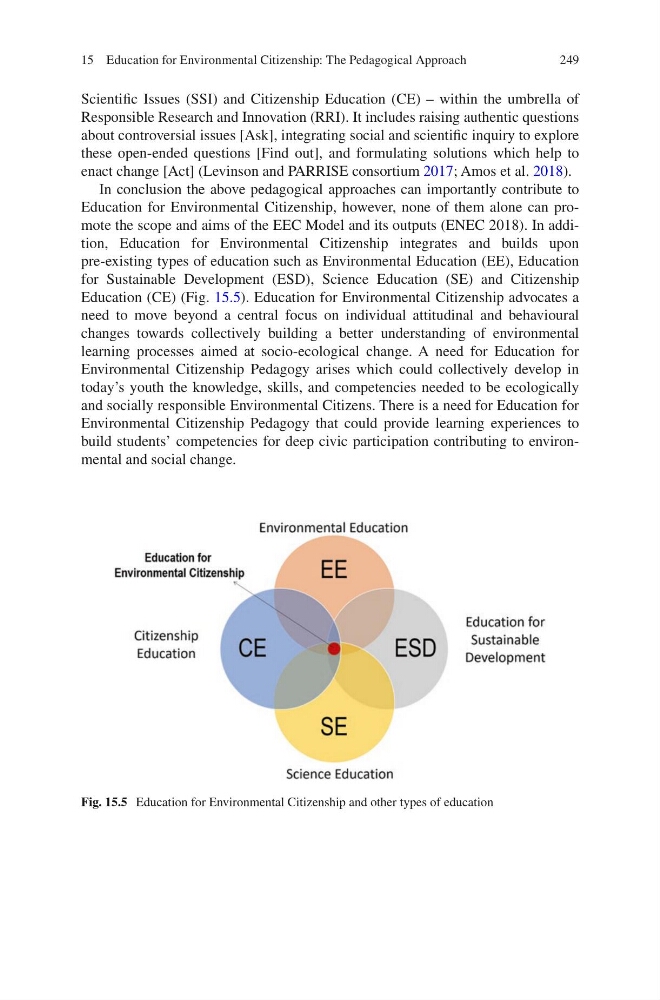
Education for Environmental Citizenship, however, none of them alone can promote the scope and aims of the EEC Model and its outputs (ENEC 2018). In addition, Education for Environmental Citizenship integrates and builds upon
pre-existing types of education such as Environmental Education (EE), Education
for Sustainable Development (ESD), Science Education (SE) and Citizenship
Education (CE) (Fig. 15.5). Education for Environmental Citizenship advocates a
need to move beyond a central focus on individual attitudinal and behavioural
changes towards collectively building a better understanding of environmental
learning processes aimed at socio-ecological change. A need for Education for
Environmental Citizenship Pedagogy arises which could collectively develop in
today’s youth the knowledge, skills, and competencies needed to be ecologically
and socially responsible Environmental Citizens. There is a need for Education for
Environmental Citizenship Pedagogy that could provide learning experiences to
build students’ competencies for deep civic participation contributing to environmental and social change.
Fig. 15.5 Education for Environmental Citizenship and other types of education
15 Education for Environmental Citizenship: The Pedagogical Approach
Scientific Issues (SSI) and Citizenship Education (CE) – within the umbrella of
Responsible Research and Innovation (RRI). It includes raising authentic questions
about controversial issues [Ask], integrating social and scientific inquiry to explore
these open-ended questions [Find out], and formulating solutions which help to
enact change [Act] (Levinson and PARRISE consortium 2017; Amos et al. 2018).
In conclusion the above pedagogical approaches can importantly contribute to
Education for Environmental Citizenship, however, none of them alone can promote the scope and aims of the EEC Model and its outputs (ENEC 2018). In addition, Education for Environmental Citizenship integrates and builds upon
pre-existing types of education such as Environmental Education (EE), Education
for Sustainable Development (ESD), Science Education (SE) and Citizenship
Education (CE) (Fig. 15.5). Education for Environmental Citizenship advocates a
need to move beyond a central focus on individual attitudinal and behavioural
changes towards collectively building a better understanding of environmental
learning processes aimed at socio-ecological change. A need for Education for
Environmental Citizenship Pedagogy arises which could collectively develop in
today’s youth the knowledge, skills, and competencies needed to be ecologically
and socially responsible Environmental Citizens. There is a need for Education for
Environmental Citizenship Pedagogy that could provide learning experiences to
build students’ competencies for deep civic participation contributing to environmental and social change.
Fig. 15.5 Education for Environmental Citizenship and other types of education
15 Education for Environmental Citizenship: The Pedagogical Approach