

187
duties to protect nature and is as such closely connected to the ENEC definition of
Environmental Citizenship.
In significant life experiences research, formal education is consistently ranked
high but lower than non-formal education. Also the social context with which these
experiences occur is important. Participants often report that their own commitment
to act for the environment has sprouted from inspirational role model in their
families or peer groups. Thanks to their flexibility in organisation and intended
outcomes, non-formal education programmes can be considered as promising. With
these programmes, young children and preadolescents can develop into role models
for Environmental Citizenship and inspire their peers. In their study on the
environmental literacy of youth movement members, Goldman et al. (2015) show
how self-perception as role models for younger members on environmental actions
is part of their social activism. Inspiring teachers are at a cross section between
formal education, the social context and non-formal education.
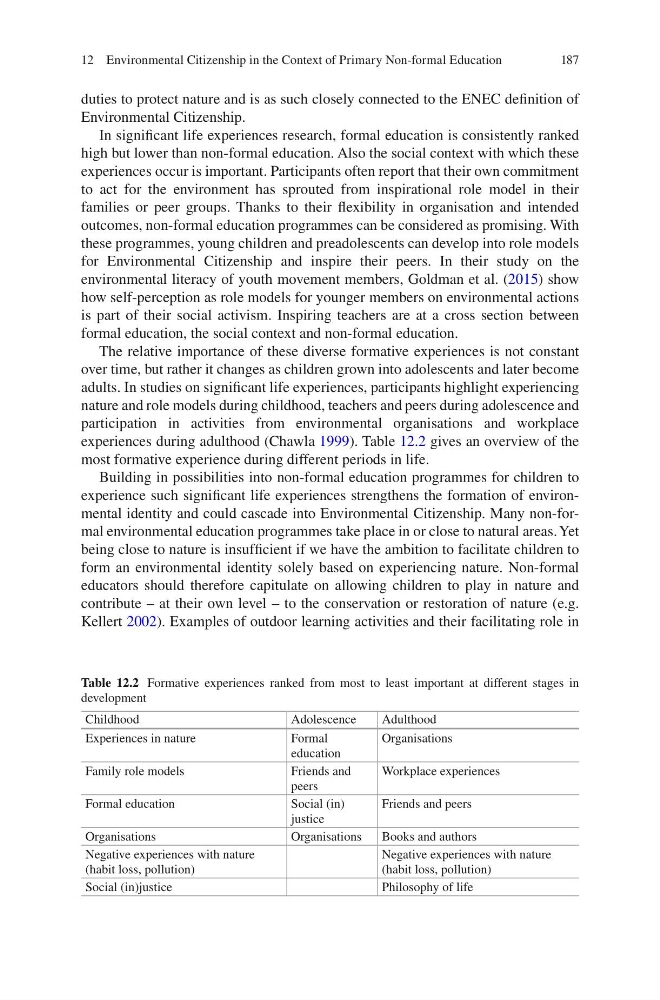
The relative importance of these diverse formative experiences is not constant
over time, but rather it changes as children grown into adolescents and later become
adults. In studies on significant life experiences, participants highlight experiencing
nature and role models during childhood, teachers and peers during adolescence and
participation in activities from environmental organisations and workplace
experiences during adulthood (Chawla 1999). Table 12.2 gives an overview of the
most formative experience during different periods in life.
Building in possibilities into non-formal education programmes for children to
experience such significant life experiences strengthens the formation of environmental identity and could cascade into Environmental Citizenship. Many non-formal environmental education programmes take place in or close to natural areas. Yet
being close to nature is insufficient if we have the ambition to facilitate children to
form an environmental identity solely based on experiencing nature. Non-formal
educators should therefore capitulate on allowing children to play in nature and
contribute – at their own level – to the conservation or restoration of nature (e.g.
Kellert 2002). Examples of outdoor learning activities and their facilitating role in
Table 12.2 Formative experiences ranked from most to least important at different stages in
development
Childhood
Adolescence
Adulthood
Experiences in nature
Formal
education
Organisations
Family role models
Friends and
peers
Workplace experiences
Formal education
Social (in)
justice
Friends and peers
Organisations
Organisations
Books and authors
Negative experiences with nature
(habit loss, pollution)
Negative experiences with nature
(habit loss, pollution)
Social (in)justice
Philosophy of life
12 Environmental Citizenship in the Context of Primary Non-formal Education
duties to protect nature and is as such closely connected to the ENEC definition of
Environmental Citizenship.
In significant life experiences research, formal education is consistently ranked
high but lower than non-formal education. Also the social context with which these
experiences occur is important. Participants often report that their own commitment
to act for the environment has sprouted from inspirational role model in their
families or peer groups. Thanks to their flexibility in organisation and intended
outcomes, non-formal education programmes can be considered as promising. With
these programmes, young children and preadolescents can develop into role models
for Environmental Citizenship and inspire their peers. In their study on the
environmental literacy of youth movement members, Goldman et al. (2015) show
how self-perception as role models for younger members on environmental actions
is part of their social activism. Inspiring teachers are at a cross section between
formal education, the social context and non-formal education.
The relative importance of these diverse formative experiences is not constant
over time, but rather it changes as children grown into adolescents and later become
adults. In studies on significant life experiences, participants highlight experiencing
nature and role models during childhood, teachers and peers during adolescence and
participation in activities from environmental organisations and workplace
experiences during adulthood (Chawla 1999). Table 12.2 gives an overview of the
most formative experience during different periods in life.
Building in possibilities into non-formal education programmes for children to
experience such significant life experiences strengthens the formation of environmental identity and could cascade into Environmental Citizenship. Many non-formal environmental education programmes take place in or close to natural areas. Yet
being close to nature is insufficient if we have the ambition to facilitate children to
form an environmental identity solely based on experiencing nature. Non-formal
educators should therefore capitulate on allowing children to play in nature and
contribute – at their own level – to the conservation or restoration of nature (e.g.
Kellert 2002). Examples of outdoor learning activities and their facilitating role in
Table 12.2 Formative experiences ranked from most to least important at different stages in
development
Childhood
Adolescence
Adulthood
Experiences in nature
Formal
education
Organisations
Family role models
Friends and
peers
Workplace experiences
Formal education
Social (in)
justice
Friends and peers
Organisations
Organisations
Books and authors
Negative experiences with nature
(habit loss, pollution)
Negative experiences with nature
(habit loss, pollution)
Social (in)justice
Philosophy of life
12 Environmental Citizenship in the Context of Primary Non-formal Education