

153
which is occurring at unprecedented speed). In the age where some of the planetary
ecological limits have already been exceeded (Rockström et al. 2009), the Education
of Environmental Citizenship in understanding what those circumstances mean in
areas that affect individual health (e.g. air and water pollution), social health (e.g.
collective movement to solve an environmental injustice) and political health (e.g.
preventing conflicts in the face of resource depletion) is essential.
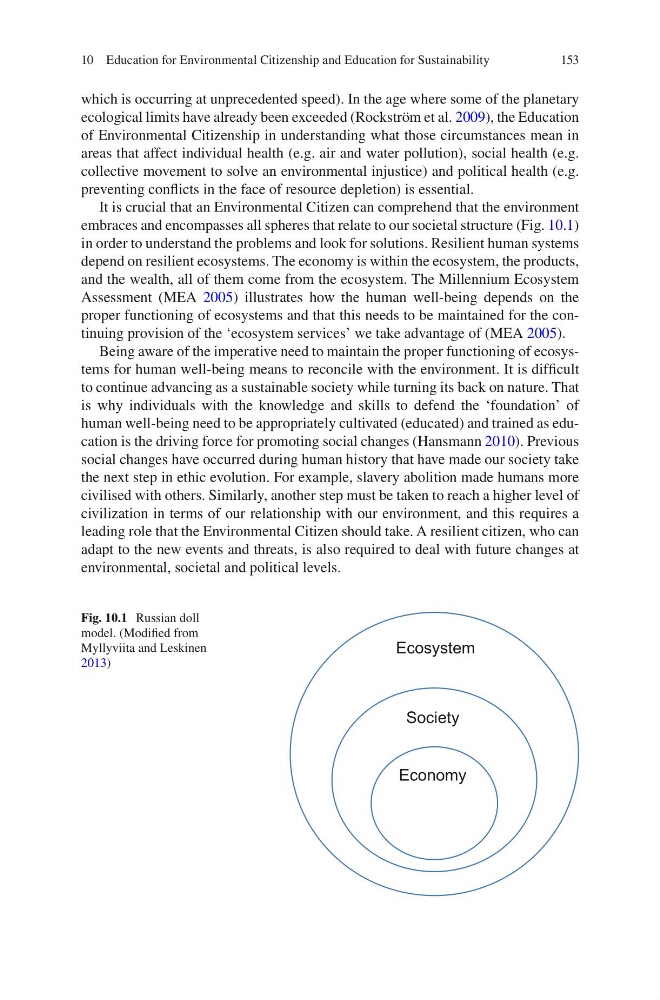
It is crucial that an Environmental Citizen can comprehend that the environment
embraces and encompasses all spheres that relate to our societal structure (Fig. 10.1)
in order to understand the problems and look for solutions. Resilient human systems
depend on resilient ecosystems. The economy is within the ecosystem, the products,
and the wealth, all of them come from the ecosystem. The Millennium Ecosystem
Assessment (MEA 2005) illustrates how the human well-being depends on the
proper functioning of ecosystems and that this needs to be maintained for the continuing provision of the ‘ecosystem services’ we take advantage of (MEA 2005).
Being aware of the imperative need to maintain the proper functioning of ecosystems for human well-being means to reconcile with the environment. It is difficult
to continue advancing as a sustainable society while turning its back on nature. That
is why individuals with the knowledge and skills to defend the ‘foundation’ of
human well-being need to be appropriately cultivated (educated) and trained as education is the driving force for promoting social changes (Hansmann 2010). Previous
social changes have occurred during human history that have made our society take
the next step in ethic evolution. For example, slavery abolition made humans more
civilised with others. Similarly, another step must be taken to reach a higher level of
civilization in terms of our relationship with our environment, and this requires a
leading role that the Environmental Citizen should take. A resilient citizen, who can
adapt to the new events and threats, is also required to deal with future changes at
environmental, societal and political levels.
Ecosystem
Society
Economy
Fig. 10.1 Russian doll
model. (Modified from
Myllyviita and Leskinen
2013)
10 Education for Environmental Citizenship and Education for Sustainability
which is occurring at unprecedented speed). In the age where some of the planetary
ecological limits have already been exceeded (Rockström et al. 2009), the Education
of Environmental Citizenship in understanding what those circumstances mean in
areas that affect individual health (e.g. air and water pollution), social health (e.g.
collective movement to solve an environmental injustice) and political health (e.g.
preventing conflicts in the face of resource depletion) is essential.
It is crucial that an Environmental Citizen can comprehend that the environment
embraces and encompasses all spheres that relate to our societal structure (Fig. 10.1)
in order to understand the problems and look for solutions. Resilient human systems
depend on resilient ecosystems. The economy is within the ecosystem, the products,
and the wealth, all of them come from the ecosystem. The Millennium Ecosystem
Assessment (MEA 2005) illustrates how the human well-being depends on the
proper functioning of ecosystems and that this needs to be maintained for the continuing provision of the ‘ecosystem services’ we take advantage of (MEA 2005).
Being aware of the imperative need to maintain the proper functioning of ecosystems for human well-being means to reconcile with the environment. It is difficult
to continue advancing as a sustainable society while turning its back on nature. That
is why individuals with the knowledge and skills to defend the ‘foundation’ of
human well-being need to be appropriately cultivated (educated) and trained as education is the driving force for promoting social changes (Hansmann 2010). Previous
social changes have occurred during human history that have made our society take
the next step in ethic evolution. For example, slavery abolition made humans more
civilised with others. Similarly, another step must be taken to reach a higher level of
civilization in terms of our relationship with our environment, and this requires a
leading role that the Environmental Citizen should take. A resilient citizen, who can
adapt to the new events and threats, is also required to deal with future changes at
environmental, societal and political levels.
Ecosystem
Society
Economy
Fig. 10.1 Russian doll
model. (Modified from
Myllyviita and Leskinen
2013)
10 Education for Environmental Citizenship and Education for Sustainability