

proceeding without another species M (any medium species, wall) participation.
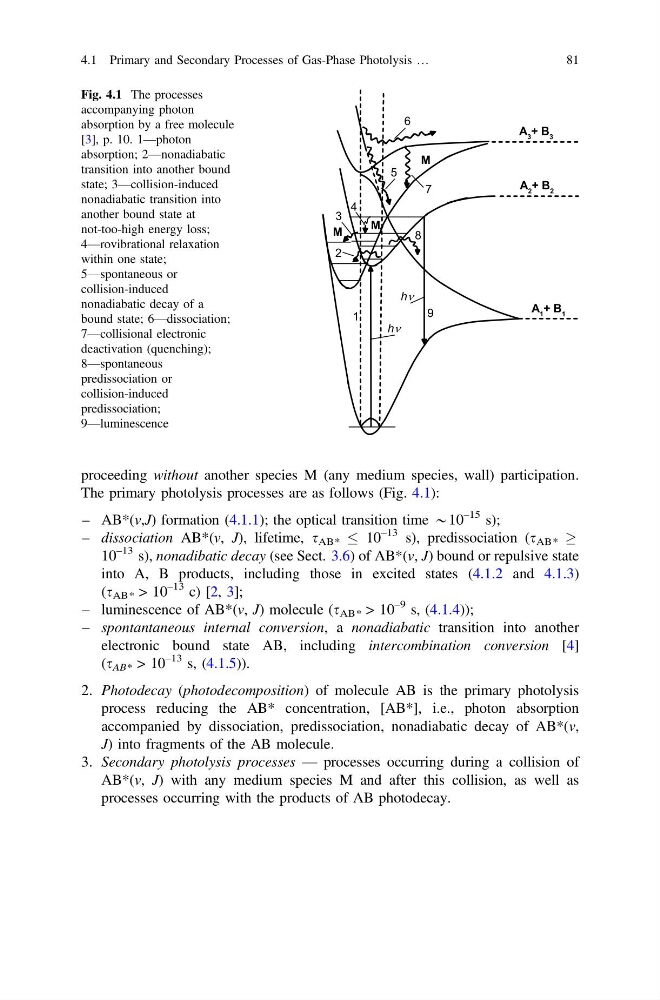
The primary photolysis processes are as follows (Fig. 4.1):
– AB*(v,J) formation (4.1.1); the optical transition time *10
–15 s);
– dissociation AB*(v, J), lifetime, s AB*
10
–13 s), predissociation (s AB* !
10
–13 s), nonadibatic decay (see Sect. 3.6) of AB*(v, J) bound or repulsive state
into A, B products, including those in excited states (4.1.2 and 4.1.3)
(s AB* > 10
–13 c) [2, 3];
– luminescence of AB*(v, J) molecule (s AB* > 10
–9 s, (4.1.4));
– spontantaneous internal conversion, a nonadiabatic transition into another
electronic bound state AB, including intercombination conversion [4]
(s AB* > 10
–13 s, (4.1.5)).
2. Photodecay (photodecomposition) of molecule AB is the primary photolysis
process reducing the AB* concentration, [AB*], i.e., photon absorption
accompanied by dissociation, predissociation, nonadiabatic decay of AB*(v,
J) into fragments of the AB molecule.
3. Secondary photolysis processes — processes occurring during a collision of
AB*(v, J) with any medium species M and after this collision, as well as
processes occurring with the products of AB photodecay.
Fig. 4.1 The processes
accompanying photon
absorption by a free molecule
[3], p. 10. 1—photon
absorption; 2—nonadiabatic
transition into another bound
state; 3—collision-induced
nonadiabatic transition into
another bound state at
not-too-high energy loss;
4—rovibrational relaxation
within one state;
5—spontaneous or
collision-induced
nonadiabatic decay of a
bound state; 6—dissociation;
7—collisional electronic
deactivation (quenching);
8—spontaneous
predissociation or
collision-induced
predissociation;
9—luminescence
4.1 Primary and Secondary Processes of Gas-Phase Photolysis …
81
The primary photolysis processes are as follows (Fig. 4.1):
– AB*(v,J) formation (4.1.1); the optical transition time *10
–15 s);
– dissociation AB*(v, J), lifetime, s AB*
10
–13 s), predissociation (s AB* !
10
–13 s), nonadibatic decay (see Sect. 3.6) of AB*(v, J) bound or repulsive state
into A, B products, including those in excited states (4.1.2 and 4.1.3)
(s AB* > 10
–13 c) [2, 3];
– luminescence of AB*(v, J) molecule (s AB* > 10
–9 s, (4.1.4));
– spontantaneous internal conversion, a nonadiabatic transition into another
electronic bound state AB, including intercombination conversion [4]
(s AB* > 10
–13 s, (4.1.5)).
2. Photodecay (photodecomposition) of molecule AB is the primary photolysis
process reducing the AB* concentration, [AB*], i.e., photon absorption
accompanied by dissociation, predissociation, nonadiabatic decay of AB*(v,
J) into fragments of the AB molecule.
3. Secondary photolysis processes — processes occurring during a collision of
AB*(v, J) with any medium species M and after this collision, as well as
processes occurring with the products of AB photodecay.
Fig. 4.1 The processes
accompanying photon
absorption by a free molecule
[3], p. 10. 1—photon
absorption; 2—nonadiabatic
transition into another bound
state; 3—collision-induced
nonadiabatic transition into
another bound state at
not-too-high energy loss;
4—rovibrational relaxation
within one state;
5—spontaneous or
collision-induced
nonadiabatic decay of a
bound state; 6—dissociation;
7—collisional electronic
deactivation (quenching);
8—spontaneous
predissociation or
collision-induced
predissociation;
9—luminescence
4.1 Primary and Secondary Processes of Gas-Phase Photolysis …
81