

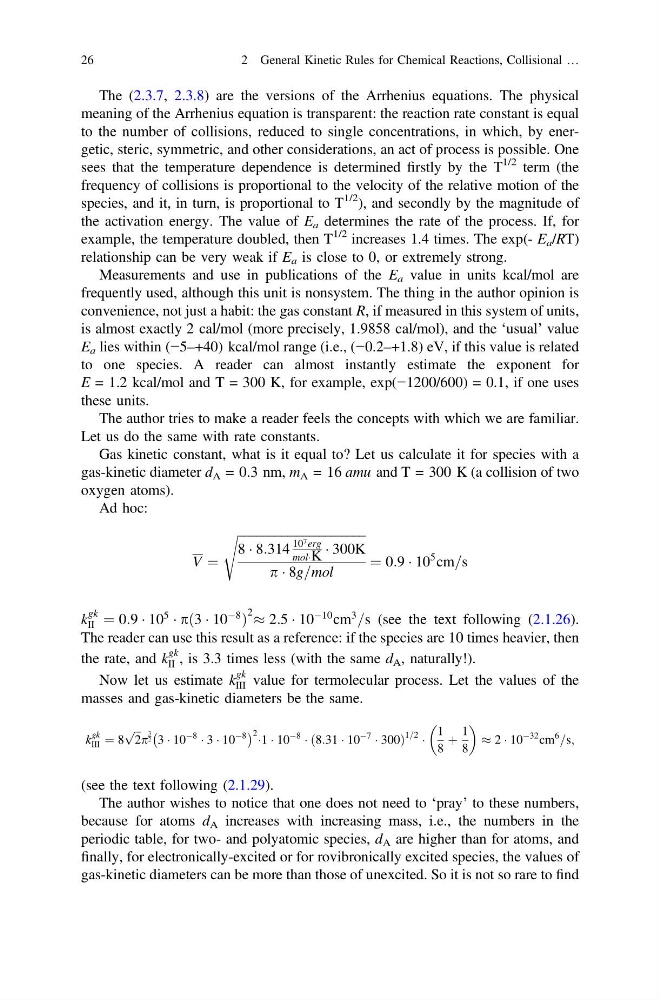
The (2.3.7, 2.3.8) are the versions of the Arrhenius equations. The physical
meaning of the Arrhenius equation is transparent: the reaction rate constant is equal
to the number of collisions, reduced to single concentrations, in which, by energetic, steric, symmetric, and other considerations, an act of process is possible. One
sees that the temperature dependence is determined firstly by the T
1/2 term (the
frequency of collisions is proportional to the velocity of the relative motion of the
species, and it, in turn, is proportional to T
1/2
), and secondly by the magnitude of
the activation energy. The value of E a determines the rate of the process. If, for
example, the temperature doubled, then T
1/2 increases 1.4 times. The exp(- E a /RT)
relationship can be very weak if E a is close to 0, or extremely strong.
Measurements and use in publications of the E a value in units kcal/mol are
frequently used, although this unit is nonsystem. The thing in the author opinion is
convenience, not just a habit: the gas constant R, if measured in this system of units,
is almost exactly 2 cal/mol (more precisely, 1.9858 cal/mol), and the ‘usual’ value
E a lies within (−5–+40) kcal/mol range (i.e., (−0.2–+1.8) eV, if this value is related
to one species. A reader can almost instantly estimate the exponent for
E = 1.2 kcal/mol and T = 300 K, for example, exp(−1200/600) = 0.1, if one uses
these units.
The author tries to make a reader feels the concepts with which we are familiar.
Let us do the same with rate constants.
Gas kinetic constant, what is it equal to? Let us calculate it for species with a
gas-kinetic diameter d A = 0.3 nm, m A = 16 amu and T = 300 K (a collision of two
oxygen atoms).
Ad hoc:
V ¼
ffiffiffiffiffiffiffiffiffiffiffiffiffiffiffiffiffiffiffiffiffiffiffiffiffiffiffiffiffiffiffiffiffiffiffiffiffiffiffiffiffi
8 Á 8:314
10 7 erg
molÁK
Á 300K
p Á 8g=mol
s
¼ 0:9 Á 10
5 cm=s
k
gk
II ¼ 0:9 Á 10
5
Á p 3 Á 10
À8
ð
Þ
2 % 2:5 Á 10
À10 cm
3
=s (see the text following (2.1.26).
The reader can use this result as a reference: if the species are 10 times heavier, then
the rate, and k
gk
II , is 3.3 times less (with the same d A , naturally!).
Now let us estimate k
gk
III value for termolecular process. Let the values of the
masses and gas-kinetic diameters be the same.
k
gk
III ¼ 8
ffiffi ffi
2
p p
3
2 3 Á 10
À8 Á 3 Á 10
À8
À
Á 2 Á1 Á 10
À8 Á ð8:31 Á 10
À7 Á 300Þ
1=2 Á
1
8
þ
1
8
% 2 Á 10
À32 cm
6 =s;
(see the text following (2.1.29).
The author wishes to notice that one does not need to ‘pray’ to these numbers,
because for atoms d A increases with increasing mass, i.e., the numbers in the
periodic table, for two- and polyatomic species, d A are higher than for atoms, and
finally, for electronically-excited or for rovibronically excited species, the values of
gas-kinetic diameters can be more than those of unexcited. So it is not so rare to find
26
2 General Kinetic Rules for Chemical Reactions, Collisional …
meaning of the Arrhenius equation is transparent: the reaction rate constant is equal
to the number of collisions, reduced to single concentrations, in which, by energetic, steric, symmetric, and other considerations, an act of process is possible. One
sees that the temperature dependence is determined firstly by the T
1/2 term (the
frequency of collisions is proportional to the velocity of the relative motion of the
species, and it, in turn, is proportional to T
1/2
), and secondly by the magnitude of
the activation energy. The value of E a determines the rate of the process. If, for
example, the temperature doubled, then T
1/2 increases 1.4 times. The exp(- E a /RT)
relationship can be very weak if E a is close to 0, or extremely strong.
Measurements and use in publications of the E a value in units kcal/mol are
frequently used, although this unit is nonsystem. The thing in the author opinion is
convenience, not just a habit: the gas constant R, if measured in this system of units,
is almost exactly 2 cal/mol (more precisely, 1.9858 cal/mol), and the ‘usual’ value
E a lies within (−5–+40) kcal/mol range (i.e., (−0.2–+1.8) eV, if this value is related
to one species. A reader can almost instantly estimate the exponent for
E = 1.2 kcal/mol and T = 300 K, for example, exp(−1200/600) = 0.1, if one uses
these units.
The author tries to make a reader feels the concepts with which we are familiar.
Let us do the same with rate constants.
Gas kinetic constant, what is it equal to? Let us calculate it for species with a
gas-kinetic diameter d A = 0.3 nm, m A = 16 amu and T = 300 K (a collision of two
oxygen atoms).
Ad hoc:
V ¼
ffiffiffiffiffiffiffiffiffiffiffiffiffiffiffiffiffiffiffiffiffiffiffiffiffiffiffiffiffiffiffiffiffiffiffiffiffiffiffiffiffi
8 Á 8:314
10 7 erg
molÁK
Á 300K
p Á 8g=mol
s
¼ 0:9 Á 10
5 cm=s
k
gk
II ¼ 0:9 Á 10
5
Á p 3 Á 10
À8
ð
Þ
2 % 2:5 Á 10
À10 cm
3
=s (see the text following (2.1.26).
The reader can use this result as a reference: if the species are 10 times heavier, then
the rate, and k
gk
II , is 3.3 times less (with the same d A , naturally!).
Now let us estimate k
gk
III value for termolecular process. Let the values of the
masses and gas-kinetic diameters be the same.
k
gk
III ¼ 8
ffiffi ffi
2
p p
3
2 3 Á 10
À8 Á 3 Á 10
À8
À
Á 2 Á1 Á 10
À8 Á ð8:31 Á 10
À7 Á 300Þ
1=2 Á
1
8
þ
1
8
% 2 Á 10
À32 cm
6 =s;
(see the text following (2.1.29).
The author wishes to notice that one does not need to ‘pray’ to these numbers,
because for atoms d A increases with increasing mass, i.e., the numbers in the
periodic table, for two- and polyatomic species, d A are higher than for atoms, and
finally, for electronically-excited or for rovibronically excited species, the values of
gas-kinetic diameters can be more than those of unexcited. So it is not so rare to find
26
2 General Kinetic Rules for Chemical Reactions, Collisional …