

Cl 2 A
0
; v A 0 ; A; v A ; B
0
; v B 0 ; B; v B
ð
Þ !
He Cl 2 X; v X
ð
ÞþDE;
ð7:2:49Þ
the Cl 2 (B,v B ) and Cl 2 (A,v A ) radiative lifetimes are 3.05Á10
−4 s [23] and (0.02–0.08)
s [24], k 2.48 = 8.4Á10
−11 cm
3 /s, k 2.49 = 1.6Á10
−14 cm
3 /s. Process (7.2.49) is collisional deactivation (high DE) and coupling of the triplet state manifold
Cl 2 ðA
0
; v A 0 ; A; v A ; B
0
; v B 0 ; B; v B Þ with the singlet I 2 (X,v X ) state (low DE) following by
fast collisional vibrational relaxation within the l 2 (X,v X ) level manifold. This process is strongly forbidden for He atoms due to DS = 0 propensity rule (see
Sect. 5.7), and its rate constant is low, k 2.49 = 2.5Á10
−17 cm
3 /s. The coupling of the
Cl 2 triplet states, including the Cl 2 ðB; v B Þ and ‘dark’ Cl 2 ðA
0
; v A 0 ; B
0
; v B 0 Þ states,
radiative transitions from which are forbidden, induced by collisions with He atoms
is fast. Therefore, the effective reversed radiative lifetime decreases with [He] from
*180 s
−1 (the Cl 2 ðA; v A ; B; v B Þ manifold, process (7.2.46a)) at low He pressure to
*20 s
−1 (the Cl 2 ðA
0
; v A 0 ; A; v A ; B
0
; v B 0 ; B; v B Þ manifold, process (7.2.46b)) at
p He > 5000 Torr (Fig. 7.5).
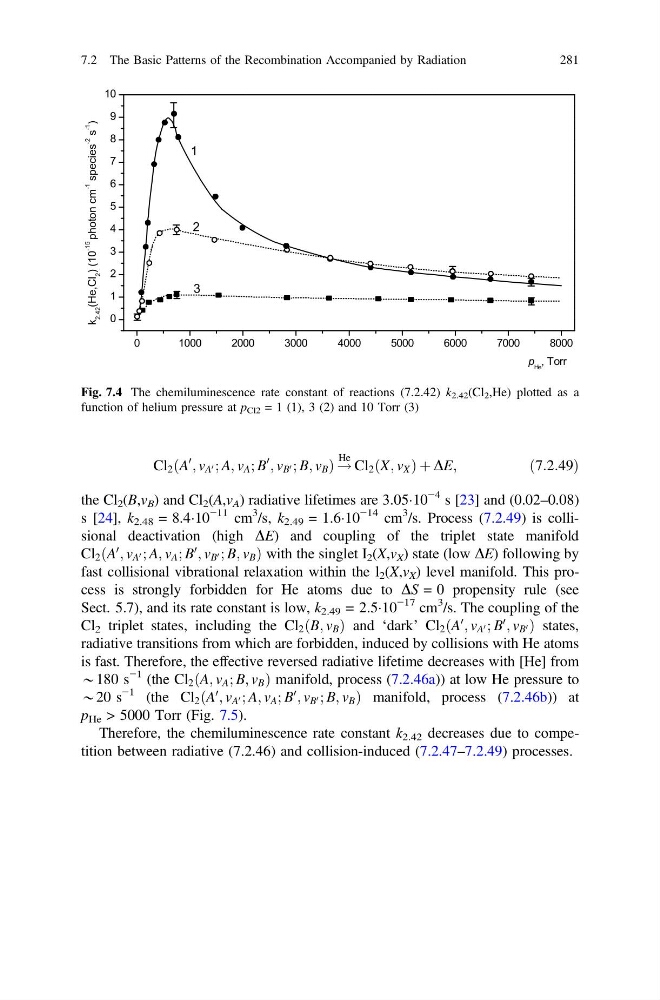
Therefore, the chemiluminescence rate constant k 2.42 decreases due to competition between radiative (7.2.46) and collision-induced (7.2.47–7.2.49) processes.
Fig. 7.4 The chemiluminescence rate constant of reactions (7.2.42) k 2.42 (Cl 2 ,He) plotted as a
function of helium pressure at p Cl2 = 1 (1), 3 (2) and 10 Torr (3)
7.2 The Basic Patterns of the Recombination Accompanied by Radiation
281
0
; v A 0 ; A; v A ; B
0
; v B 0 ; B; v B
ð
Þ !
He Cl 2 X; v X
ð
ÞþDE;
ð7:2:49Þ
the Cl 2 (B,v B ) and Cl 2 (A,v A ) radiative lifetimes are 3.05Á10
−4 s [23] and (0.02–0.08)
s [24], k 2.48 = 8.4Á10
−11 cm
3 /s, k 2.49 = 1.6Á10
−14 cm
3 /s. Process (7.2.49) is collisional deactivation (high DE) and coupling of the triplet state manifold
Cl 2 ðA
0
; v A 0 ; A; v A ; B
0
; v B 0 ; B; v B Þ with the singlet I 2 (X,v X ) state (low DE) following by
fast collisional vibrational relaxation within the l 2 (X,v X ) level manifold. This process is strongly forbidden for He atoms due to DS = 0 propensity rule (see
Sect. 5.7), and its rate constant is low, k 2.49 = 2.5Á10
−17 cm
3 /s. The coupling of the
Cl 2 triplet states, including the Cl 2 ðB; v B Þ and ‘dark’ Cl 2 ðA
0
; v A 0 ; B
0
; v B 0 Þ states,
radiative transitions from which are forbidden, induced by collisions with He atoms
is fast. Therefore, the effective reversed radiative lifetime decreases with [He] from
*180 s
−1 (the Cl 2 ðA; v A ; B; v B Þ manifold, process (7.2.46a)) at low He pressure to
*20 s
−1 (the Cl 2 ðA
0
; v A 0 ; A; v A ; B
0
; v B 0 ; B; v B Þ manifold, process (7.2.46b)) at
p He > 5000 Torr (Fig. 7.5).
Therefore, the chemiluminescence rate constant k 2.42 decreases due to competition between radiative (7.2.46) and collision-induced (7.2.47–7.2.49) processes.
Fig. 7.4 The chemiluminescence rate constant of reactions (7.2.42) k 2.42 (Cl 2 ,He) plotted as a
function of helium pressure at p Cl2 = 1 (1), 3 (2) and 10 Torr (3)
7.2 The Basic Patterns of the Recombination Accompanied by Radiation
281