

if the volume V does not change during the reaction. The rate of the process is the
rate of any reactant concentrations changes with a minus sign divided by the
reactant stoichiometric coefficient or the rate of any product concentrations change
with a plus sign divided by the product stoichiometric coefficient.
It is easy to see that the r value does not depend on which reactant or product one
uses to calculate the reaction rate, since, as can be seen from the stoichiometric
equation, changes in the concentrations of reagents and products are proportional to
the corresponding stoichiometric coefficients. The definitions (2.1.8a–c) are not
valid for describing processes in an open space such as a gas jet. Nevertheless, they
are valid for small degrees of conversion and low-temperature variation even for a
flow reactor.
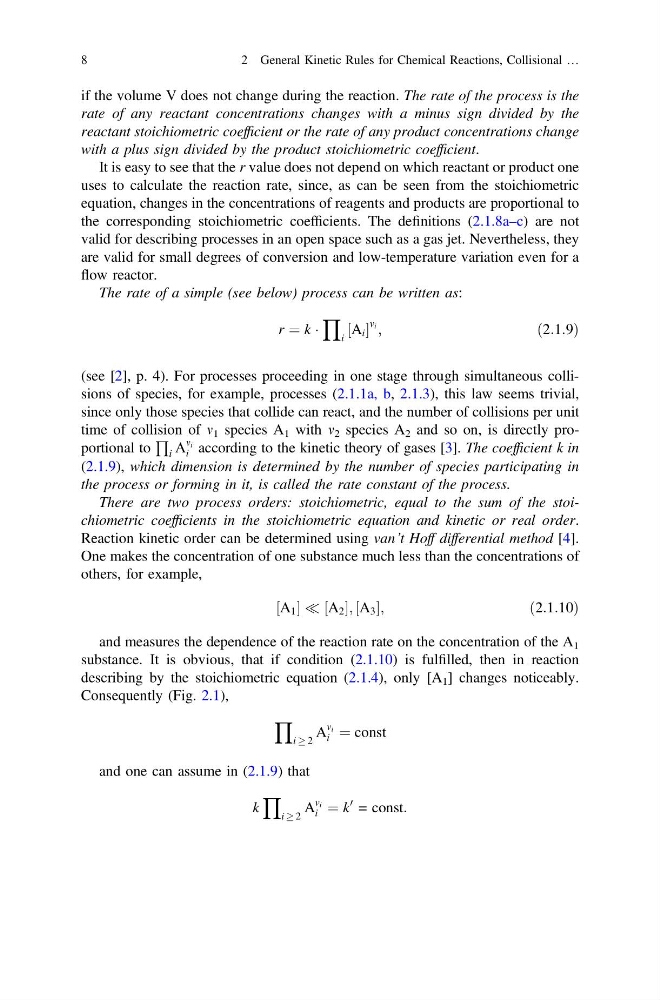
The rate of a simple (see below) process can be written as:
r ¼ k Á
Y
i
A i
½
v i
;
ð2:1:9Þ
(see [2], p. 4). For processes proceeding in one stage through simultaneous collisions of species, for example, processes (2.1.1a, b, 2.1.3), this law seems trivial,
since only those species that collide can react, and the number of collisions per unit
time of collision of m 1 species A 1 with m 2 species A 2 and so on, is directly proportional to
Q
i A
m i
i according to the kinetic theory of gases [3]. The coefficient k in
(2.1.9), which dimension is determined by the number of species participating in
the process or forming in it, is called the rate constant of the process.
There are two process orders: stoichiometric, equal to the sum of the stoichiometric coefficients in the stoichiometric equation and kinetic or real order.
Reaction kinetic order can be determined using van’t Hoff differential method [4].
One makes the concentration of one substance much less than the concentrations of
others, for example,
A 1
½ ( A 2
½ ; A 3
½ ;
ð2:1:10Þ
and measures the dependence of the reaction rate on the concentration of the A 1
substance. It is obvious, that if condition (2.1.10) is fulfilled, then in reaction
describing by the stoichiometric equation (2.1.4), only [A 1 ] changes noticeably.
Consequently (Fig. 2.1),
Y
i ! 2
A
v i
i ¼ const
and one can assume in (2.1.9) that
k
Y
i ! 2
A
v i
i ¼ k
0 = const:
8
2 General Kinetic Rules for Chemical Reactions, Collisional …
rate of any reactant concentrations changes with a minus sign divided by the
reactant stoichiometric coefficient or the rate of any product concentrations change
with a plus sign divided by the product stoichiometric coefficient.
It is easy to see that the r value does not depend on which reactant or product one
uses to calculate the reaction rate, since, as can be seen from the stoichiometric
equation, changes in the concentrations of reagents and products are proportional to
the corresponding stoichiometric coefficients. The definitions (2.1.8a–c) are not
valid for describing processes in an open space such as a gas jet. Nevertheless, they
are valid for small degrees of conversion and low-temperature variation even for a
flow reactor.
The rate of a simple (see below) process can be written as:
r ¼ k Á
Y
i
A i
½
v i
;
ð2:1:9Þ
(see [2], p. 4). For processes proceeding in one stage through simultaneous collisions of species, for example, processes (2.1.1a, b, 2.1.3), this law seems trivial,
since only those species that collide can react, and the number of collisions per unit
time of collision of m 1 species A 1 with m 2 species A 2 and so on, is directly proportional to
Q
i A
m i
i according to the kinetic theory of gases [3]. The coefficient k in
(2.1.9), which dimension is determined by the number of species participating in
the process or forming in it, is called the rate constant of the process.
There are two process orders: stoichiometric, equal to the sum of the stoichiometric coefficients in the stoichiometric equation and kinetic or real order.
Reaction kinetic order can be determined using van’t Hoff differential method [4].
One makes the concentration of one substance much less than the concentrations of
others, for example,
A 1
½ ( A 2
½ ; A 3
½ ;
ð2:1:10Þ
and measures the dependence of the reaction rate on the concentration of the A 1
substance. It is obvious, that if condition (2.1.10) is fulfilled, then in reaction
describing by the stoichiometric equation (2.1.4), only [A 1 ] changes noticeably.
Consequently (Fig. 2.1),
Y
i ! 2
A
v i
i ¼ const
and one can assume in (2.1.9) that
k
Y
i ! 2
A
v i
i ¼ k
0 = const:
8
2 General Kinetic Rules for Chemical Reactions, Collisional …