

To compare data given in Figs. 6.17a and 6.20, one has to take into account the
difference of the I 2 (B, 19) and I 2 (B, 18) levels, 93.3 cm
−1 . The experimental
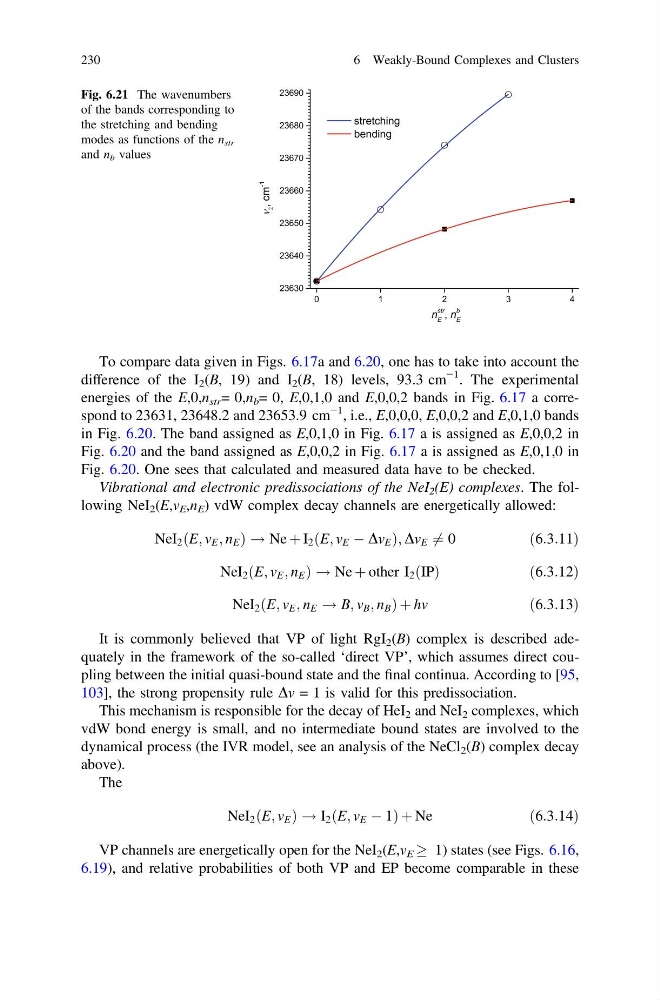
energies of the E,0,n str = 0,n b = 0, E,0,1,0 and E,0,0,2 bands in Fig. 6.17 a correspond to 23631, 23648.2 and 23653.9 cm
−1 , i.e., E,0,0,0, E,0,0,2 and E,0,1,0 bands
in Fig. 6.20. The band assigned as E,0,1,0 in Fig. 6.17 a is assigned as E,0,0,2 in
Fig. 6.20 and the band assigned as E,0,0,2 in Fig. 6.17 a is assigned as E,0,1,0 in
Fig. 6.20. One sees that calculated and measured data have to be checked.
Vibrational and electronic predissociations of the NeI 2 (E) complexes. The following NeI 2 (E,v E ,n E ) vdW complex decay channels are energetically allowed:
NeI 2 E; v E ; n E
ð
Þ!Ne þ I 2 E; v E À Dv E
ð
Þ ; Dv E 6 ¼ 0
ð6:3:11Þ
NeI 2 E; v E ; n E
ð
Þ!Ne þ other I 2 ðIPÞ
ð 6:3:12Þ
NeI 2 E; v E ; n E ! B; v B ; n B
ð
Þ þ hv
ð6:3:13Þ
It is commonly believed that VP of light RgI 2 (B) complex is described adequately in the framework of the so-called ‘direct VP’, which assumes direct coupling between the initial quasi-bound state and the final continua. According to [95,
103], the strong propensity rule Dv = 1 is valid for this predissociation.
This mechanism is responsible for the decay of HeI 2 and NeI 2 complexes, which
vdW bond energy is small, and no intermediate bound states are involved to the
dynamical process (the IVR model, see an analysis of the NeCl 2 (B) complex decay
above).
The
NeI 2 E; v E
ð
Þ!I 2 E; v E À 1
ð
ÞþNe
ð6:3:14Þ
VP channels are energetically open for the NeI 2 (E,v E ! 1) states (see Figs. 6.16,
6.19), and relative probabilities of both VP and EP become comparable in these
Fig. 6.21 The wavenumbers
of the bands corresponding to
the stretching and bending
modes as functions of the n str
and n b values
230
6 Weakly-Bound Complexes and Clusters
difference of the I 2 (B, 19) and I 2 (B, 18) levels, 93.3 cm
−1 . The experimental
energies of the E,0,n str = 0,n b = 0, E,0,1,0 and E,0,0,2 bands in Fig. 6.17 a correspond to 23631, 23648.2 and 23653.9 cm
−1 , i.e., E,0,0,0, E,0,0,2 and E,0,1,0 bands
in Fig. 6.20. The band assigned as E,0,1,0 in Fig. 6.17 a is assigned as E,0,0,2 in
Fig. 6.20 and the band assigned as E,0,0,2 in Fig. 6.17 a is assigned as E,0,1,0 in
Fig. 6.20. One sees that calculated and measured data have to be checked.
Vibrational and electronic predissociations of the NeI 2 (E) complexes. The following NeI 2 (E,v E ,n E ) vdW complex decay channels are energetically allowed:
NeI 2 E; v E ; n E
ð
Þ!Ne þ I 2 E; v E À Dv E
ð
Þ ; Dv E 6 ¼ 0
ð6:3:11Þ
NeI 2 E; v E ; n E
ð
Þ!Ne þ other I 2 ðIPÞ
ð 6:3:12Þ
NeI 2 E; v E ; n E ! B; v B ; n B
ð
Þ þ hv
ð6:3:13Þ
It is commonly believed that VP of light RgI 2 (B) complex is described adequately in the framework of the so-called ‘direct VP’, which assumes direct coupling between the initial quasi-bound state and the final continua. According to [95,
103], the strong propensity rule Dv = 1 is valid for this predissociation.
This mechanism is responsible for the decay of HeI 2 and NeI 2 complexes, which
vdW bond energy is small, and no intermediate bound states are involved to the
dynamical process (the IVR model, see an analysis of the NeCl 2 (B) complex decay
above).
The
NeI 2 E; v E
ð
Þ!I 2 E; v E À 1
ð
ÞþNe
ð6:3:14Þ
VP channels are energetically open for the NeI 2 (E,v E ! 1) states (see Figs. 6.16,
6.19), and relative probabilities of both VP and EP become comparable in these
Fig. 6.21 The wavenumbers
of the bands corresponding to
the stretching and bending
modes as functions of the n str
and n b values
230
6 Weakly-Bound Complexes and Clusters