

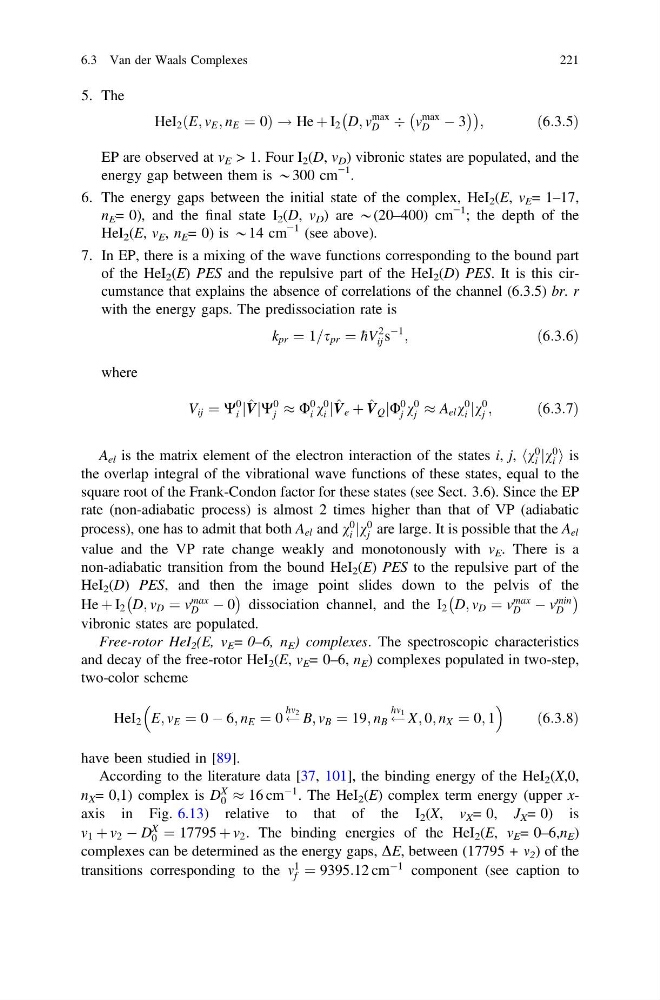
5. The
HeI 2 E; v E ; n E ¼ 0
ð
Þ!He þ I 2 D; v
max
D Ä v
max
D À 3
À
Á
À
Á ;
ð6:3:5Þ
EP are observed at v E > 1. Four I 2 (D, v D ) vibronic states are populated, and the
energy gap between them is *300 cm
−1 .
6. The energy gaps between the initial state of the complex, HeI 2 (E, v E = 1–17,
n E = 0), and the final state I 2 (D, v D ) are *(20–400) cm
−1 ; the depth of the
HeI 2 (E, v E , n E = 0) is *14 cm
−1 (see above).
7. In EP, there is a mixing of the wave functions corresponding to the bound part
of the HeI 2 (E) PES and the repulsive part of the HeI 2 (D) PES. It is this circumstance that explains the absence of correlations of the channel (6.3.5) br. r
with the energy gaps. The predissociation rate is
k pr ¼ 1=s pr ¼ hV
2
ij s
À1
;
ð6:3:6Þ
where
V ij ¼ W
0
i j ^
VjW
0
j % U
0
i v
0
i j ^
V e þ ^
V Q jU
0
j v
0
j % A el v
0
i jv
0
j ;
ð6:3:7Þ
A el is the matrix element of the electron interaction of the states i, j, hv
0
i jv
0
i i is
the overlap integral of the vibrational wave functions of these states, equal to the
square root of the Frank-Condon factor for these states (see Sect. 3.6). Since the EP
rate (non-adiabatic process) is almost 2 times higher than that of VP (adiabatic
process), one has to admit that both A el and v
0
i jv
0
j are large. It is possible that the A el
value and the VP rate change weakly and monotonously with v E . There is a
non-adiabatic transition from the bound HeI 2 (E) PES to the repulsive part of the
HeI 2 (D) PES, and then the image point slides down to the pelvis of the
He þ I 2 D; v D ¼ v
max
D À 0
À
Á
dissociation channel, and the I 2 D; v D ¼ v
max
D À v
min
D
À
Á
vibronic states are populated.
Free-rotor HeI 2 (E, v E = 0–6, n E ) complexes. The spectroscopic characteristics
and decay of the free-rotor HeI 2 (E, v E = 0–6, n E ) complexes populated in two-step,
two-color scheme
HeI 2 E; v E ¼ 0 À 6; n E ¼ 0
hm 2 B; v B ¼ 19; n B
hm 1 X; 0; n X ¼ 0; 1
ð6:3:8Þ
have been studied in [89].
According to the literature data [37, 101], the binding energy of the HeI 2 (X,0,
n X = 0,1) complex is D
X
0 % 16 cm
À1 . The HeI 2 (E) complex term energy (upper xaxis in Fig. 6.13) relative to that of the I 2 (X, v X = 0, J X = 0) is
v 1 þ v 2 À D
X
0 ¼ 17795 þ v 2 . The binding energies of the HeI 2 (E, v E = 0–6,n E )
complexes can be determined as the energy gaps, DE, between (17795 + m 2 ) of the
transitions corresponding to the m
1
f ¼ 9395:12 cm
À1 component (see caption to
6.3 Van der Waals Complexes
221
HeI 2 E; v E ; n E ¼ 0
ð
Þ!He þ I 2 D; v
max
D Ä v
max
D À 3
À
Á
À
Á ;
ð6:3:5Þ
EP are observed at v E > 1. Four I 2 (D, v D ) vibronic states are populated, and the
energy gap between them is *300 cm
−1 .
6. The energy gaps between the initial state of the complex, HeI 2 (E, v E = 1–17,
n E = 0), and the final state I 2 (D, v D ) are *(20–400) cm
−1 ; the depth of the
HeI 2 (E, v E , n E = 0) is *14 cm
−1 (see above).
7. In EP, there is a mixing of the wave functions corresponding to the bound part
of the HeI 2 (E) PES and the repulsive part of the HeI 2 (D) PES. It is this circumstance that explains the absence of correlations of the channel (6.3.5) br. r
with the energy gaps. The predissociation rate is
k pr ¼ 1=s pr ¼ hV
2
ij s
À1
;
ð6:3:6Þ
where
V ij ¼ W
0
i j ^
VjW
0
j % U
0
i v
0
i j ^
V e þ ^
V Q jU
0
j v
0
j % A el v
0
i jv
0
j ;
ð6:3:7Þ
A el is the matrix element of the electron interaction of the states i, j, hv
0
i jv
0
i i is
the overlap integral of the vibrational wave functions of these states, equal to the
square root of the Frank-Condon factor for these states (see Sect. 3.6). Since the EP
rate (non-adiabatic process) is almost 2 times higher than that of VP (adiabatic
process), one has to admit that both A el and v
0
i jv
0
j are large. It is possible that the A el
value and the VP rate change weakly and monotonously with v E . There is a
non-adiabatic transition from the bound HeI 2 (E) PES to the repulsive part of the
HeI 2 (D) PES, and then the image point slides down to the pelvis of the
He þ I 2 D; v D ¼ v
max
D À 0
À
Á
dissociation channel, and the I 2 D; v D ¼ v
max
D À v
min
D
À
Á
vibronic states are populated.
Free-rotor HeI 2 (E, v E = 0–6, n E ) complexes. The spectroscopic characteristics
and decay of the free-rotor HeI 2 (E, v E = 0–6, n E ) complexes populated in two-step,
two-color scheme
HeI 2 E; v E ¼ 0 À 6; n E ¼ 0
hm 2 B; v B ¼ 19; n B
hm 1 X; 0; n X ¼ 0; 1
ð6:3:8Þ
have been studied in [89].
According to the literature data [37, 101], the binding energy of the HeI 2 (X,0,
n X = 0,1) complex is D
X
0 % 16 cm
À1 . The HeI 2 (E) complex term energy (upper xaxis in Fig. 6.13) relative to that of the I 2 (X, v X = 0, J X = 0) is
v 1 þ v 2 À D
X
0 ¼ 17795 þ v 2 . The binding energies of the HeI 2 (E, v E = 0–6,n E )
complexes can be determined as the energy gaps, DE, between (17795 + m 2 ) of the
transitions corresponding to the m
1
f ¼ 9395:12 cm
À1 component (see caption to
6.3 Van der Waals Complexes
221