

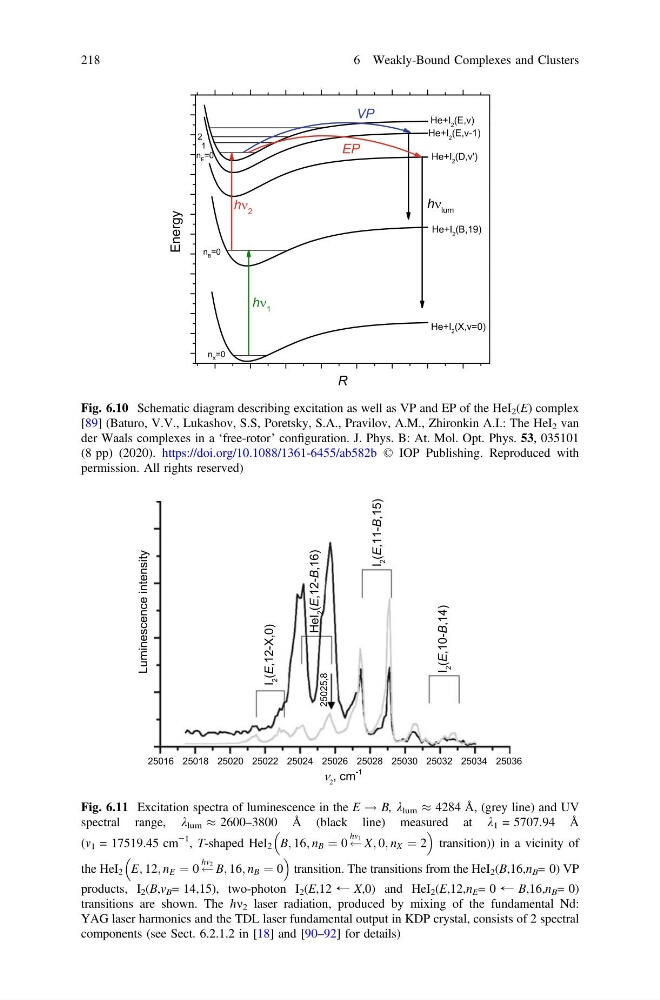
Fig. 6.10 Schematic diagram describing excitation as well as VP and EP of the HeI 2 (E) complex
[89] (Baturo, V.V., Lukashov, S.S, Poretsky, S.A., Pravilov, A.M., Zhironkin A.I.: The HeI 2 van
der Waals complexes in a ‘free-rotor’ configuration. J. Phys. B: At. Mol. Opt. Phys. 53, 035101
(8 pp) (2020). https://doi.org/10.1088/1361-6455/ab582b © IOP Publishing. Reproduced with
permission. All rights reserved)
Fig. 6.11 Excitation spectra of luminescence in the E ! B, k lum % 4284 Å, (grey line) and UV
spectral range, k lum % 2600–3800 Å (black line) measured at k 1 = 5707.94 Å
(m 1 = 17519.45 cm
−1
, T-shaped HeI 2 B; 16; n B ¼ 0
hm1 X; 0; n X ¼ 2
transition)) in a vicinity of
the HeI 2 E; 12; n E ¼ 0
hm2 B; 16; n B ¼ 0
transition. The transitions from the HeI 2 (B,16,n B = 0) VP
products, I 2 (B,v B = 14,15), two-photon I 2 (E,12 ← X,0) and HeI 2 (E,12,n E = 0 ← B,16,n B = 0)
transitions are shown. The hm 2 laser radiation, produced by mixing of the fundamental Nd:
YAG laser harmonics and the TDL laser fundamental output in KDP crystal, consists of 2 spectral
components (see Sect. 6.2.1.2 in [18] and [90–92] for details)
218
6 Weakly-Bound Complexes and Clusters
[89] (Baturo, V.V., Lukashov, S.S, Poretsky, S.A., Pravilov, A.M., Zhironkin A.I.: The HeI 2 van
der Waals complexes in a ‘free-rotor’ configuration. J. Phys. B: At. Mol. Opt. Phys. 53, 035101
(8 pp) (2020). https://doi.org/10.1088/1361-6455/ab582b © IOP Publishing. Reproduced with
permission. All rights reserved)
Fig. 6.11 Excitation spectra of luminescence in the E ! B, k lum % 4284 Å, (grey line) and UV
spectral range, k lum % 2600–3800 Å (black line) measured at k 1 = 5707.94 Å
(m 1 = 17519.45 cm
−1
, T-shaped HeI 2 B; 16; n B ¼ 0
hm1 X; 0; n X ¼ 2
transition)) in a vicinity of
the HeI 2 E; 12; n E ¼ 0
hm2 B; 16; n B ¼ 0
transition. The transitions from the HeI 2 (B,16,n B = 0) VP
products, I 2 (B,v B = 14,15), two-photon I 2 (E,12 ← X,0) and HeI 2 (E,12,n E = 0 ← B,16,n B = 0)
transitions are shown. The hm 2 laser radiation, produced by mixing of the fundamental Nd:
YAG laser harmonics and the TDL laser fundamental output in KDP crystal, consists of 2 spectral
components (see Sect. 6.2.1.2 in [18] and [90–92] for details)
218
6 Weakly-Bound Complexes and Clusters