

and much larger than a value of the vdW quantum, respectively [63]. Since the dark
state acts as a doorway for dissociation, the final rotational distribution of Cl 2 (B, v B -
Dv B ) depends strongly on the nature of the dark state. As a result, complicated
oscillatory rotational distributions that depend strongly on the initial excitation are
obtained in the sparse regime.
The bimodal rotational distributions of the Cl 2 (B, v B −1, J B ) VP products takes
place [59].
The ArCl 2 Complexes. Experimental and calculated data on spectroscopic
characteristics of the ArCl 2 (X) are given in [23, 55, 56, 63–68]. They are given in
Table 6.3 (see Table 6.2, also)
One sees that data on T-shaped binding energies, only, are consistent enough.
The T-shaped Ar
35 Cl 2 (B, v B = 7) binding energy is D 0 = (188 ± 1) cm
−1 , and
R 0 = (3.7 ± 0.1) Å, s % 100 ps at v B = 6–11. The ArCl 2 (B, v B ) VP product disappear at v B > 12, though, according to calculation the EP probability less than 1up
to v B = 21 (Fig. 6.4).
The Dv B = 1, and 2 VP channels open for v B = 6, 7, and v B > 7, respectively.
Rather narrow, DJ
8, and wide, up to 28, rotational distributions of the Cl 2 (B,
v B ) are characteristic for the Dv B = 1, and 2 VP channels, respectively [67].
To break the T-shaped Ar-Cl 2 (B, v B ) bond it is necessary to transfer 1, 2, 3, 4 and
so on Cl 2 (B, v B ) vibrational quanta to the vdW modes for the v B = 1–7, 8–16, 17–
20, and 21–23 levels, respectively (see [48], p. 146, [68] and [69], p. 94). It has
been shown that this feature is due to the IVR process (see the description of the
IVR for NeCl 2 (B) above).
The KrCl 2 and XeCl 2 complexes. These complexes were studied in the K.
C. Janda’s group [70, 71] using the pump-probe method. It was shown that the
binding energy of the ground state complexes are D
X
0 ¼ 236:6 Æ 2:0
ð
Þ cm
À1
(KrCl 2 (X, v X = 0) and (268.3 ± 1.1) cm
−1 (XeCl 2 (X, v X = 0). The binding energy of
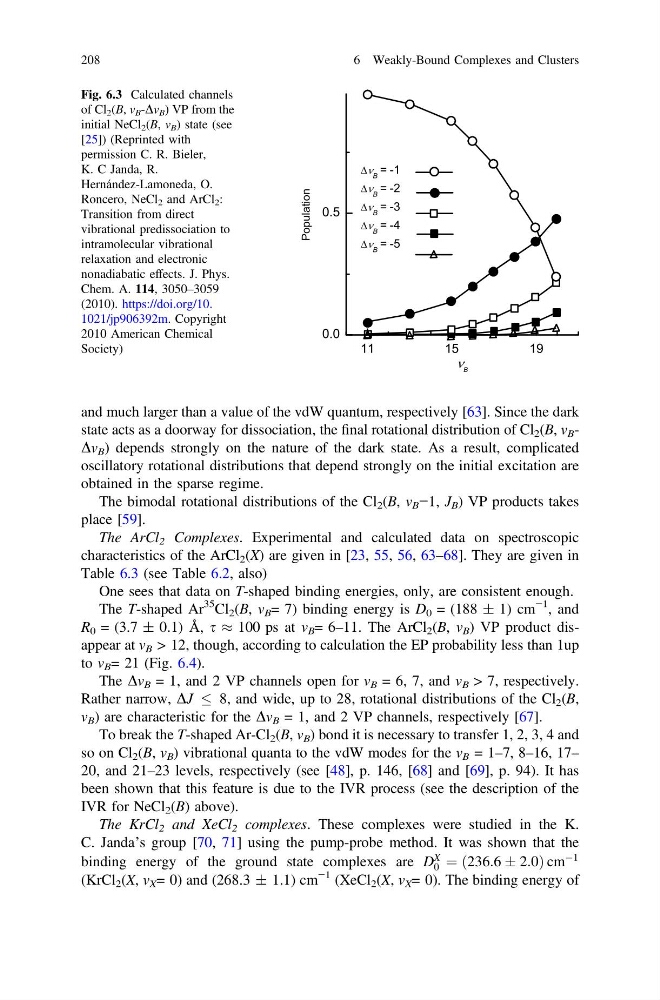
Fig. 6.3 Calculated channels
of Cl 2 (B, v B -Dv B ) VP from the
initial NeCl 2 (B, v B ) state (see
[25]) (Reprinted with
permission C. R. Bieler,
K. C Janda, R.
Hernández-Lamoneda, O.
Roncero, NeCl 2 and ArCl 2 :
Transition from direct
vibrational predissociation to
intramolecular vibrational
relaxation and electronic
nonadiabatic effects. J. Phys.
Chem. A. 114, 3050–3059
(2010). https://doi.org/10.
1021/jp906392m. Copyright
2010 American Chemical
Society)
208
6 Weakly-Bound Complexes and Clusters
state acts as a doorway for dissociation, the final rotational distribution of Cl 2 (B, v B -
Dv B ) depends strongly on the nature of the dark state. As a result, complicated
oscillatory rotational distributions that depend strongly on the initial excitation are
obtained in the sparse regime.
The bimodal rotational distributions of the Cl 2 (B, v B −1, J B ) VP products takes
place [59].
The ArCl 2 Complexes. Experimental and calculated data on spectroscopic
characteristics of the ArCl 2 (X) are given in [23, 55, 56, 63–68]. They are given in
Table 6.3 (see Table 6.2, also)
One sees that data on T-shaped binding energies, only, are consistent enough.
The T-shaped Ar
35 Cl 2 (B, v B = 7) binding energy is D 0 = (188 ± 1) cm
−1 , and
R 0 = (3.7 ± 0.1) Å, s % 100 ps at v B = 6–11. The ArCl 2 (B, v B ) VP product disappear at v B > 12, though, according to calculation the EP probability less than 1up
to v B = 21 (Fig. 6.4).
The Dv B = 1, and 2 VP channels open for v B = 6, 7, and v B > 7, respectively.
Rather narrow, DJ
8, and wide, up to 28, rotational distributions of the Cl 2 (B,
v B ) are characteristic for the Dv B = 1, and 2 VP channels, respectively [67].
To break the T-shaped Ar-Cl 2 (B, v B ) bond it is necessary to transfer 1, 2, 3, 4 and
so on Cl 2 (B, v B ) vibrational quanta to the vdW modes for the v B = 1–7, 8–16, 17–
20, and 21–23 levels, respectively (see [48], p. 146, [68] and [69], p. 94). It has
been shown that this feature is due to the IVR process (see the description of the
IVR for NeCl 2 (B) above).
The KrCl 2 and XeCl 2 complexes. These complexes were studied in the K.
C. Janda’s group [70, 71] using the pump-probe method. It was shown that the
binding energy of the ground state complexes are D
X
0 ¼ 236:6 Æ 2:0
ð
Þ cm
À1
(KrCl 2 (X, v X = 0) and (268.3 ± 1.1) cm
−1 (XeCl 2 (X, v X = 0). The binding energy of
Fig. 6.3 Calculated channels
of Cl 2 (B, v B -Dv B ) VP from the
initial NeCl 2 (B, v B ) state (see
[25]) (Reprinted with
permission C. R. Bieler,
K. C Janda, R.
Hernández-Lamoneda, O.
Roncero, NeCl 2 and ArCl 2 :
Transition from direct
vibrational predissociation to
intramolecular vibrational
relaxation and electronic
nonadiabatic effects. J. Phys.
Chem. A. 114, 3050–3059
(2010). https://doi.org/10.
1021/jp906392m. Copyright
2010 American Chemical
Society)
208
6 Weakly-Bound Complexes and Clusters